Preservation is selective
A spider does not become a fossil simply by dying. Its body must be preserved under suitable conditions and eventually discovered. Decay, compression and the surrounding material affect which structures remain visible. The fossil record is consequently not a complete list of past life. A missing fossil does not by itself demonstrate that a lineage was absent.
A window made of resin
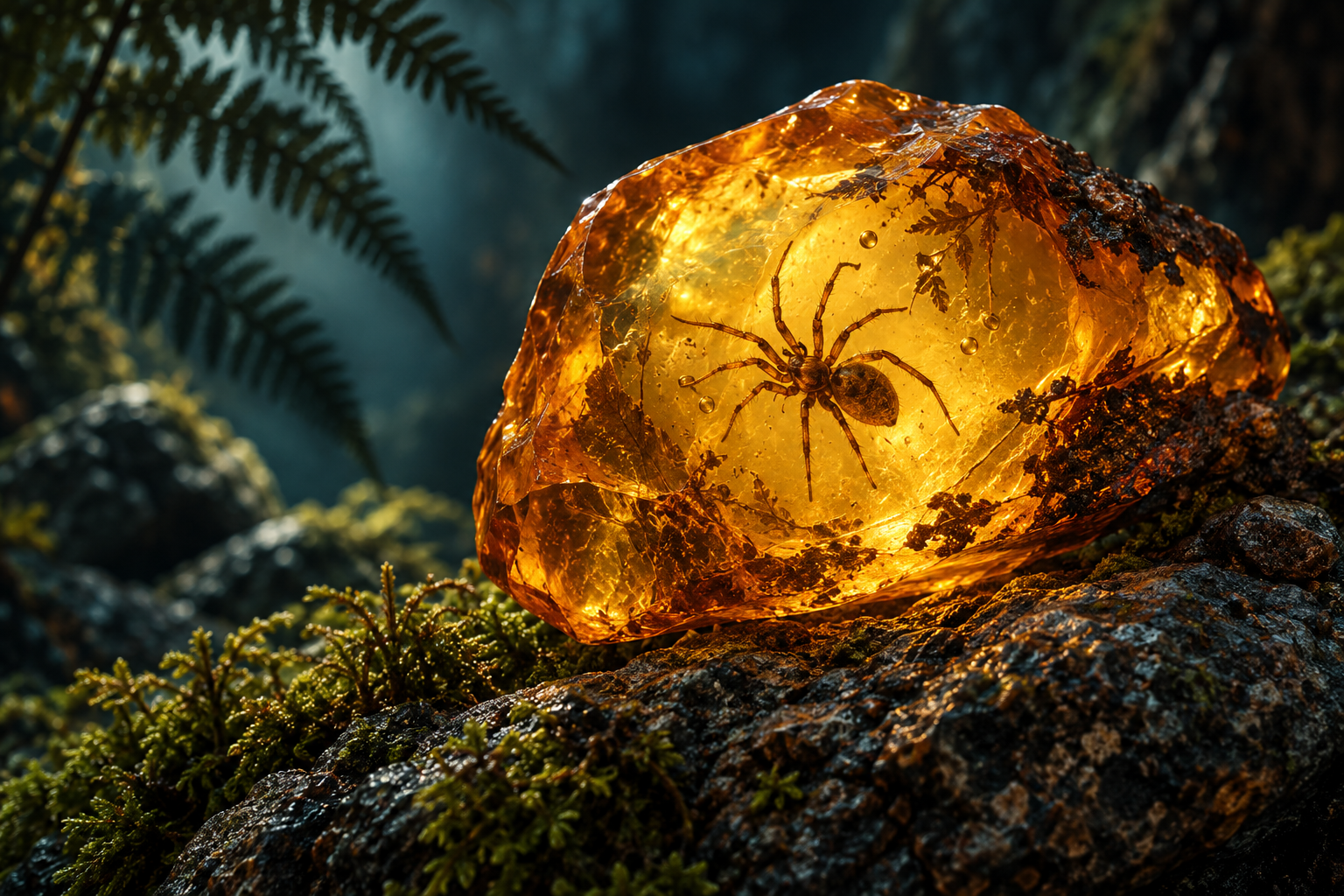
Amber is fossilised resin. Inclusions can preserve tiny structures in three dimensions, although parts may still be hidden, distorted or missing. A body posture also does not reveal every detail of behaviour. The amber illustration used here is an artistic scene rather than a photograph of a specific scientifically described specimen.
From features to explanation
Researchers compare structures such as spinnerets, segmentation and mouthparts. Classification can change when new features are recognised, as happened with Attercopus. Age, anatomy and inferred relationship are distinct claims. Together they help reconstruct history. A fossil need not be a direct ancestor of a living species: it may represent an extinct side branch.
Looking inside a rock
In 2016, computed tomography and synchrotron imaging were used to examine Idmonarachne brasieri, preserved three-dimensionally in deposits about 305–299 million years old. It has spider-like features but no spinnerets. True spiders were also known from the locality, showing that similar-looking lineages coexisted.
Sources & image credits
- Selden, Shear & Sutton (2008) · Fossil evidence for the origin of spider spinnerets ↗
- Australian Museum · Spiders ↗
- Garwood et al. (2016) · Almost a spider: a 305-million-year-old fossil arachnid and spider origins ↗
Sources checked: 1 November 2026. Figures and records carry the qualifications stated in each article.