Support and movement
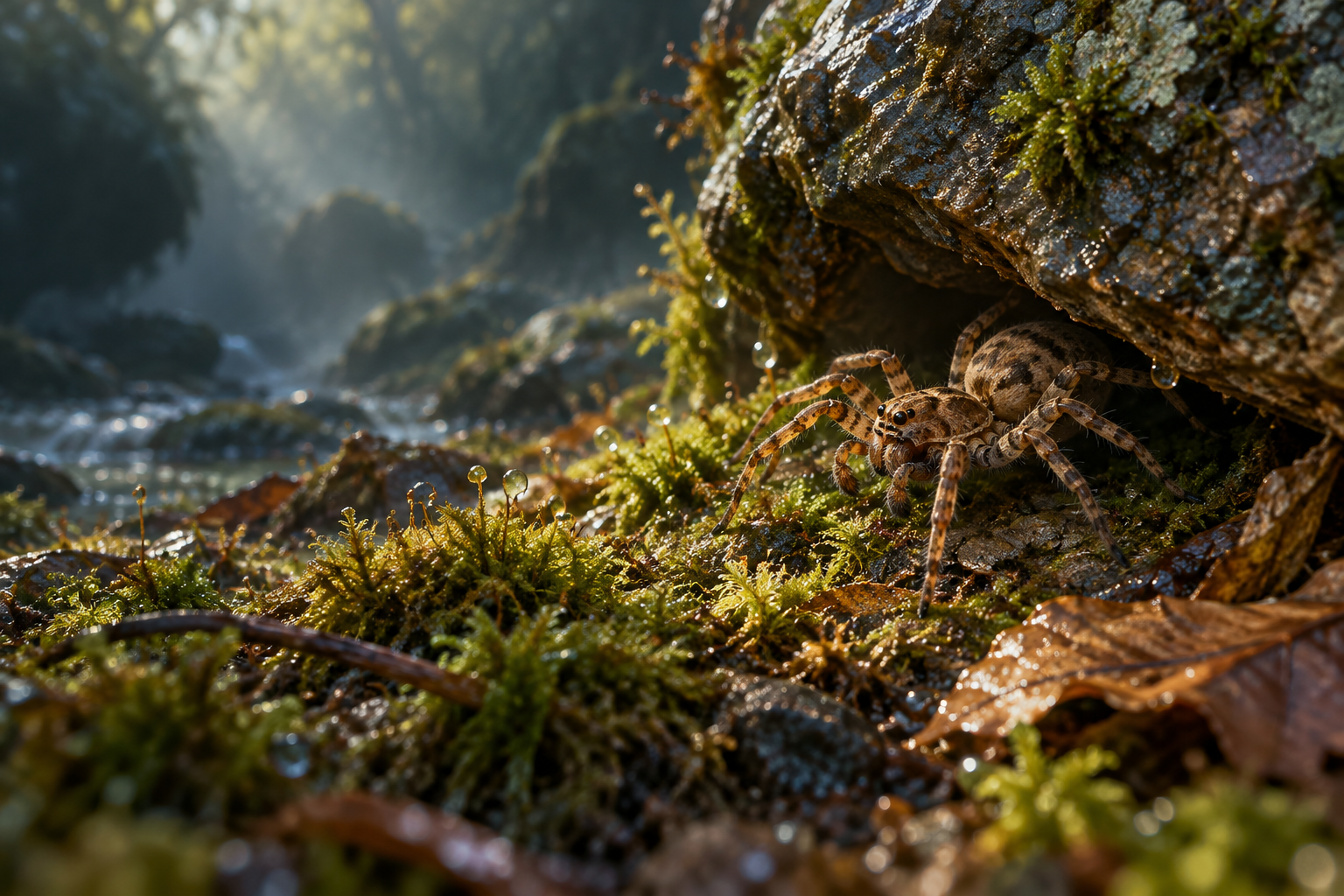
An external skeleton supports the body, while jointed legs allow movement. A spider’s four pairs of walking legs attach to the front body region. A narrow stalk connects it to the abdomen. This shared plan supports very different lives: body shape, leg posture and hairs vary among groups and affect how they use their surroundings.
Breathing air
Depending on the group, spiders breathe through book lungs, tracheae or both. Book lungs contain thin, closely arranged lamellae. Breathing and water balance constrain where an animal can remain active. A humid retreat under bark and an exposed hot surface can therefore be very different habitats even when they are only a short distance apart.
No single step
The emergence of terrestrial ways of life involved many arthropod lineages. Living spiders illustrate solutions, but they are not unchanged records of the first land animals. Anatomy and fossils support testable hypotheses. A living tarantula is no more an unchanged ancestor than a jumping spider is the final destination of evolution.
Movement combines mechanisms
Jointed appendages do not move themselves. Muscles, joint mechanics and internal pressure contribute to spider locomotion. Function therefore belongs to the whole system. Atlas joints are deliberately simplified: the model locates appendages rather than reproducing the complete biomechanics of a step.
Sources & image credits
- Australian Museum · Spider structure ↗
- Selden, Shear & Sutton (2008) · Fossil evidence for the origin of spider spinnerets ↗
Sources checked: 1 November 2026. Figures and records carry the qualifications stated in each article.