Europe is only part of its map
The wasp spider belongs to Europe’s spider fauna, but is not exclusively European. Its known range also includes North Africa and large parts of Asia as far as Japan. In meadows it can attach its web between grass stems. Vegetation is therefore more than scenery: it helps form the hunting site.
A name inspired by markings
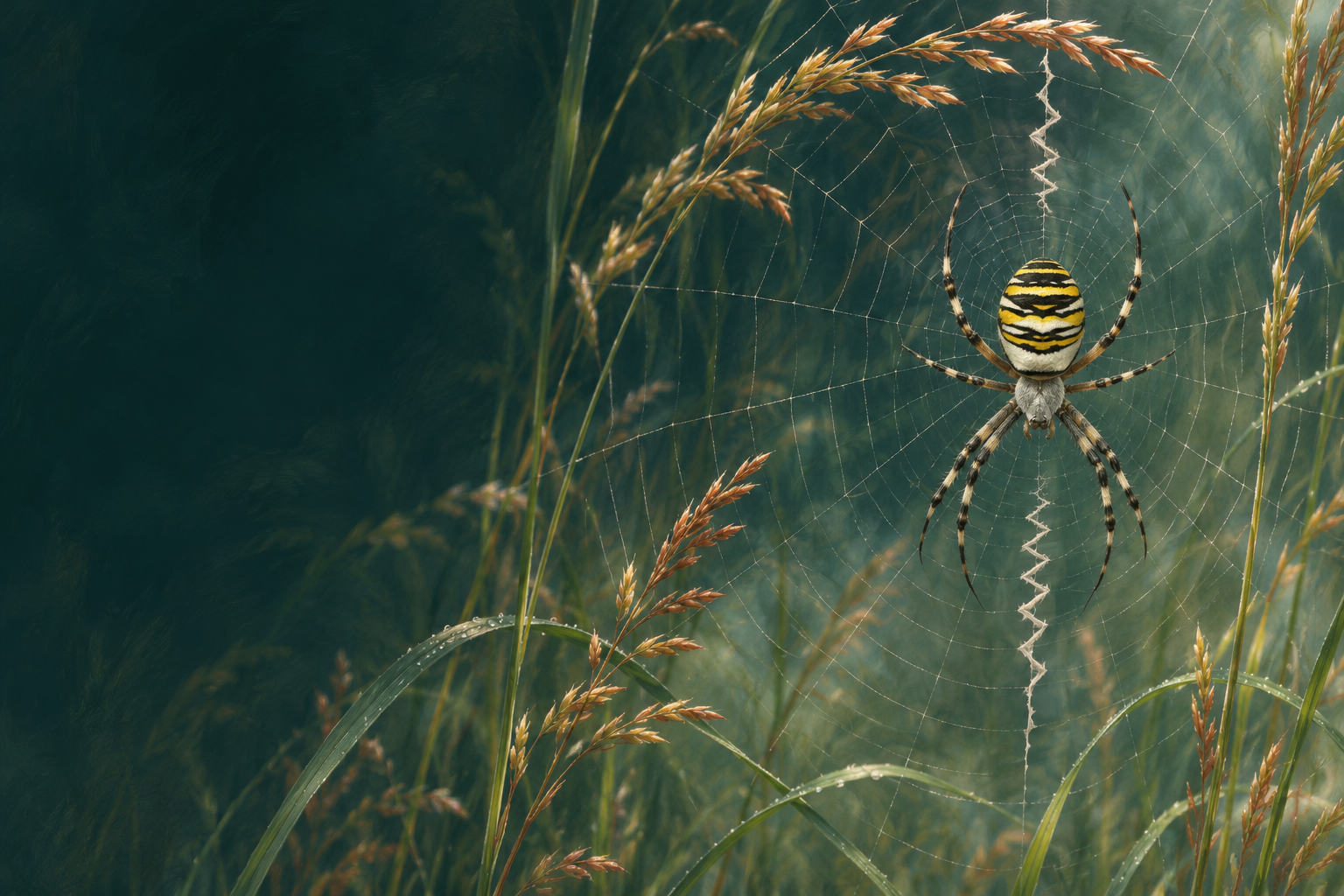
The conspicuous yellow, pale and dark bands of adult females explain the common name. Males are smaller and much less striking. Keeping only the familiar female image in mind can therefore hide part of the species from view. Markings, developmental stage and sex need to be considered together during observation.
Waiting at the web’s centre
A female may wait for prey at the centre of her orb web. Prey includes grasshoppers, flies and other insects. Looking near a web therefore reveals more than one animal: supporting threads, the capture surface and surrounding stems form a connected system. Keeping a distance preserves that relationship.
The zigzag remains a research question
Some webs carry a conspicuous white silk decoration called a stabilimentum. Its shape and presence vary. Research into web architecture asks, among other things, how these structures affect vibrations. The historical name is not an adequate explanation of function. A photograph records a shape; an experiment tests a possible effect.
Sources & image credits
- World Spider Catalog · Argiope bruennichi ↗
- Spiders of Europe · Argiope bruennichi ↗
- British Arachnological Society · Wasp Spider ↗
- The effect of different structural decoration geometries on vibration propagation in spider orb webs ↗
Sources checked: 2 November 2026. Comparisons carry the qualifications stated in each article.