Groups and lifestyles
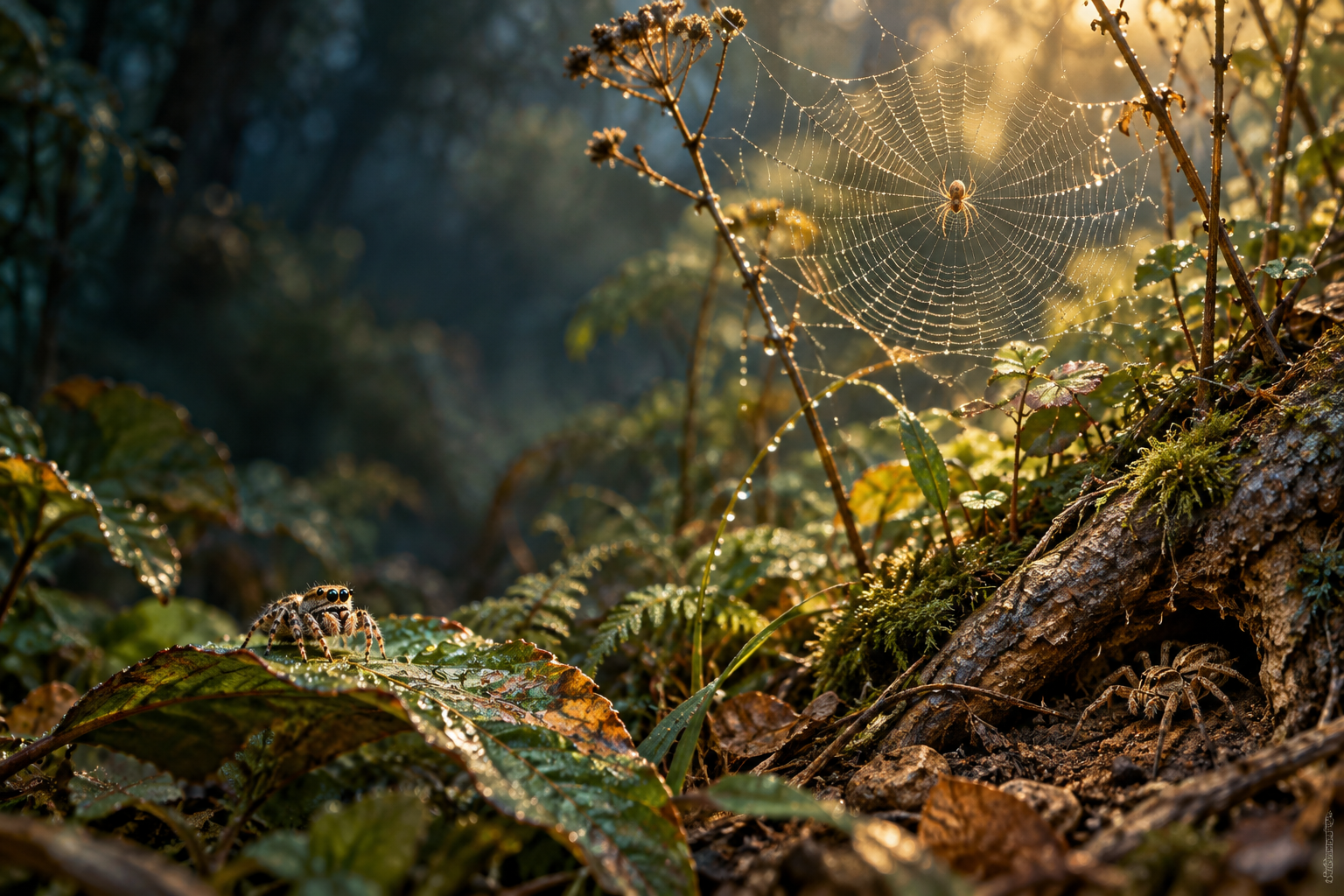
Spiders form the order Araneae within the arachnids. Jumping spiders, wolf spiders and orb weavers belong to different families; tarantulas belong to Theraphosidae. Family names group species by relationship. Terms such as web builder and running hunter describe ways of life rather than equivalent taxonomic categories.
Four portraits as starting points
Our opening selection contrasts an orb-building garden spider, a visually hunting zebra spider, a large ground-dwelling Goliath birdeater and a diving-bell spider. It does not represent every spider lineage. These contrasts make anatomy, silk use and habitat easier to explore through concrete examples. All four use the shared spider body plan in different ways.
Names connect languages
Scientific species names connect the three language editions. Common names can vary regionally or refer to several species. Reliable identification may still require additional anatomical characters. Artistic images convey an impression but do not establish identity. Our portraits therefore link to sources and distinguish explanatory illustrations from documented records.
Sources & image credits
- Australian Museum · Spiders ↗
- Australian Museum · Spider structure ↗
- World Spider Catalog · Patu digua ↗
- Fernández et al. (2018) · Phylogenomics, Diversification Dynamics, and Comparative Transcriptomics across the Spider Tree of Life ↗
Sources checked: 1 November 2026. Figures and records carry the qualifications stated in each article.