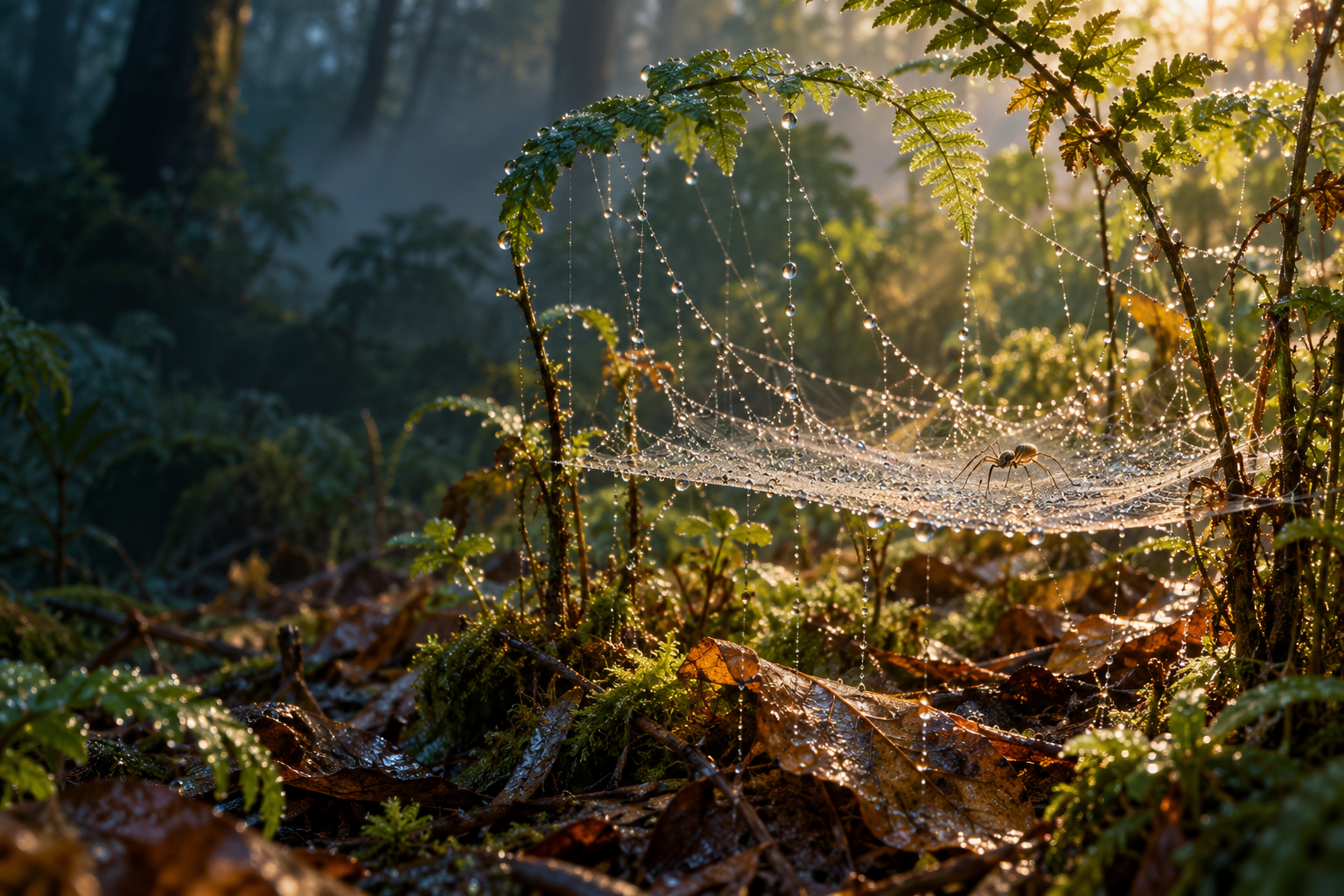
A surface in the air
An orb web is easy to recognise. A frame and radial threads support a capture surface that intercepts passing animals. Many species include sticky threads. Yet this familiar image is just one architecture among many. Even orb-building spiders differ in the orientation, size and additional structures of their webs.
Three-dimensional traps
Other spiders build silk sheets, three-dimensional tangles or combinations of both. Threads can redirect prey, hold it or transmit its movements. A funnel-shaped retreat is not necessarily the catching surface itself. To understand a web, look at where the spider waits and which threads connect its position to the capture area.
Similarity is not a family tree
Webs are both behaviour and physical structures. Their shape also depends on surroundings and available attachment points. A photograph of a web cannot therefore identify every species reliably. Reconstructing the evolutionary history of a web type likewise requires several kinds of evidence. Our models explain principles rather than replace taxonomic examination.
Sources & image credits
- Australian Museum · Prey capture and feeding ↗
- Australian Museum · Silk: the spider’s success story ↗
Sources checked: 1 November 2026. Figures and records carry the qualifications stated in each article.