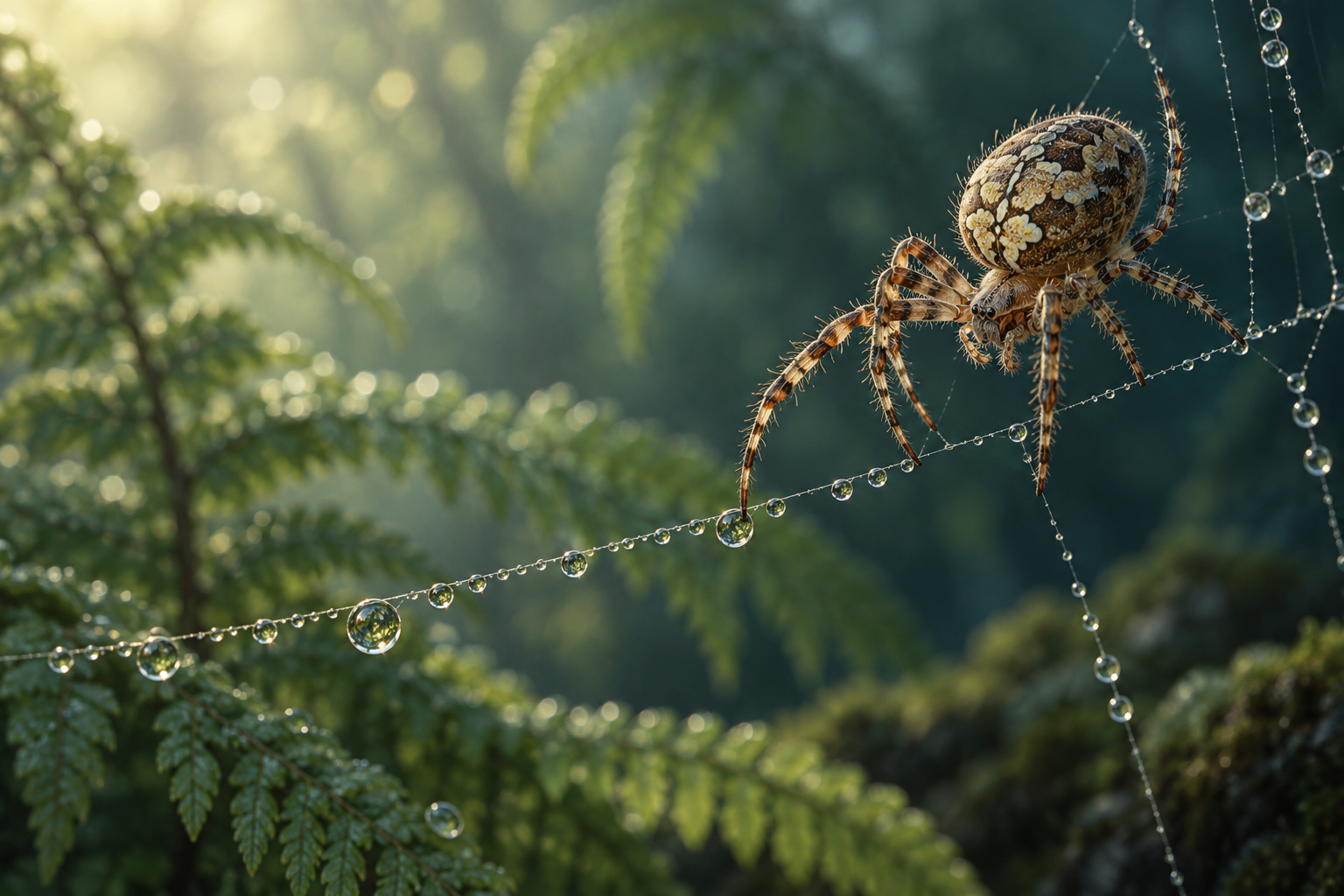
Made inside the body
Silk is produced in glands inside the abdomen. Protein-rich material changes as it becomes a fibre and leaves through tiny outlets. Movable spinnerets help position it. A spider does not simply draw one interchangeable kind of thread from its body: different glands and silks contribute to different tasks.
Material and task
An attachment point, supporting radius and capture spiral face different demands. Some threads transmit force, while others stretch or retain prey. Their properties depend on composition, structure and conditions. Claims such as stronger than steel therefore need a defined comparison. Tensile strength, extensibility and the mass of a material are not the same measurement.
Silk without capture webs
Hunting spiders also use silk for safety lines, retreats and egg protection. Silk production and web-based capture are therefore not synonymous. Our workshop shows a simplified orb web rather than a universal construction sequence. Considering these different uses reveals why silk is such an important connection between a spider’s body, movement and habitat.
Sources & image credits
- Australian Museum · Silk: the spider’s success story ↗
- Australian Museum · Egg sacs, spiderlings and dispersal ↗
Sources checked: 1 November 2026. Figures and records carry the qualifications stated in each article.