Keeping a connection
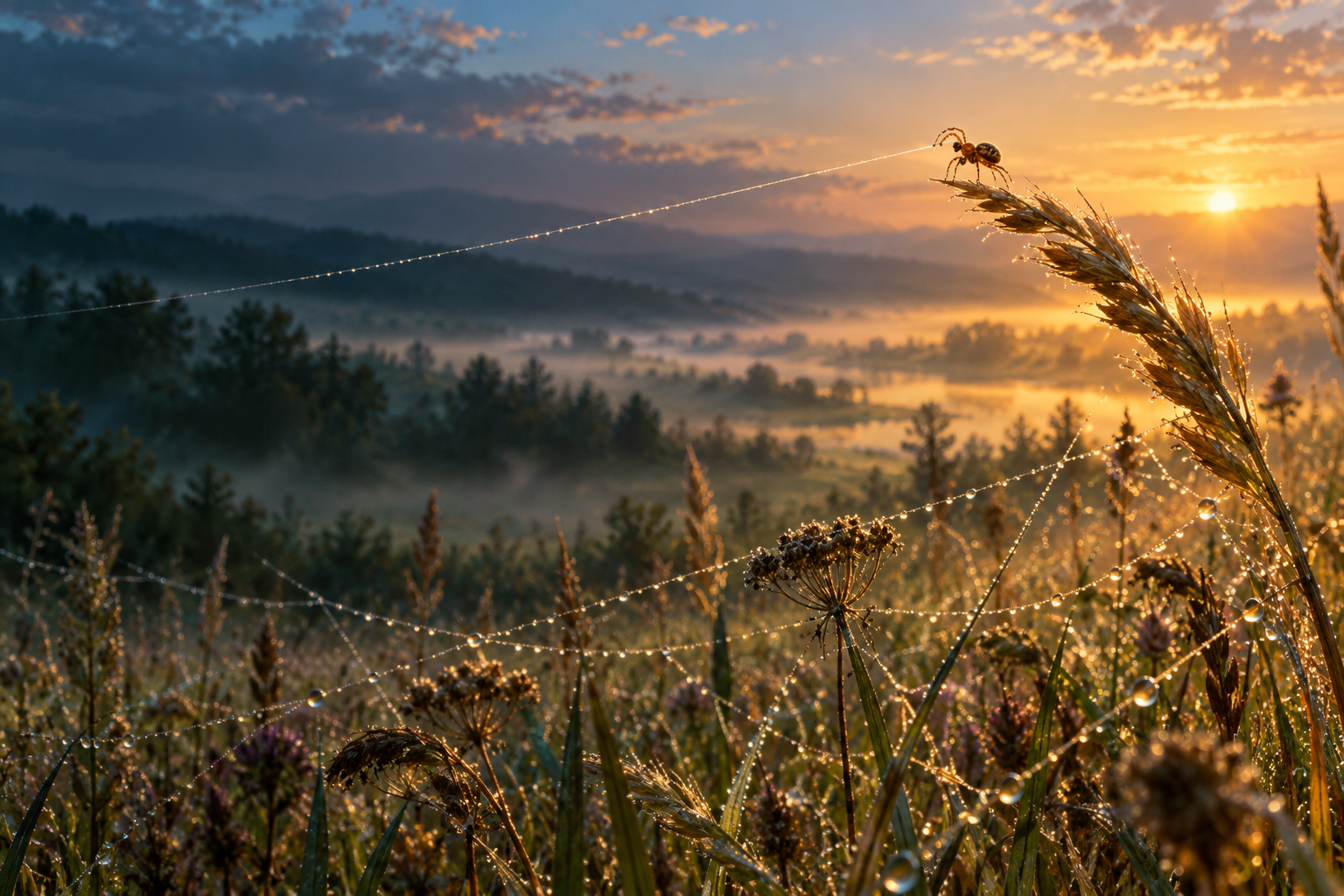
A jumping spider uses silk even while hunting without a capture web. An attached line can provide security. Spiders can also cross between nearby parts of vegetation on silk bridges. These uses show that silk complements movement rather than merely creating a fixed home. A thread maintains a mechanical connection to an earlier point.
Travelling with moving air
During ballooning, small spiders release threads and can be carried through the air. This dispersal is especially familiar in young spiders, but should not be assumed for every species or stage. A suitable destination is not guaranteed. Dispersal can open new habitats while also risking arrival somewhere without appropriate shelter or food.
Why young spiders disperse
Many spiderlings leave the egg-sac area after an initial period together, spreading competition for food and shelter across a wider area. They may walk, bridge gaps or travel through the air. A field covered with fine silk can reveal mass dispersal. It does not mean that a single enormous spider constructed one giant web there.
More than wind
Electric fields can also contribute to ballooning. In laboratory experiments in 2018, Morley and Robert showed that such fields could trigger take-off and provide lift in the Erigone spiders they studied. This does not make wind irrelevant or establish one mechanism for every flight outdoors.
Sources & image credits
- Australian Museum · Egg sacs, spiderlings and dispersal ↗
- Australian Museum · Silk: the spider’s success story ↗
- British Arachnological Society · Salticus scenicus ↗
- Morley & Robert (2018) · Electric Fields Elicit Ballooning in Spiders ↗
Sources checked: 1 November 2026. Figures and records carry the qualifications stated in each article.