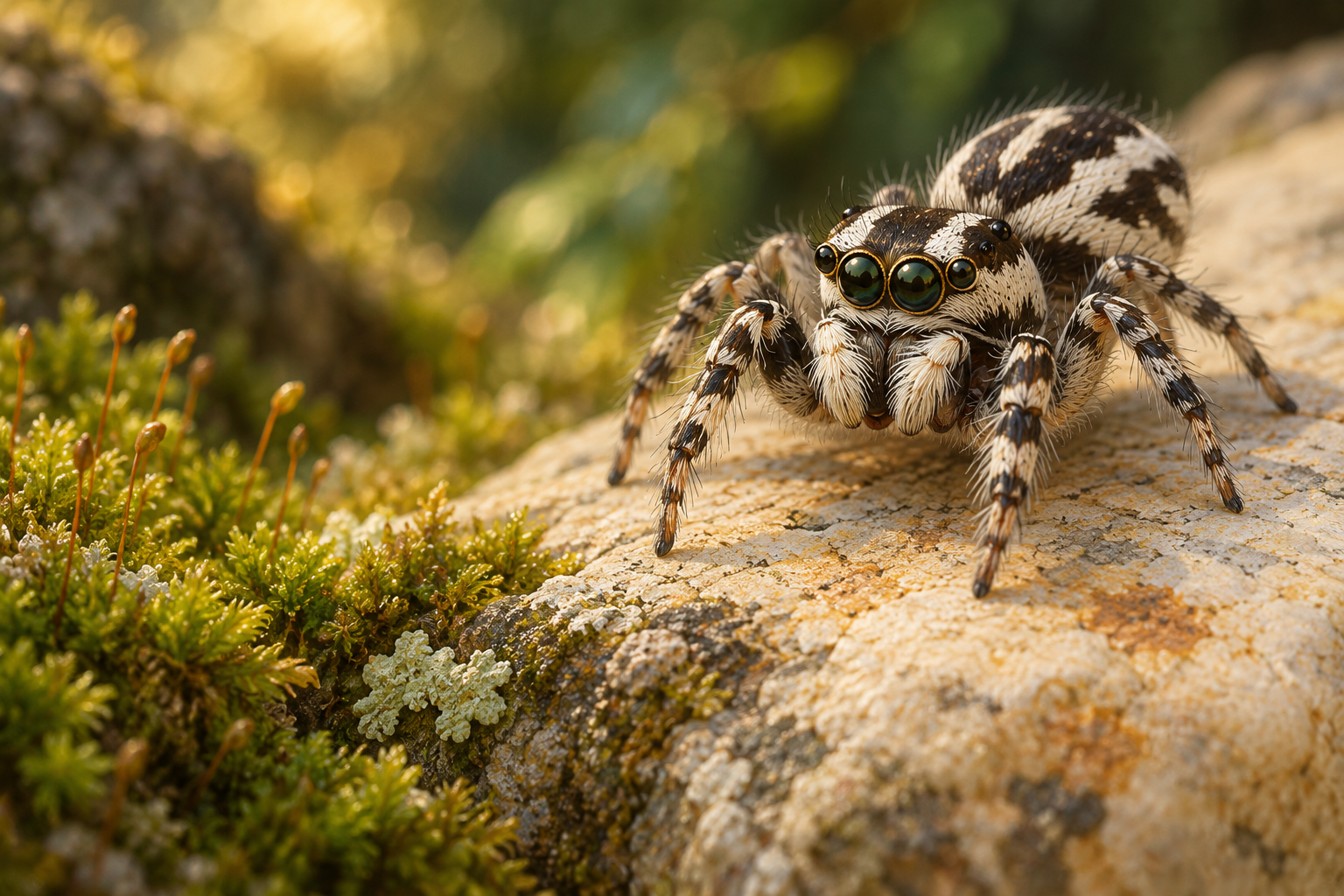
Black, white and alert
The zebra spider is known for contrasting markings and large forward-facing principal eyes. It belongs to the jumping-spider family Salticidae. On walls, fences and other surfaces it may pause and turn to orient. Turning toward a passing person shows a response to a stimulus, not evidence of a human-like intention.
Stalking and jumping
Instead of intercepting prey in an orb web, it stalks visually and leaps. Different pairs of eyes contribute different information. This strategy connects sensing and movement particularly clearly. Distance alone does not explain a successful jump: direction, range estimation and timing matter too. Jumping performance is therefore distinct from running speed or strike duration.
A hunter still needs silk
No capture web does not mean no silk. Jumping spiders use safety lines and silken retreats. They challenge the familiar idea that every spider sits in a large web. When observing, leave space and escape routes, and do not capture the animal for a supposed performance test. The artistic portrait introduces the species rather than providing reliable identification.
Sources & image credits
- British Arachnological Society · Salticus scenicus ↗
- Australian Museum · How spiders see the world ↗
- Australian Museum · Silk: the spider’s success story ↗
Sources checked: 1 November 2026. Figures and records carry the qualifications stated in each article.