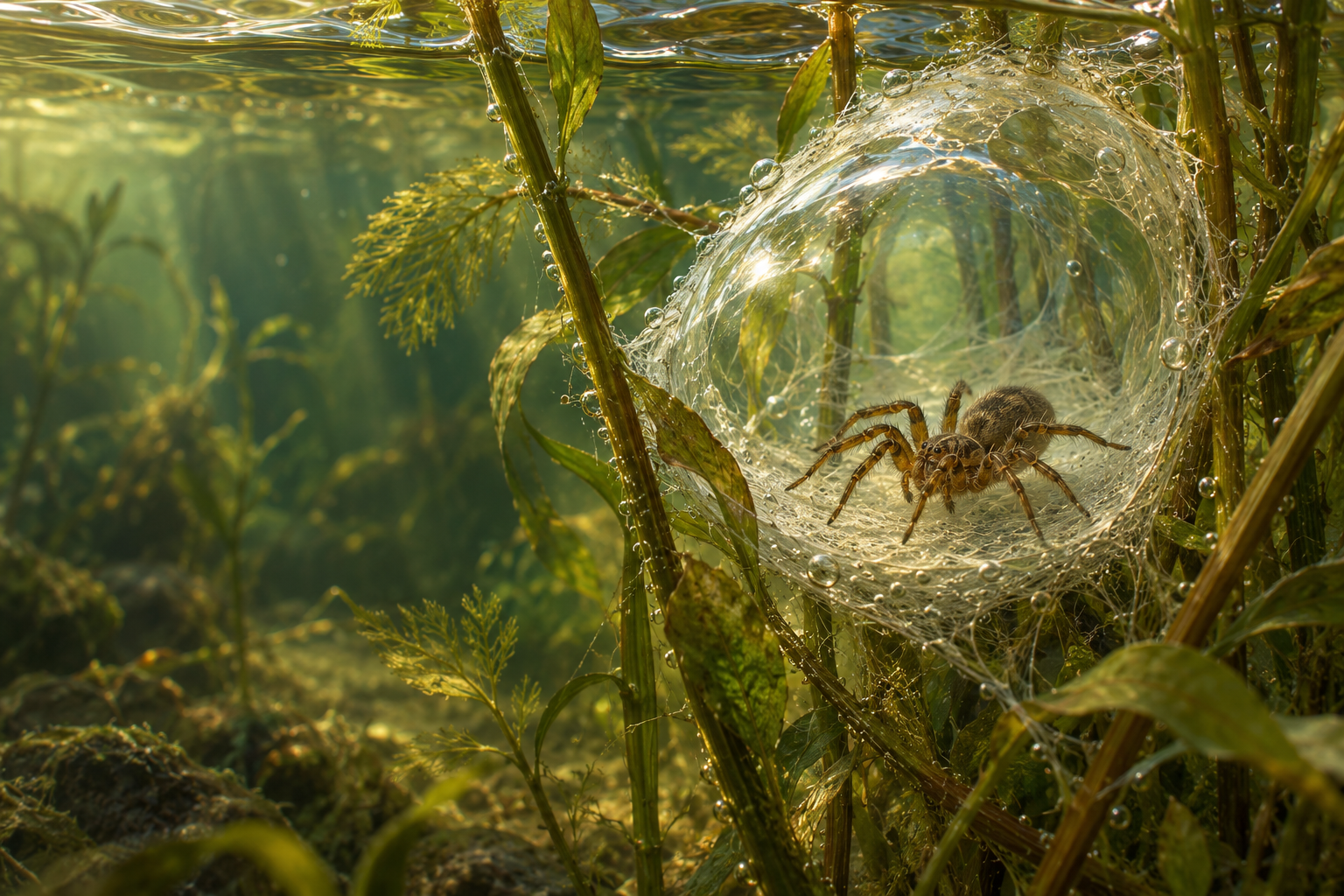
A bell of silk and air
This air-breathing spider spends much of its life in freshwater. It builds a dome-shaped web among aquatic plants and carries air down from the surface, creating a submerged space. The bell is not an organ inside the animal, and the spider has not acquired fish-like gills. It modifies its surroundings using silk.
A physical gill
In 2011, Seymour and Hetz measured oxygen exchange in the bell. Dissolved oxygen can enter its air space from the water. Under the tested conditions this exchange could meet the spiders’ resting requirements. That is a measured performance under specified conditions, not a promise for every water body, activity level or unlimited period without renewal.
Habitat and structure work together
Plants provide attachment points, while water conditions affect gas exchange. This example tightly connects anatomy, behaviour and environment. Our underwater scene is an artistic cutaway explaining a principle, not a measured experimental setup or a reconstruction drawn to scale. The source link leads to the original study for the actual measurements.
Sources & image credits
- Seymour & Hetz (2011) · The diving bell and the spider ↗
- Australian Museum · Silk: the spider’s success story ↗
Sources checked: 1 November 2026. Figures and records carry the qualifications stated in each article.