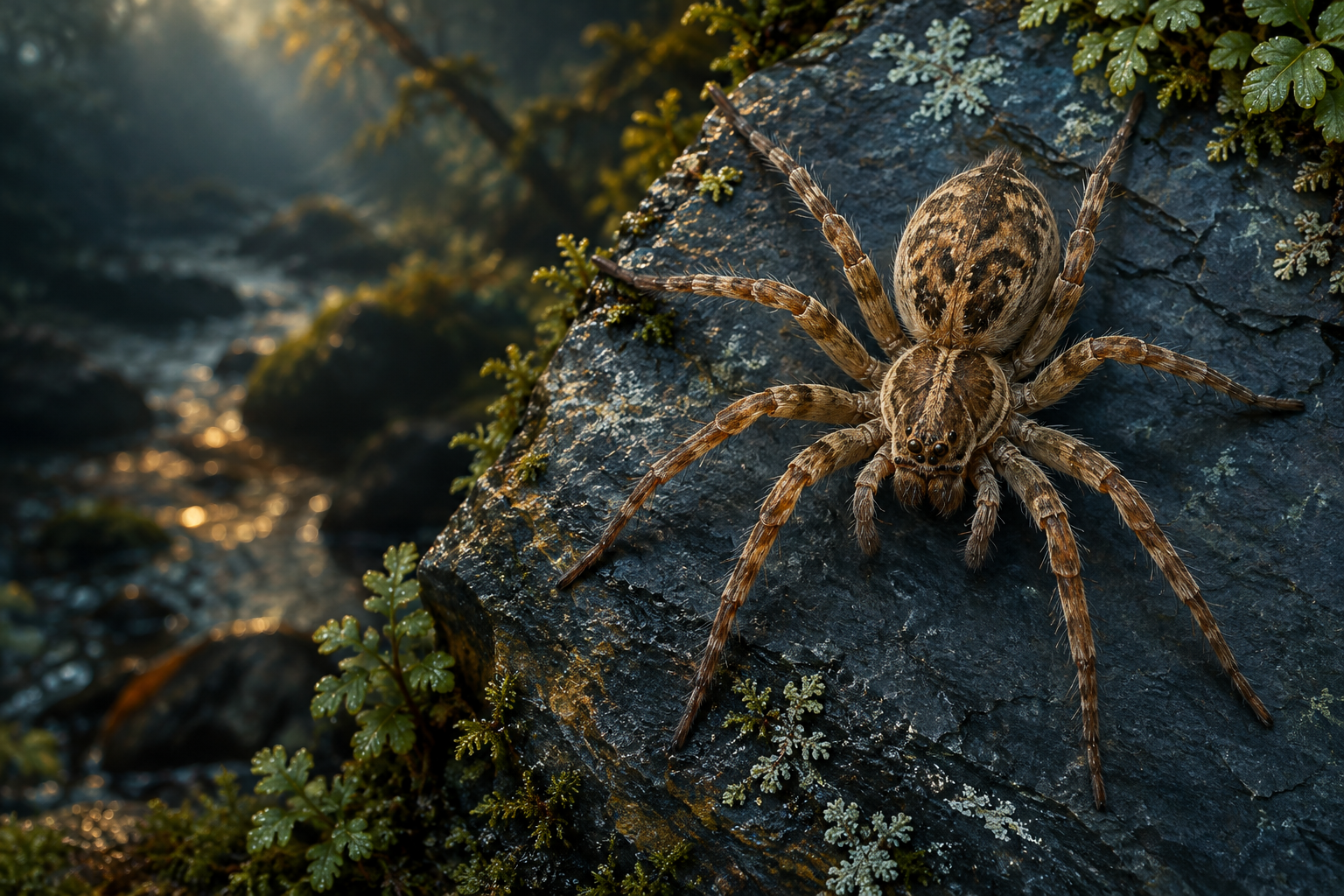
Front body and abdomen
The prosoma carries the eyes, mouthparts, pedipalps and four pairs of walking legs. A narrow pedicel joins it to the opisthosoma, or abdomen. The abdomen contains silk glands and parts of the respiratory and reproductive systems. This arrangement helps when observing an animal: not every appendage near its mouth is a walking leg.
Tools in different places
Chelicerae carry the fangs. Nearby pedipalps help with sensing and food handling; their terminal parts also transfer sperm in mature males. Spinnerets, by contrast, belong to the abdomen. Separating mouthparts from silk outlets helps explain how a spider can hold prey with its legs and mouthparts while applying silk from another part of its body.
A covering with limits
The cuticle forms a supportive external skeleton. It protects the body but cannot expand indefinitely, so growth requires moulting. Our interactive body atlas is a schematic guide to external regions. It is not a universal detailed anatomical reconstruction: internal organs and the different eye arrangements of every spider group are beyond that model.
Sources & image credits
Sources checked: 1 November 2026. Figures and records carry the qualifications stated in each article.