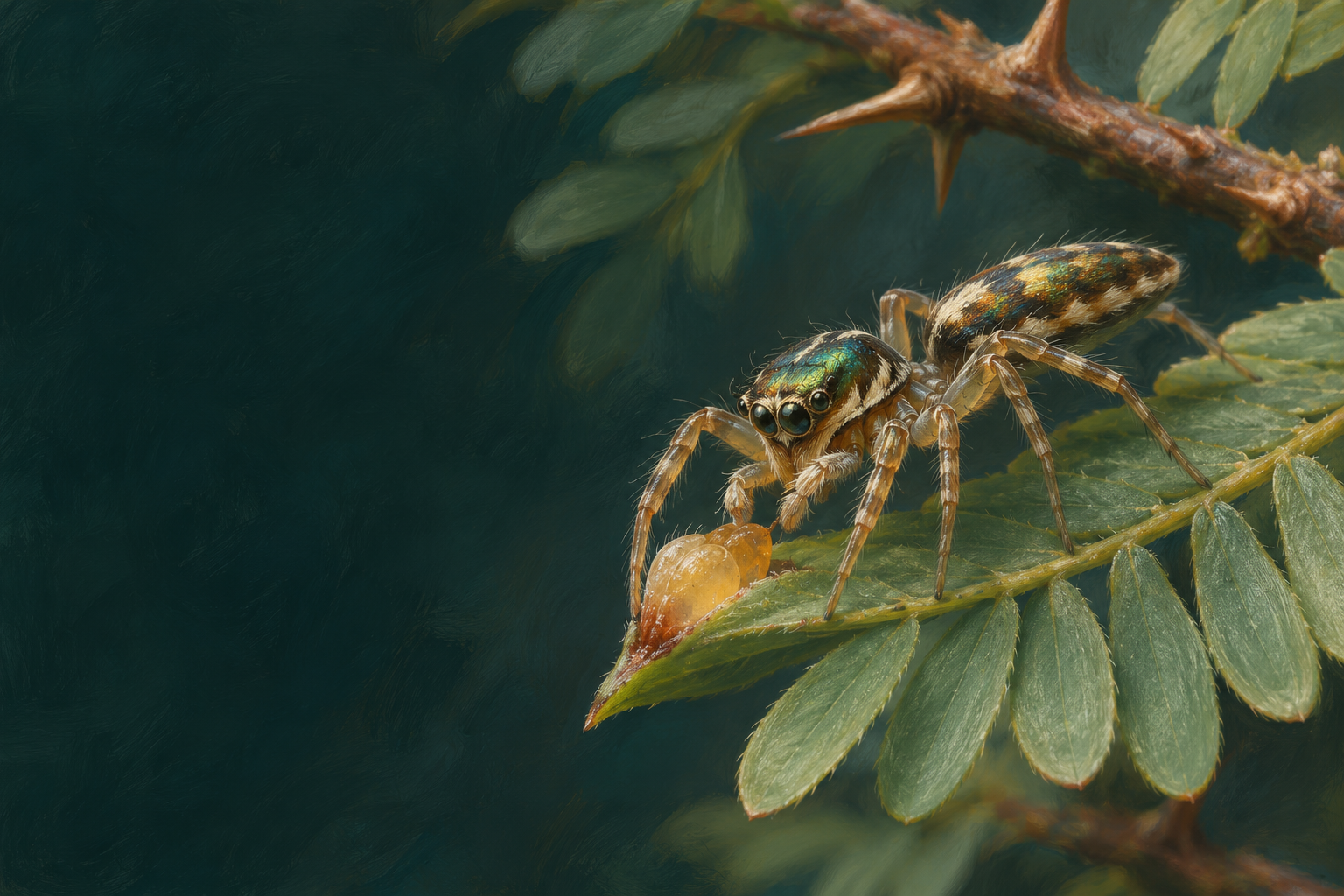
Rewards at leaf tips
Some ant-acacias produce nutritious food bodies at their leaf tips. Bagheera kiplingi collects these ready-made plant portions. Its food therefore grows on the plant rather than fleeing like an insect. This is still an active jumping spider, making decisions about where to move and how to reach a resource.
A bargain with extra diners
The food bodies normally belong to a plant–ant exchange: the plant supplies food and accommodation, while ants defend it. The spider takes a share without providing that same guarding service. A leaf thus becomes a meeting point between different ecological interests, rather than simply a green background for a hunter.
What isotopes reveal
A single meal does not define a diet. Researchers therefore combined direct feeding observations with isotope analyses, which provide evidence about food assimilated over a longer period. Together these approaches support the unusual importance of plant material. They do not remove animal prey from the spider’s possible menu or make every individual an obligate herbivore.
A Central American exception
The World Spider Catalog records the species from Mexico to Costa Rica. That geographical range is different from a statement about abundance. Its place in this collection rests on documented feeding ecology: a small jumping spider demonstrates that even a familiar animal group can contain remarkably different ways of making a living.
What do we know, and where are the limits?
Field observations and isotope analyses support a large plant contribution in studied populations. This establishes neither complete vegetarianism nor an identical diet at every locality.
Sources & image credits
- World Spider Catalog · Bagheera kiplingi ↗
- Meehan et al. (2009) · Herbivory in a spider through exploitation of an ant–plant mutualism ↗
- Ruiz & Edwards · Taxonomic references for Bagheera ↗
Sources and classification checked on 3 November 2026. Scientific names and interpretations may change with new evidence.