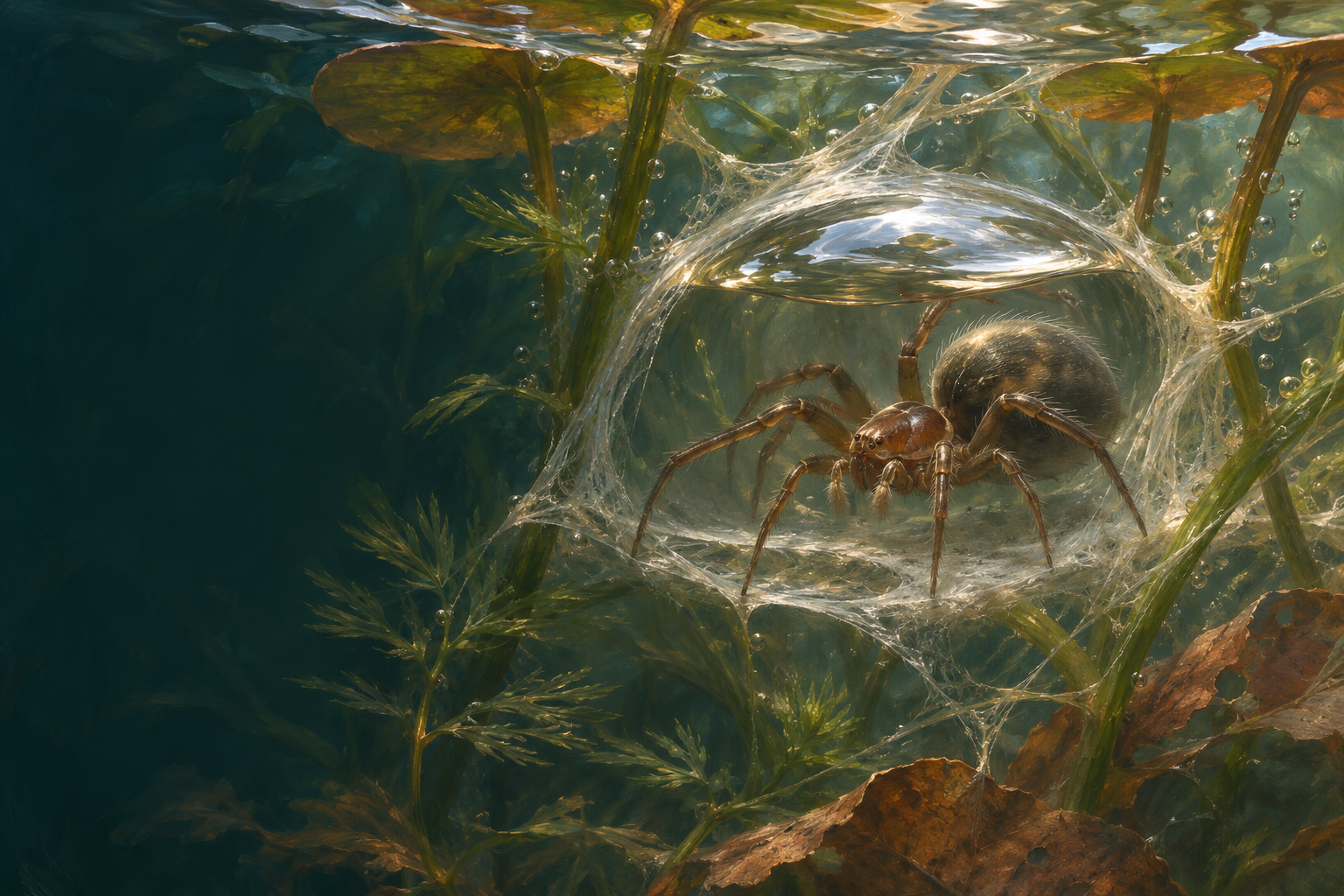
A bell made of silk and air
Argyroneta aquatica builds silk among aquatic plants to hold an air pocket. The bell is not a rigid shell with an impermeable wall. Silk stabilises its shape while air meets water across an interface. This lets an air-breathing spider establish a submerged living space anchored to the vegetation around it in the pond.
Air is carried down
The spider carries air down from the surface. Water-repellent hairs retain an air layer against its body and assist that transport. This explains its silvery underwater appearance. The sheen is not a metallic exoskeleton: it arises at the boundary between media. The air forms a delicate layer against the body.
Oxygen can enter from the water
Measurements inside diving bells show that oxygen can move from surrounding water into the air pocket. This is why the bell is described as a physical gill. Concentration differences drive the exchange. The spider does not breathe water like a fish; it continues using air whose gases exchange with the surroundings across the bell’s interface.
A solution requiring maintenance
A physical gill still has limits. Even while oxygen enters, loss of other gases affects bubble volume. Surface visits and conditions in the water therefore remain important. This example brings behaviour and physics together: an impressive adaptation does not abolish the demands of a habitat, but allows an animal to meet them in a distinctive way.
What do we know, and where are the limits?
Oxygen measurements support the bell’s physical-gill function. It does not replace air replenishment indefinitely; the current catalog places the species in Argyronetidae.
Sources & image credits
- World Spider Catalog · Argyroneta aquatica ↗
- Seymour & Hetz (2011) · The diving bell and the spider: the physical gill of Argyroneta aquatica ↗
- Spiders of Europe · Argyroneta aquatica ↗
Sources and classification checked on 3 November 2026. Scientific names and interpretations may change with new evidence.