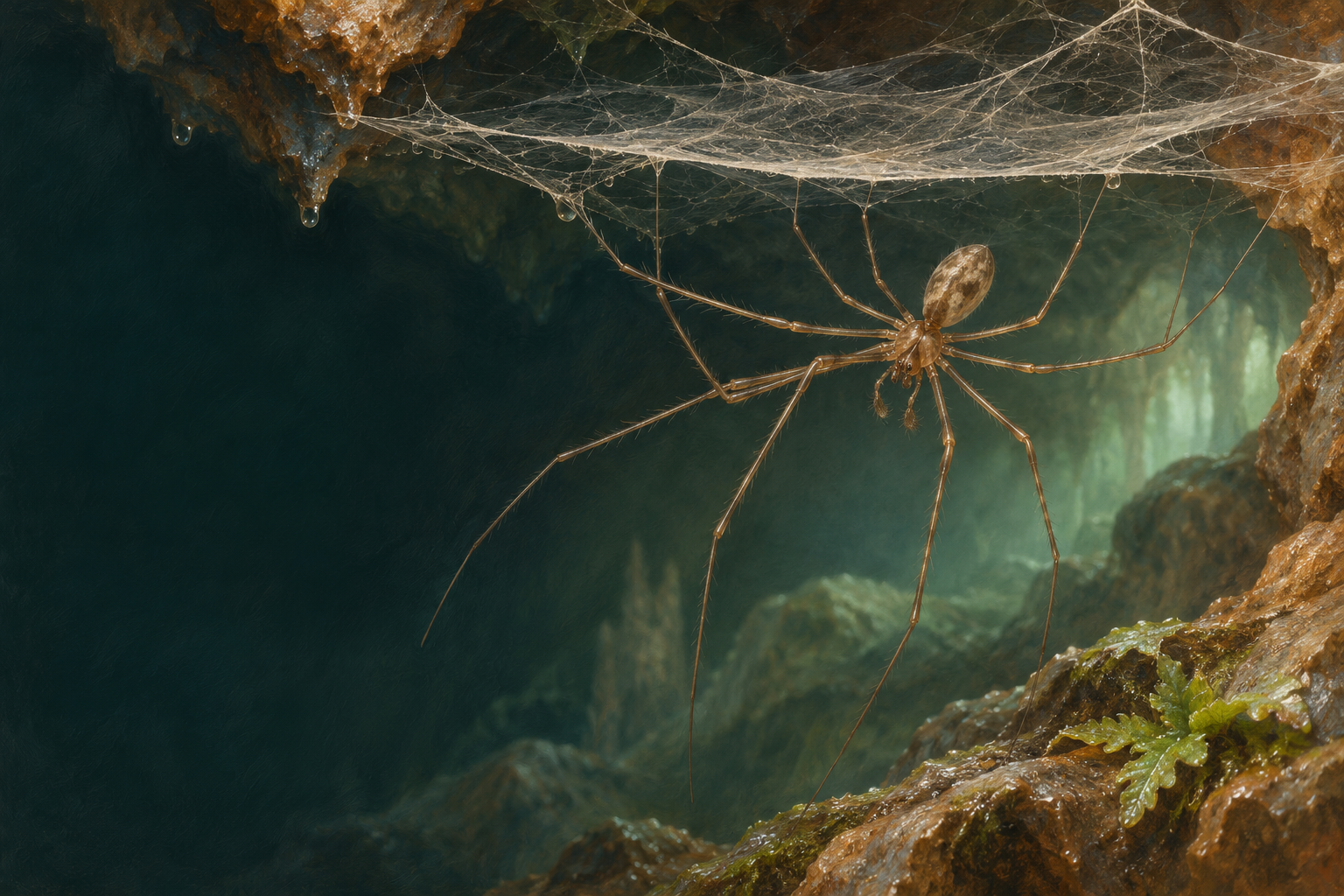
A ceiling of threads
Beneath a broad sheet of silk, the spider seems almost weightless. Its web joins suitable anchors in damp, sheltered spaces, turning part of a cave wall into usable living space. The long legs extend far beyond the relatively compact body. Perspective and darkness can make this silhouette look more dramatic than the same animal photographed beside a scale.
An egg sac held clear
The suspended egg sac is particularly remarkable. An outer covering surrounds a firmer internal structure; the eggs are not simply exposed on the cave floor. The Australian Museum describes this construction and suggests possible protective roles. Whether each proposed function operates under every condition is a different question from the well-documented existence of this carefully built silk architecture.
Tasmania beyond the cave
The species is known from Tasmania and strongly associated with moist caves. Suitable sheltered places outside caves also form part of its habitat. Its name therefore directs attention to an important setting rather than imposing an absolute boundary. Temperature, moisture and accessible refuge matter to an animal; the human label attached to a location does not define its possibilities.
A revised place in the family tree
Many accounts still place Hickmania in Austrochilidae. More recent phylogenetic work and the current catalog instead assign the genus to Gradungulidae. Two otherwise useful sources can therefore display different family names. The change shows why a library should date its sources and incorporate new evidence about relationships rather than treating a familiar classification label as permanently fixed.
What do we know, and where are the limits?
Museum accounts and behavioural research document the web and reproduction. Current placement: Gradungulidae; older sources still use Austrochilidae. Proposed protective functions of the egg sac should be distinguished from its observed structure.
Sources & image credits
- World Spider Catalog — Hickmania troglodytes ↗
- Australian Museum — Tasmanian Cave Spider ↗
- Kulkarni & Hormiga (2021) — Hooroo mates! Phylogenomic data and Hickmania relationships ↗
Sources and classification checked on 3 November 2026. Scientific names and interpretations may change with new evidence.