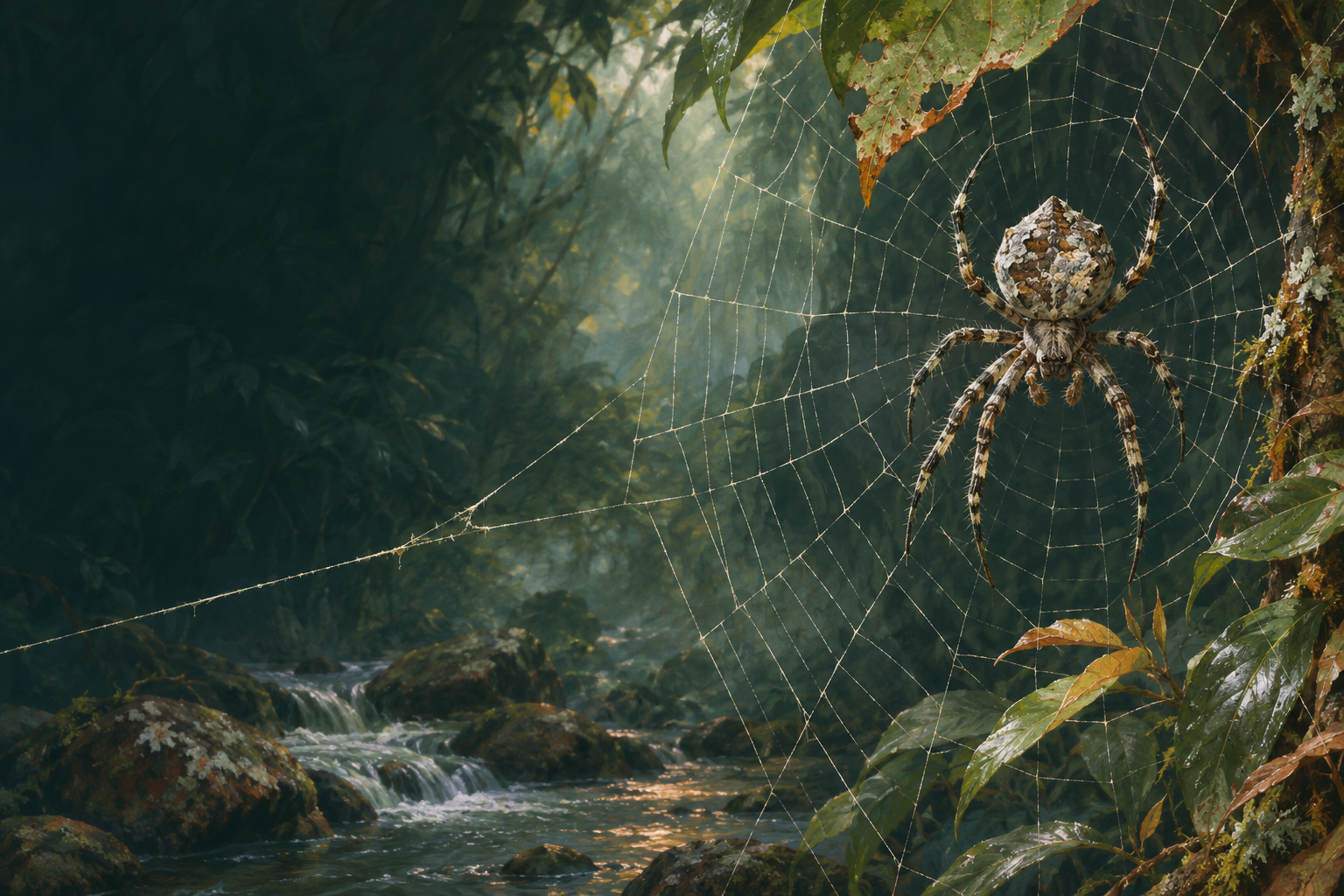
A hunting site above water
Caerostris darwini lives in Madagascar and builds orb webs above rivers and other waterways. Long bridge threads connect bank vegetation with the capture web itself. This opens a hunting space that a web between neighbouring twigs would not reach. Water, vegetation and aerial space form parts of the same architecture.
Toughness means more than strength
Toughness is a key idea in studies of its silk: a material can absorb considerable energy before breaking when it resists force while also stretching. This differs from tensile strength alone. That combination matters when a flying insect is suddenly stopped by a web and its movement must be absorbed.
One web contains different materials
An orb web is not made from one uniform thread. Supporting elements and capture spirals perform different jobs. Research therefore distinguishes silk types and their properties. Talking only about the strongest spider silk misses this toolkit: stability, stretch and contact with prey need not be achieved in exactly the same way throughout a web.
From forest to laboratory
This species links field observation, material testing and genetic research. A genome alone does not explain a finished capture web, while a beautiful photograph reveals little about proteins. Different studies bring behaviour and material together. It belongs here because it raises a productive question: how do architecture and silk suit an unusual hunting site?
What do we know, and where are the limits?
Webs and silk have been studied directly. Material measurements depend on thread type, method and developmental stage; they do not establish an everlasting world record.
Sources & image credits
- World Spider Catalog · Caerostris darwini ↗
- Kuntner & Agnarsson (2010) · Web gigantism in Darwin’s bark spider ↗
- Agnarsson, Kuntner & Blackledge (2010) · Bioprospecting Finds the Toughest Biological Material ↗
- Babb et al. (2022) · Characterization of the genome and silk-gland transcriptomes of Darwin’s bark spider ↗
Sources and classification checked on 3 November 2026. Scientific names and interpretations may change with new evidence.