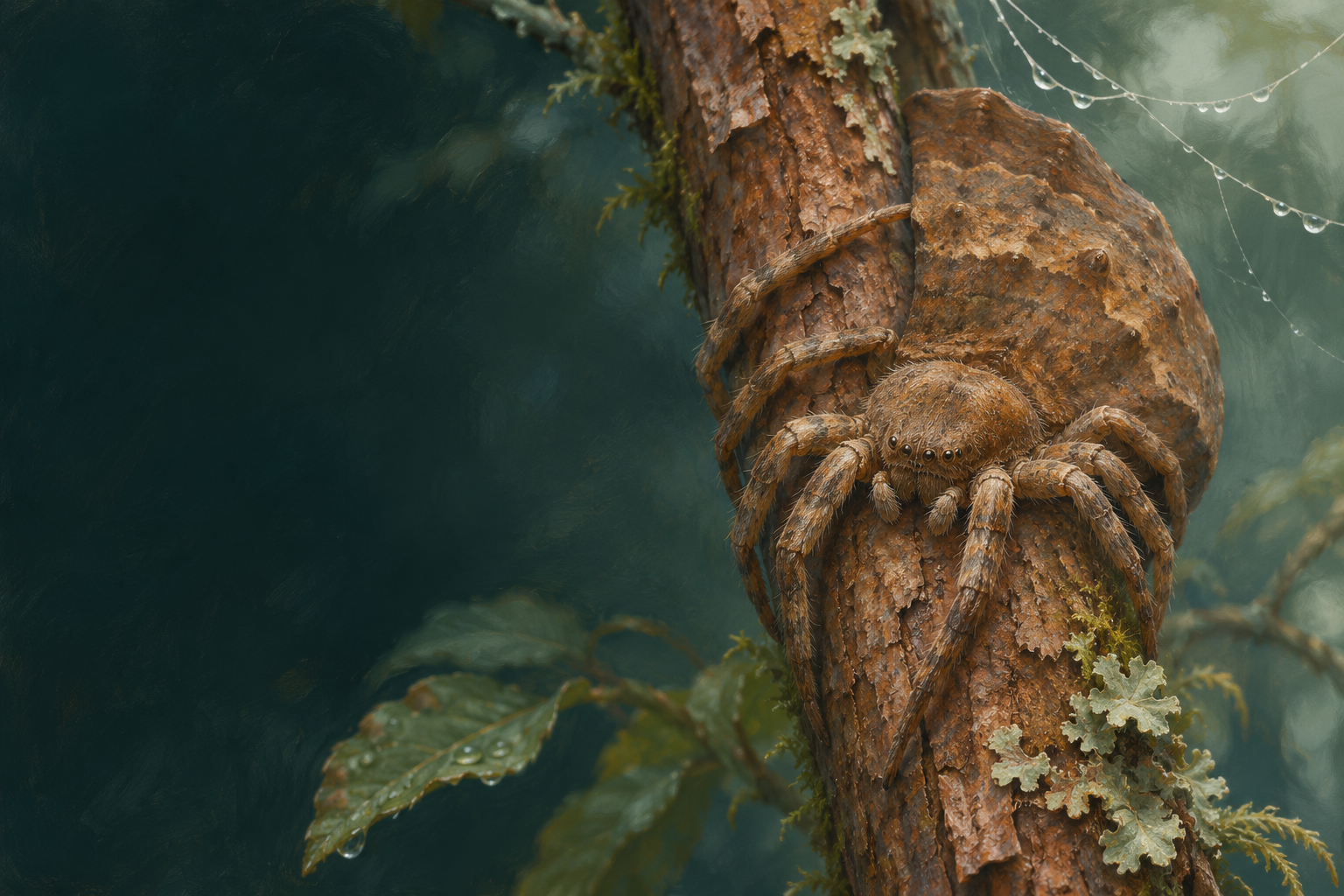
The twig becomes part of the outline
Dolophones is described as wrapping around its resting place. The body can fit closely to a twig or flatten against bark. A curved underside helps match that surface. Concealment is therefore not simply a matter of colour: the animal’s three-dimensional shape also corresponds to the structure on which it is resting during the day.
Texture instead of a smooth surface
The upper surface is described as shield-like, with small disc-like structures. Together with brown patterns, it creates a texture that can be difficult to separate from bark. Concealment involves this combination of outline, posture and markings. Finding the animal therefore requires recognising more than one conspicuous feature against its background.
From daytime shelter to orb web
The expert account describes daytime resting and large vertical orb webs at night. An animal concealed tightly against a twig is therefore still a web builder. The contrast shows why an encounter photograph records only a moment of its biology. Resting sites and capture sites can place different demands on the same body and behaviour.
What we can name confidently
The World Spider Catalog accepts Dolophones conifera as an Australian species. Not every similarly resting Dolophones can be identified confidently from a photograph alone. We therefore distinguish the accepted species from cautious image identifications. Selection recognises a documented body adaptation, without implying a complete distribution map or measured protection against every possible enemy.
What do we know, and where are the limits?
Taxonomy and expert natural-history observations support this portrait. Some photographs in the expert source are cautiously identified as possible members of the species; the illustration cannot replace specimen-based identification.
Sources & image credits
- World Spider Catalog · Dolophones conifera ↗
- Robert Whyte / Arachne · Dolophones conifera ↗
- World Spider Catalog · Original taxonomic reference, included taxa ↗
Sources and classification checked on 3 November 2026. Scientific names and interpretations may change with new evidence.