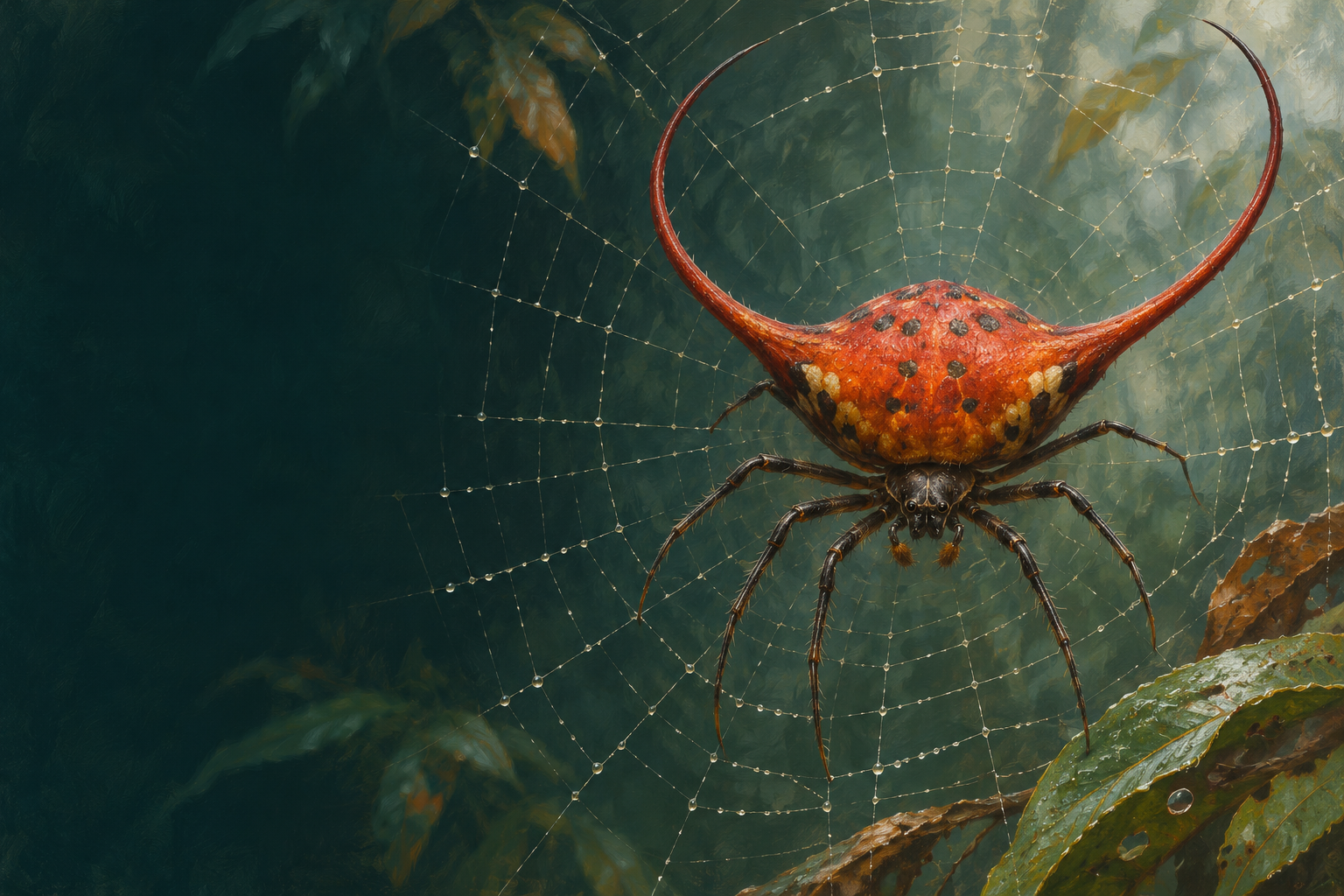
Arcs rather than extra legs
The female’s two exceptionally long lateral spines arise from the abdomen. Its eight walking legs instead attach to the front body. The distinction sounds simple but is easily blurred in fantastic images. In the real animal the visual effect comes from the contrast: a compact abdomen with far-reaching extensions alongside the fine, jointed legs that actually support movement.
Silk between plants
Accounts from Southeast Asia describe webs in undergrowth, sometimes near or above water. The geometric trapping surface holds a spider whose outline differs dramatically from a familiar garden orb-weaver. Web position and vegetation structure are connected: available anchors define the space. Observations at particular sites do not mean that every web of this species must hang directly over water.
What do the spines do?
Conspicuous structures invite quick explanations involving protection, signalling or balance. Without suitable tests these remain hypotheses. The taxonomic sources establish shape and diagnostic differences rather than a complete account of benefit. This open question is itself part of the species’ appeal: detailed anatomical knowledge can coexist with substantial uncertainty about the function of an extraordinary feature.
A familiar animal under another name
Older books and image archives often label this spider Gasteracantha arcuata. The current catalog places it in Macracantha. In this context the two combinations connect to the same species history rather than two different spiders. Using the accepted placement helps keep comparisons among spiny orb-weavers clear while preserving a route between recent research and observations published under the older name.
What do we know, and where are the limits?
Taxonomic studies document the spines and webs, without demonstrating the spines’ exact adaptive function. The accepted name is Macracantha arcuata; older sources use Gasteracantha arcuata.
Sources & image credits
- World Spider Catalog — Macracantha arcuata ↗
- Tan et al. (2019) — Phylogenetic relationships of spiny orb-weavers in Peninsular Malaysia ↗
- Macharoenboon et al. (2021) — Spiny-backed orb-weavers of Thailand ↗
Sources and classification checked on 3 November 2026. Scientific names and interpretations may change with new evidence.