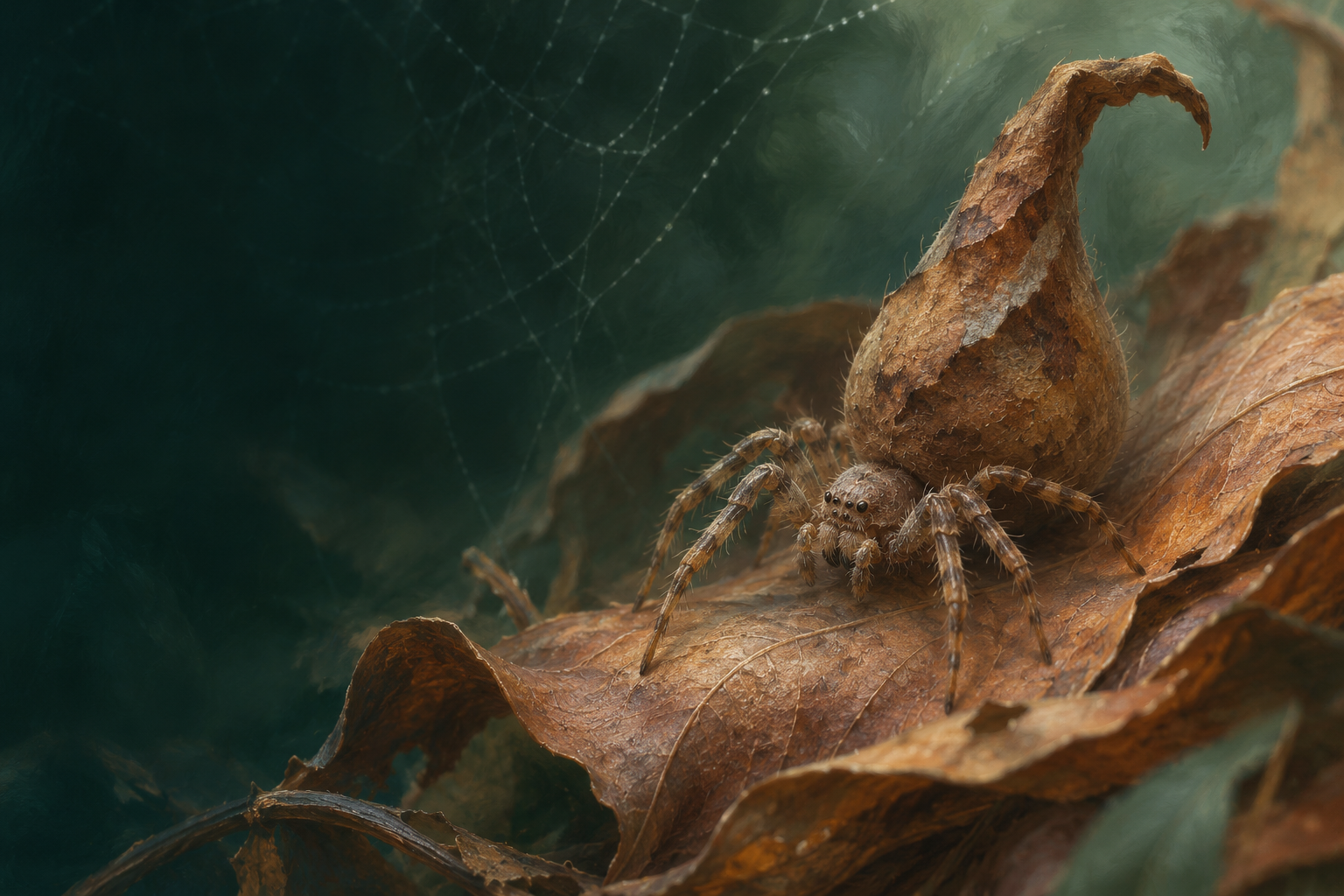
The hat is part of the body
The distinctive tip belongs to the abdomen. It is neither an object worn by the spider nor a horn on its head. The brownish outline suggests dry, curled foliage. Someone overlooking the legs and small front body might initially see only a plant fragment. That shift between recognition and concealment makes the silhouette especially compelling for this selection.
An orb web after dark
The original description identifies it as a nocturnal orb-weaver and reports resting among dry foliage. Two different possibilities meet here: an inconspicuous body at rest and a silk trapping device during activity. The web is not an extension of the supposed hat. Its threads form a separate tool, while the spider’s body can remain difficult to recognize elsewhere.
A forest patch in the Western Ghats
The described female came from Karnataka in India’s Western Ghats. The publication identifies a forest setting with evergreen and semi-evergreen vegetation. A precise collection locality makes a portrait checkable, but cannot replace a wider survey. Whether the species occupies other suitable sites cannot be inferred from its striking appearance or from how widely its memorable name has circulated.
An imaginative name, real research
The species name refers to the speaking hat from the Harry Potter stories, making the spider unusually memorable. The scientific foundations remain documented characters, deposited material and comparisons with related species. An imaginative name can open a door to curiosity; the description behind it allows the animal to be recognized independently of the cultural story attached to it.
What do we know, and where are the limits?
The original description is based on a female from India’s Western Ghats. The hat comparison explains the name, not a demonstrated protective function. Few published records do not establish global rarity.
Sources & image credits
- World Spider Catalog — Eriovixia gryffindori ↗
- Ahmed, Khalap & Sumukha (2016) — A new dry-foliage-mimicking Eriovixia ↗
- Zoological Survey of India — Animal Discoveries 2016 ↗
Sources and classification checked on 3 November 2026. Scientific names and interpretations may change with new evidence.