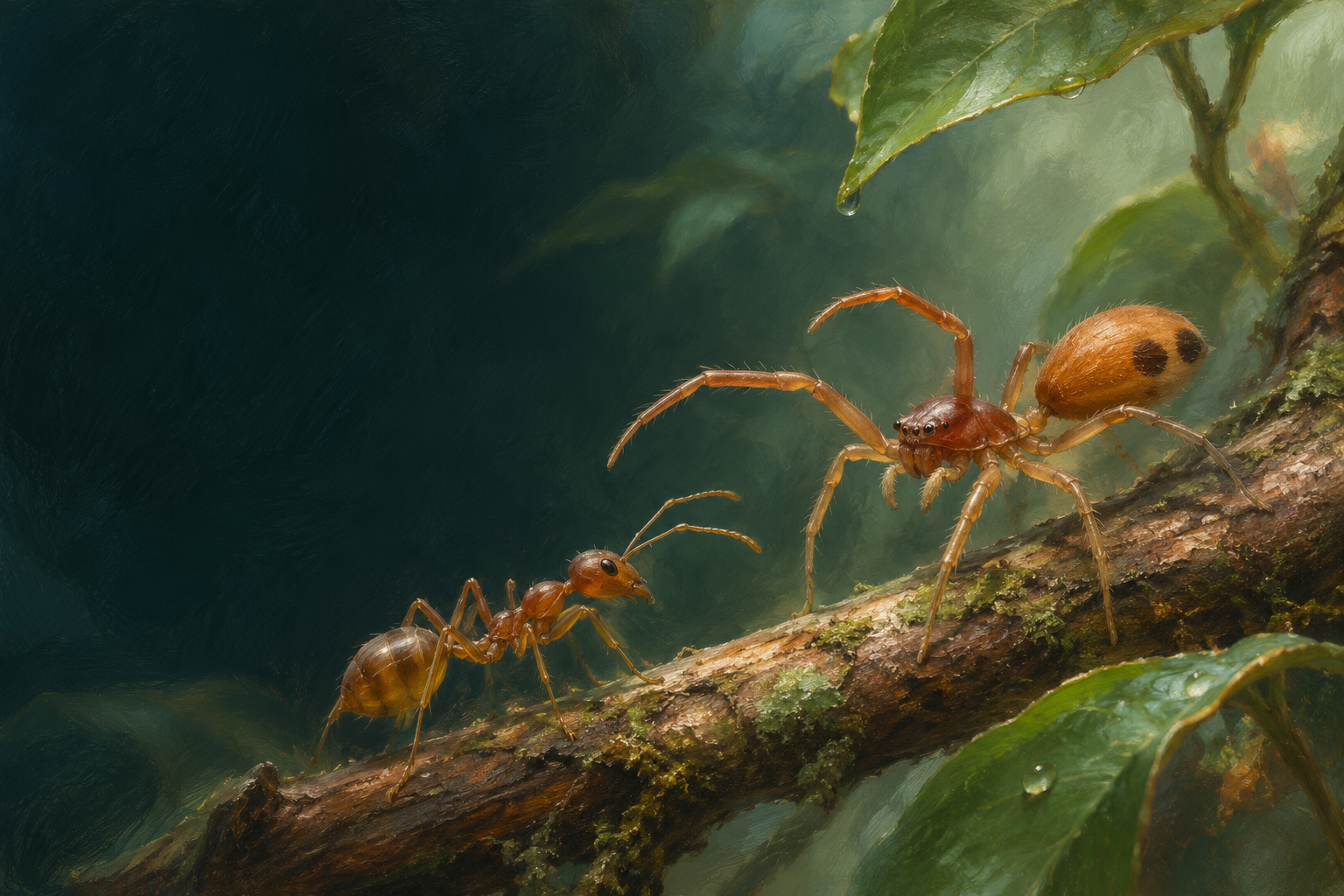
Another route to an ant-like form
Ant-like spiders need not be jumping spiders. Amyciaea belongs to the crab-spider family. Slender legs, reddish-brown body regions and an elongated abdomen produce a different impression from the familiar broad-legged image of that family. Comparing its appearance with an ant is not a statement about close ancestry: the underlying spider body remains fundamentally different from that of an insect.
Two dark markings
A zoological description highlights two dark marks toward the rear sides of the abdomen. Small characters such as these make the overall resemblance more precise. They are not eyes at the wrong end of the body. Like other spiders, it has eight walking legs and no antennae. The resemblance involves body shape, markings and posture.
Ant association as a research question
Amyciaea is discussed in connection with ants and ant hunting. Not every account, however, carefully distinguishes its constituent species. We use genus-level information as context rather than assigning an elaborate attack sequence to A. forticeps without matching evidence. Resemblance, occurrence alongside ants and demonstrated feeding behaviour are three distinct levels of a biological story, even when they appear together in a photograph.
An Asian selection with a precise identity
The catalog and zoological works document the species in Asia, while Indian sources connect its name with described material. Its inclusion does not imply that it is rare everywhere. Instead it broadens this library’s scope: alongside remarkable webs and long spines, there is room for a body that initially directs a viewer’s attention toward an entirely different group of animals.
What do we know, and where are the limits?
Zoological descriptions support body structure and Asian records. General accounts of Amyciaea ant hunting do not replace a separately tested behavioural study of A. forticeps.
Sources & image credits
- World Spider Catalog — Amyciaea forticeps ↗
- Zoological Survey of India — Fauna of India: Thomisidae ↗
- Assam State Biodiversity Board — Common spiders from protected areas of Upper Assam ↗
Sources and classification checked on 3 November 2026. Scientific names and interpretations may change with new evidence.