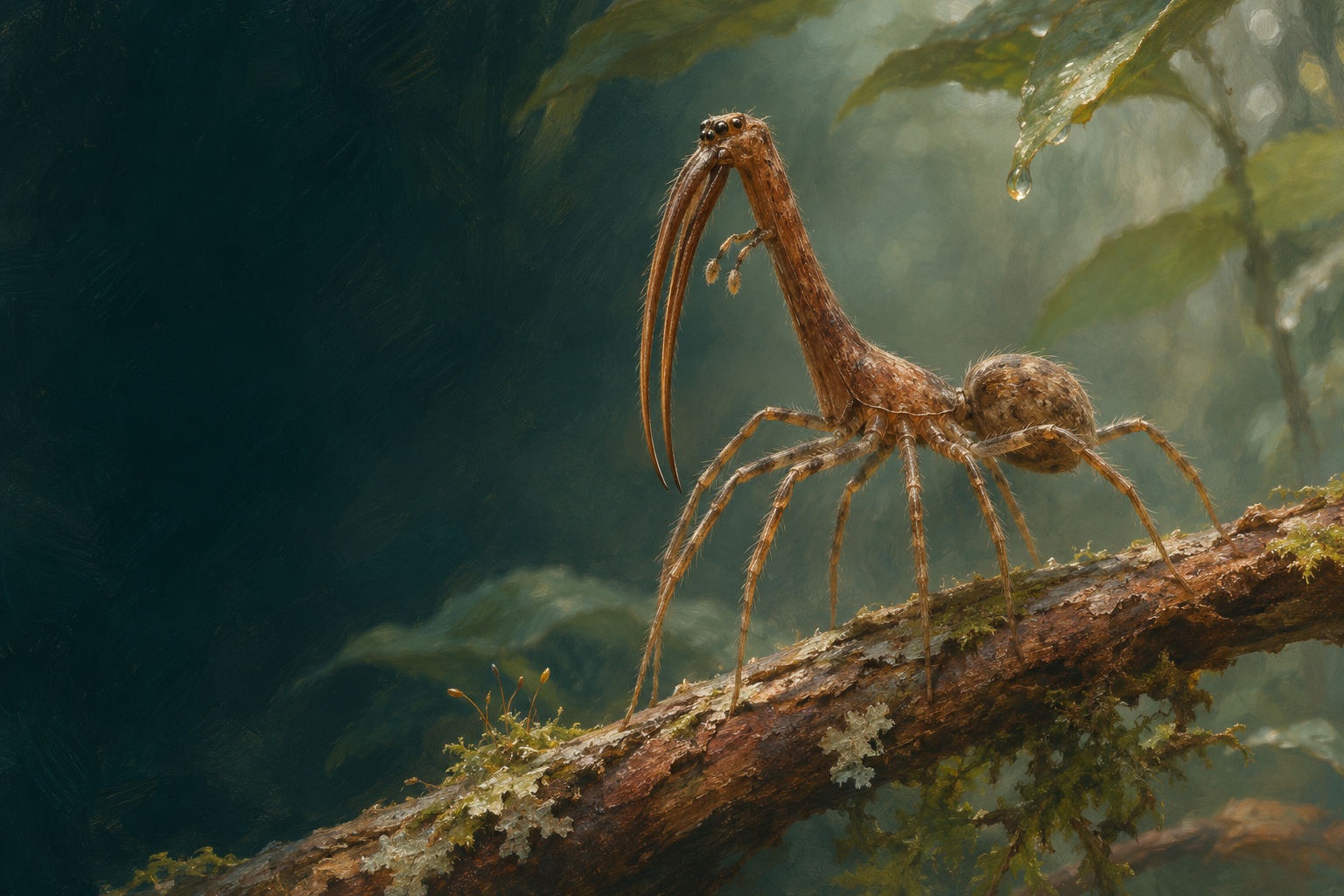
A neck without a backbone
The apparent neck is an elongated part of the front body. The eye-bearing head region sits above the exceptionally long chelicerae. These mouthparts are neither a bird beak nor an extra pair of legs. Their unusual arrangement creates distance between the hunter’s body and another spider equipped with potentially dangerous mouthparts of its own.
Spiders as prey
Pelican-like archaeids are known for hunting other spiders. Observations show how elongated jaws can hold prey away from the hunter. This gives the striking body shape a functional context without turning a single illustration into a complete hunting account. Encounter, attack and restraint are separate stages, and their details can differ among species and circumstances.
A Madagascar forest inhabitant
Eriauchenus workmani is known from Madagascar. The taxonomic revision lists specimens from several forest areas in the island’s east. It therefore does not fit a simple story of a sensation seen only once. Its distinction lies in its body plan and ecological context. Multiple collection localities, in turn, do not measure how many animals occupy each location.
A name with a history
Older and even relatively recent publications often use Eriauchenius. The current World Spider Catalog uses Eriauchenus and treats the alternative spelling as a lapsus. Such corrections do not change the animal, but they help bring knowledge together. We use the accepted form while linking the revision so that research filed under the older spelling remains discoverable.
What do we know, and where are the limits?
The 2018 revision describes the species in detail. Some hunting accounts concern observed archaeids generally; not every movement has been tested separately in this species. Current spelling: Eriauchenus.
Sources & image credits
- World Spider Catalog — Eriauchenus workmani ↗
- Wood & Scharff (2018) — Madagascan pelican spiders ↗
- Smithsonian — Newly discovered pelican spiders of Madagascar ↗
Sources and classification checked on 3 November 2026. Scientific names and interpretations may change with new evidence.