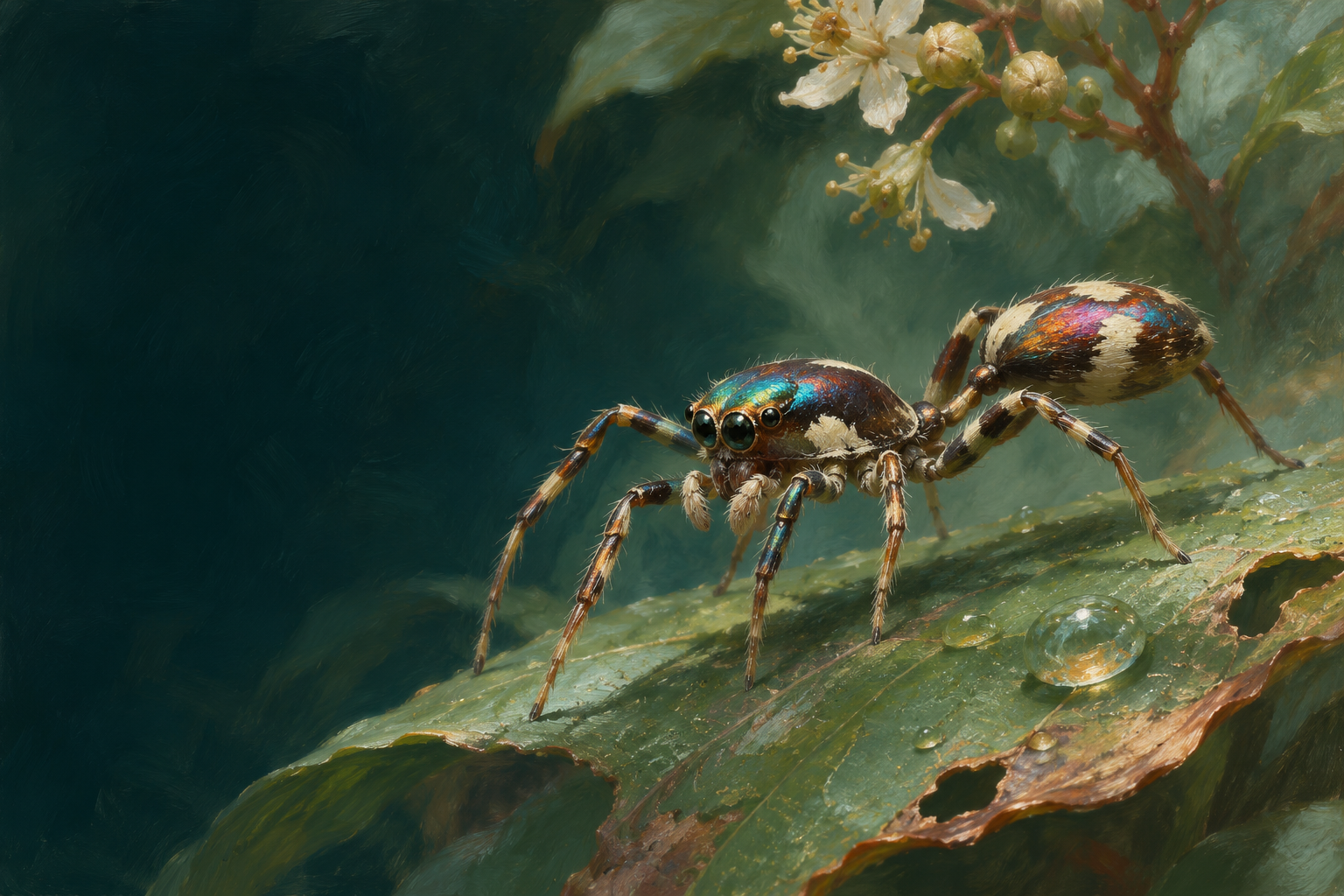
A colourful puzzle
At first glance Siler collingwoodi does not match the usual image of an inconspicuous ant copy. This jumping spider has metallic-looking colours. Concealment, however, depends on the observer and the background. An animal that stands out in an isolated photograph may be perceived quite differently among the colours and textures of vegetation.
Movement belongs to the pattern
Researchers compared paths and movement features with several ants living alongside the spider. The resemblance was not a perfect copy of one particular species. That makes the case instructive: mimicry can arise from a combination of approximations. A moving animal supplies more information than the outline of its body in a still image.
Include the predator’s view
Predator trials tested whether the combination of traits actually changes responses. Such experiments connect a proposed resemblance with the behaviour of a receiver. They replace the simple question “Does it look like an ant to us?” with the more precise question of how a potential enemy responds to the spider under specified conditions.
Imperfect can be enough
The catalogue records the species in China and Japan. Its special place in this collection rests on a scientific counterexample to the perfect disguise, not on unsupported rarity. Evolution need not produce a photographically exact replica. What matters is the effect of a combination of traits in a particular environment and community.
What do we know, and where are the limits?
A study combines movement analyses, background comparisons and predator trials. Its results describe tested situations, not perfect protection in every setting.
Sources & image credits
- World Spider Catalog · Siler collingwoodi ↗
- Imperfect ant mimicry contributes to local adaptation in a jumping spider (2023) ↗
- World Spider Catalog · Siler taxonomic references ↗
Sources and classification checked on 3 November 2026. Scientific names and interpretations may change with new evidence.