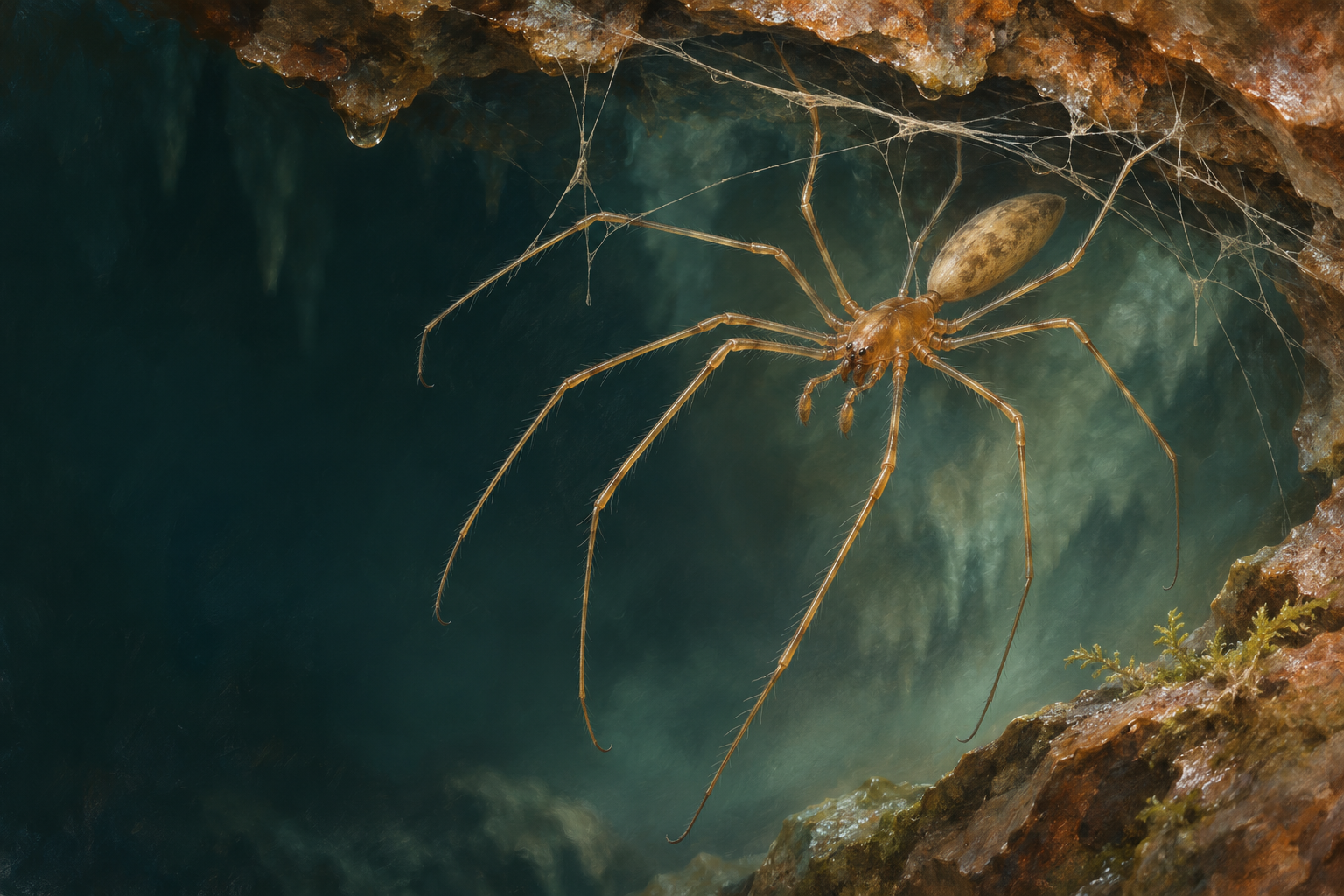
Hooks at the ends of the legs
Its most striking equipment is on its feet rather than in enormous jaws. The leg tips carry strong, conspicuously curved claws. Together with other anatomical characters, these helped researchers recognize a separate evolutionary lineage. A structure can be intriguing before its precise use has been observed: the claws alone do not reveal the hunting sequence.
More than a cave address
The original description connects caves in the northwestern United States with a collection from old-growth forest in California. Calling it exclusively subterranean would therefore be too restrictive. Moist forests and sheltered spaces offer several possible microhabitats in this region. Collection points show where animals were documented; they do not produce a complete map of occupancy.
Recognizing a family
In 2012 researchers described a new species and established the family Trogloraptoridae for it. Such decisions depend on comparisons of numerous structures and analyses of relationships. The animal did not, of course, originate when it received a name. What changed was scientific recognition: an existing lineage gained an identifiable place within spider classification.
Knowledge keeps moving
For years the name Trogloraptor was closely associated with this single species. The description of T. tulishpun in 2026 means the genus is no longer restricted to one known species. That change belongs in this portrait. An extraordinary discovery does not end the search; it supplies new characters and questions with which to examine later finds.
What do we know, and where are the limits?
The description and collection localities are documented; the hooks do not establish a known preferred prey. The genus now also includes T. tulishpun, described in 2026.
Sources & image credits
- World Spider Catalog — Trogloraptor marchingtoni ↗
- Griswold, Audisio & Ledford (2012) — An extraordinary new family of spiders ↗
- World Spider Catalog — Trogloraptor, including T. tulishpun (2026) ↗
Sources and classification checked on 3 November 2026. Scientific names and interpretations may change with new evidence.