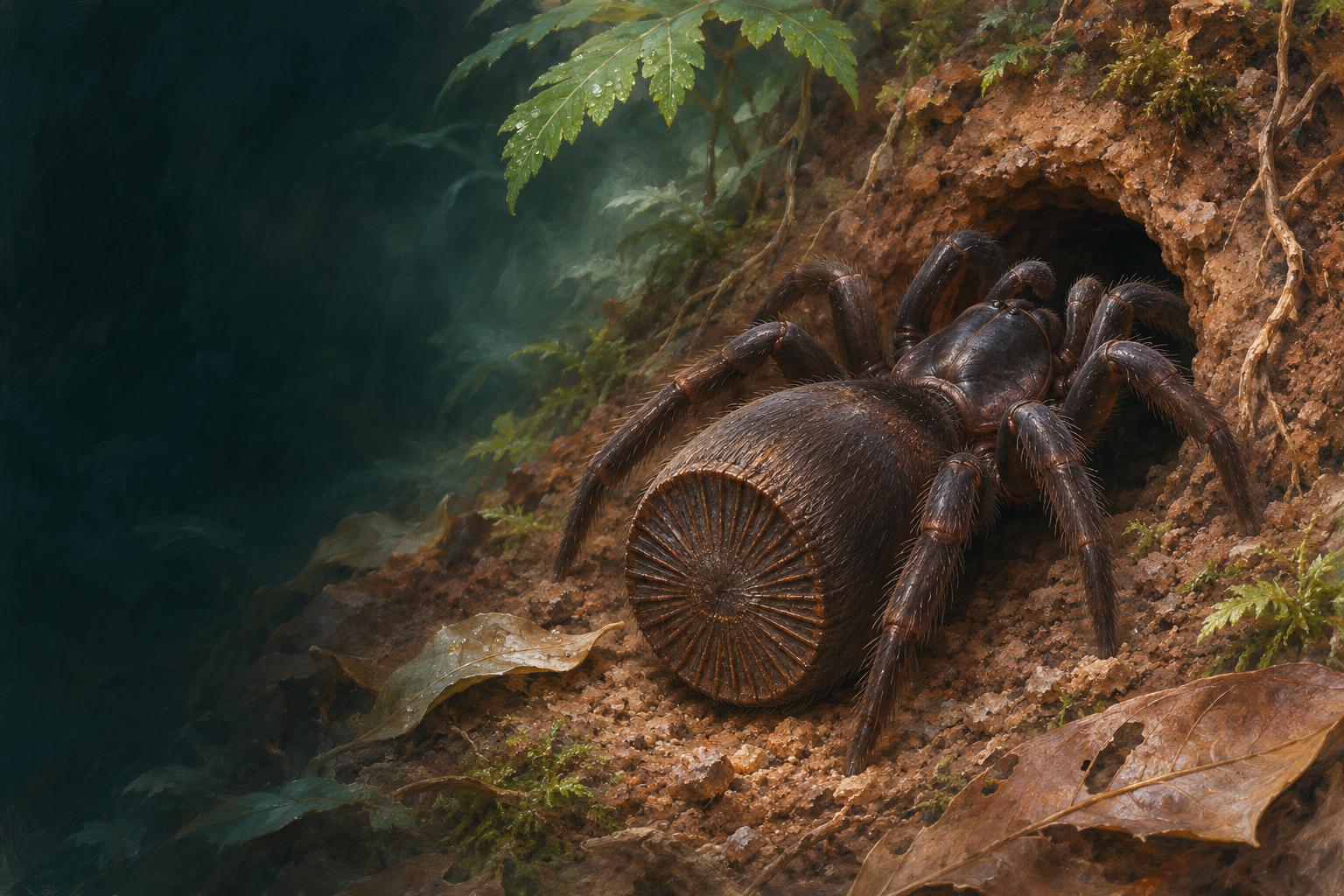
A disc, not a missing body part
The abdomen ends abruptly in a ribbed, hardened surface. It has not been cut off in an accident. The disc is normal anatomy and carries structures researchers use in comparisons. Seen closely, it can resemble an impressed seal. Its apparent markings are natural ribs and depressions rather than human carving, lettering or evidence of an archaeological object attached to an animal.
At the end of a narrow burrow
Cyclocosmia inhabits earthen burrows, and its abdominal disc is discussed in connection with blocking narrow passages. This genus-level context helps make functional sense of the shape. It does not justify inventing an elaborate mechanical trap. A protective body position and a capture device into which prey falls are very different ideas and should not be quietly treated as the same behaviour.
Males need descriptions too
Although the species was named in 1901, its first male description appeared only in 2022. This shows how uneven knowledge can be within a single species. The examined specimen expanded the anatomy available for comparison and aided later identification. It does not mean males had previously been absent, only that a secure scientific association and published description had been missing.
China without a rarity legend
Published records come from China. A concealed lifestyle and an incomplete collection history can easily inspire dramatic claims of extreme rarity. We do not repeat such numbers without a dependable survey. The documented anatomy and gradually completed description are remarkable enough. An otherwise modest new find can be scientifically valuable precisely because it answers a long-standing question about the other sex.
What do we know, and where are the limits?
Taxonomic studies document the disc and Chinese localities. The male description appeared in 2022. Burrow plugging is genus-level context; not every popular anecdote has been tested for this species.
Sources & image credits
- World Spider Catalog — Cyclocosmia ricketti ↗
- Lin et al. (2022) — First description of the male of Cyclocosmia ricketti ↗
- Xu et al. (2017) — Trapdoor spiders of Cyclocosmia from China and Vietnam ↗
Sources and classification checked on 3 November 2026. Scientific names and interpretations may change with new evidence.