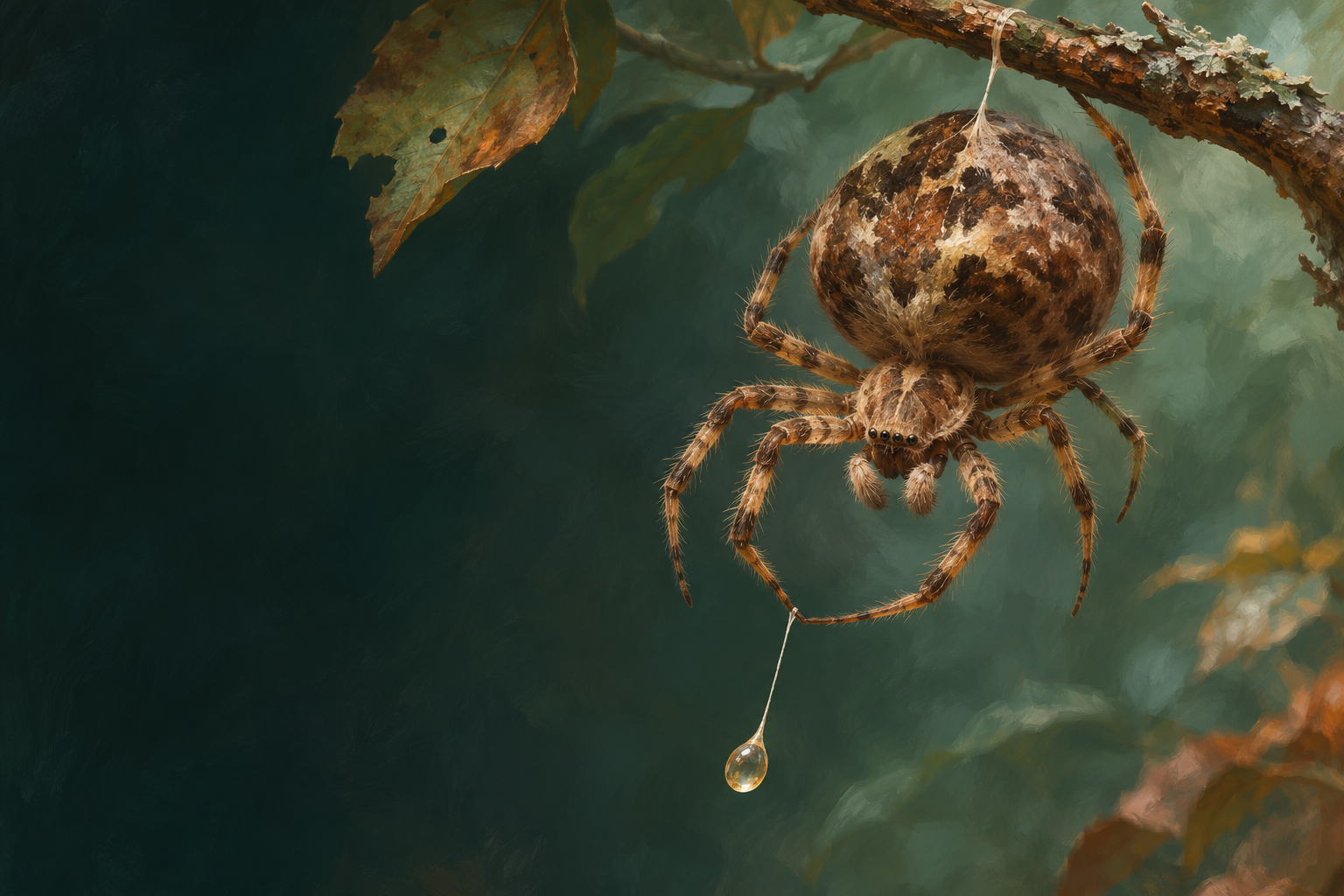
A droplet on a line
A hunting female can use a short silk line ending in a sticky ball. This device, called a bolas, is directed towards a nearby insect. It differs fundamentally from the standing web used by many orb weavers. The spider nevertheless belongs to Araneidae, a family containing strikingly different ways of deploying capture silk.
Scent as a false promise
Male moths locate potential mates partly through chemical signals. Analyses of Mastophora hutchinsoni detected matching components in emitted volatiles. The spider therefore exploits a communication channel used by its prey. This aggressive chemical mimicry is different from producing an unspecific smell that happens to draw the largest possible assortment of insects.
Scales create a material challenge
Moths bear scales that can detach readily. Such a surface presents a special challenge for an adhesive: retaining a few loose scales is not the same as retaining the prey. Research on the bolas droplet therefore examines its material properties. This hunting story connects chemical information with the physics of holding a moving, scaly animal.
Young spiders hunt differently
A field study in Kentucky described development as well as adult females. Small spiderlings were observed ambushing prey beneath leaves. A portrait with a bolas thus depicts a particular phase of life. The catalogue records the species in Canada and the USA; one impressive hunting method does not summarise its entire biology.
What do we know, and where are the limits?
Field studies, emitted-volatile analyses and material research complement one another. Bolas hunting chiefly describes later female stages; juveniles and males must not simply be assigned the same equipment.
Sources & image credits
- World Spider Catalog · Mastophora hutchinsoni ↗
- Yeargan (1988) · Ecology of a bolas spider ↗
- Gemeno, Yeargan & Haynes (2000) · Aggressive chemical mimicry ↗
- Bolas-spider adhesive and moth capture ↗
Sources and classification checked on 3 November 2026. Scientific names and interpretations may change with new evidence.