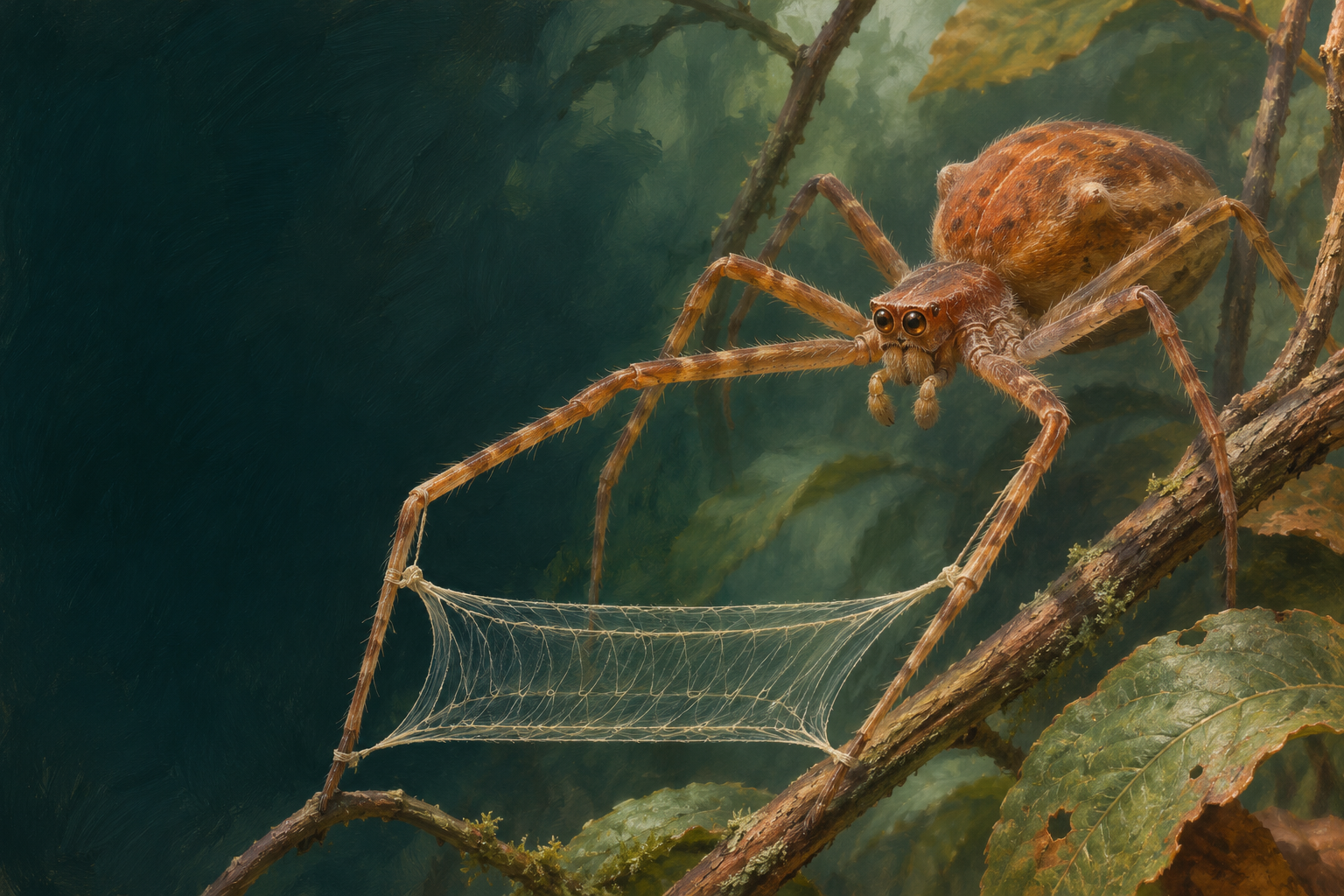
A night-time cast
Asianopis subrufa holds a small capture net ready and stretches it over a passing animal during a strike. The silk acts as a moving capture surface. Unlike a fixed orb web, success depends directly on the spider’s own movement. The contrast between still waiting and a rapid cast is central to this hunting scene.
Another kind of capture silk
The net contains finely hackled cribellate silk. Retaining prey therefore does not simply require a large visible glue droplet. Comparing spider webs reveals different material solutions. A small rectangle can be an effective capture device without looking like the familiar sticky spiral of an orb, and its properties depend on the structure of the silk itself.
Inconspicuous by day
The Australian Museum describes salmon-brown females with low lateral abdominal humps. Quiet daytime posture among twigs helps them remain inconspicuous. The species is described from open woodland and gardens. A dramatic night portrait therefore presents only one part of a life that also includes long periods of remaining still within ordinary vegetation.
The name has a history
Older sources list the species as Deinopis subrufa. A revision placed it in Asianopis, so the older combination does not automatically denote another species. Such changes reflect updated interpretations of relationships. This portrait connects the accepted name with species-specific museum information while keeping experimental findings about other net casters distinct.
What do we know, and where are the limits?
The Australian Museum describes this species’ natural history. Transfer from Deinopis to Asianopis follows taxonomic research; hearing experiments on Deinopis spinosa do not establish hearing in this species.
Sources & image credits
- World Spider Catalog · Asianopis subrufa ↗
- Australian Museum · Rufous Net-casting Spider ↗
- Biogeography and eye size evolution of the ogre-faced spiders (2022) ↗
Sources and classification checked on 3 November 2026. Scientific names and interpretations may change with new evidence.