Hunting other hunters
Other spiders form part of Portia fimbriata’s prey. Such encounters involve an opponent that may also see, escape or fight back. Researchers studying Queensland animals have investigated an especially inconspicuous approach to other jumping spiders. The kind of animal in front of the predator influences how that hunt unfolds.
Freezing when watched
During the studied cryptic stalk, Portia moves very slowly and retracts its palps. When the other jumping spider turns to face it, it freezes. Researchers used artificial prey images to test which eye features elicit these responses. An impressive scene thus becomes a testable question about the information used for visual recognition.
Silk carries information
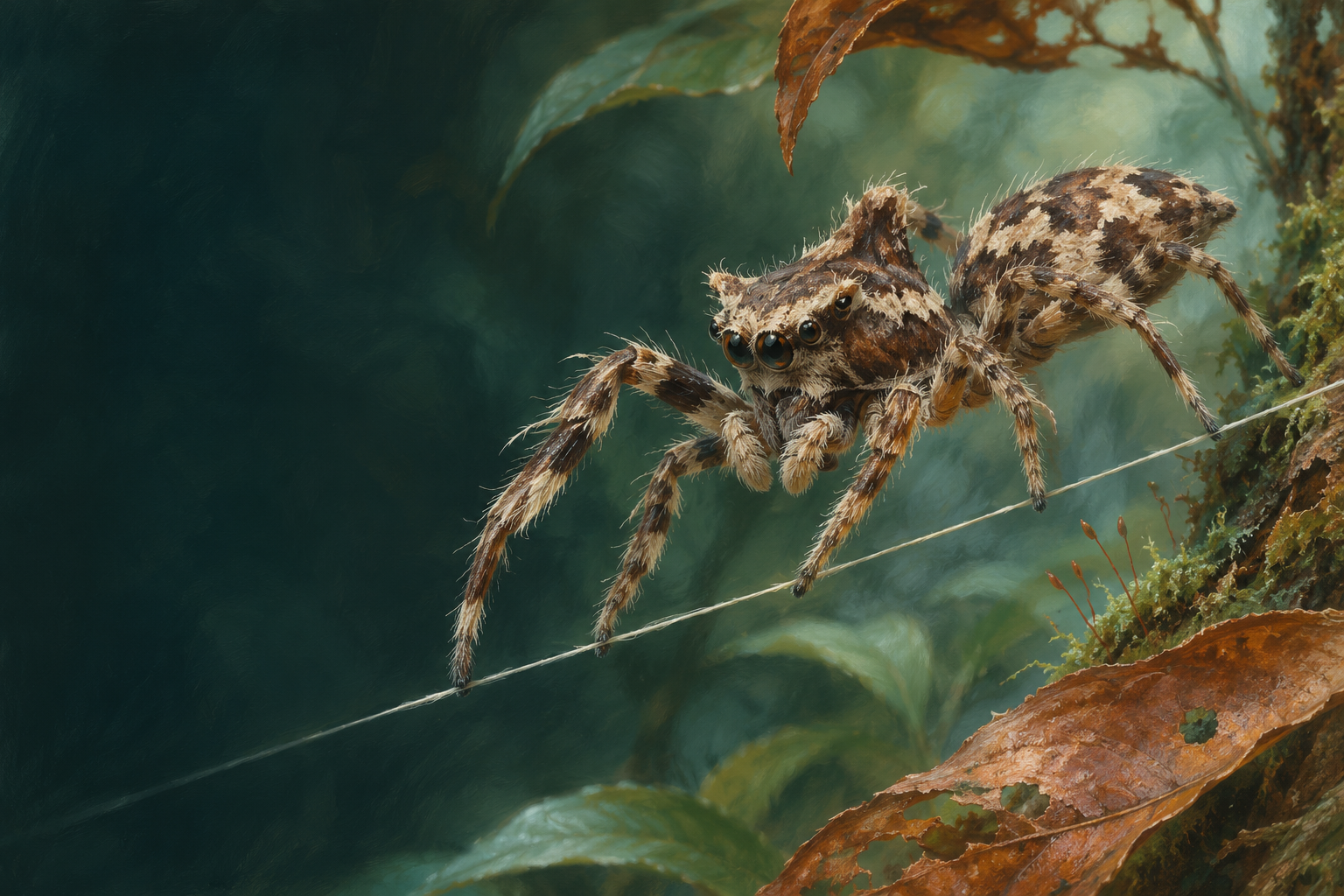
Portia can also enter another spider’s web and produce vibrations through its movements. For a web resident, such signals are an important part of the surrounding world. Hunting on silk therefore involves more than avoiding sticky threads: it means entering an information network already used by another animal to detect events around it.
No single universal strategy
The species name covers populations across a broad Asian–Australian region. It does not guarantee identical behavioural details everywhere. That distinction is part of the interest: evolution takes place in particular habitats with particular prey communities. Research describes flexible and locally distinctive tactics, rather than demonstrating human thought reproduced inside a miniature hunter.
What do we know, and where are the limits?
Queensland animals are particularly well studied. Their specialised stalking tactic must not be attributed to every population or every Portia species.
Sources & image credits
- World Spider Catalog · Portia fimbriata ↗
- Harland & Jackson (2001) · Species eliciting cryptic stalking ↗
- Harland & Jackson (2002) · Virtual prey eye cues ↗
- Web use during predatory encounters between Portia fimbriata and its prey (2000) ↗
- Australian Museum · Fringed Jumping Spider ↗
Sources and classification checked on 3 November 2026. Scientific names and interpretations may change with new evidence.