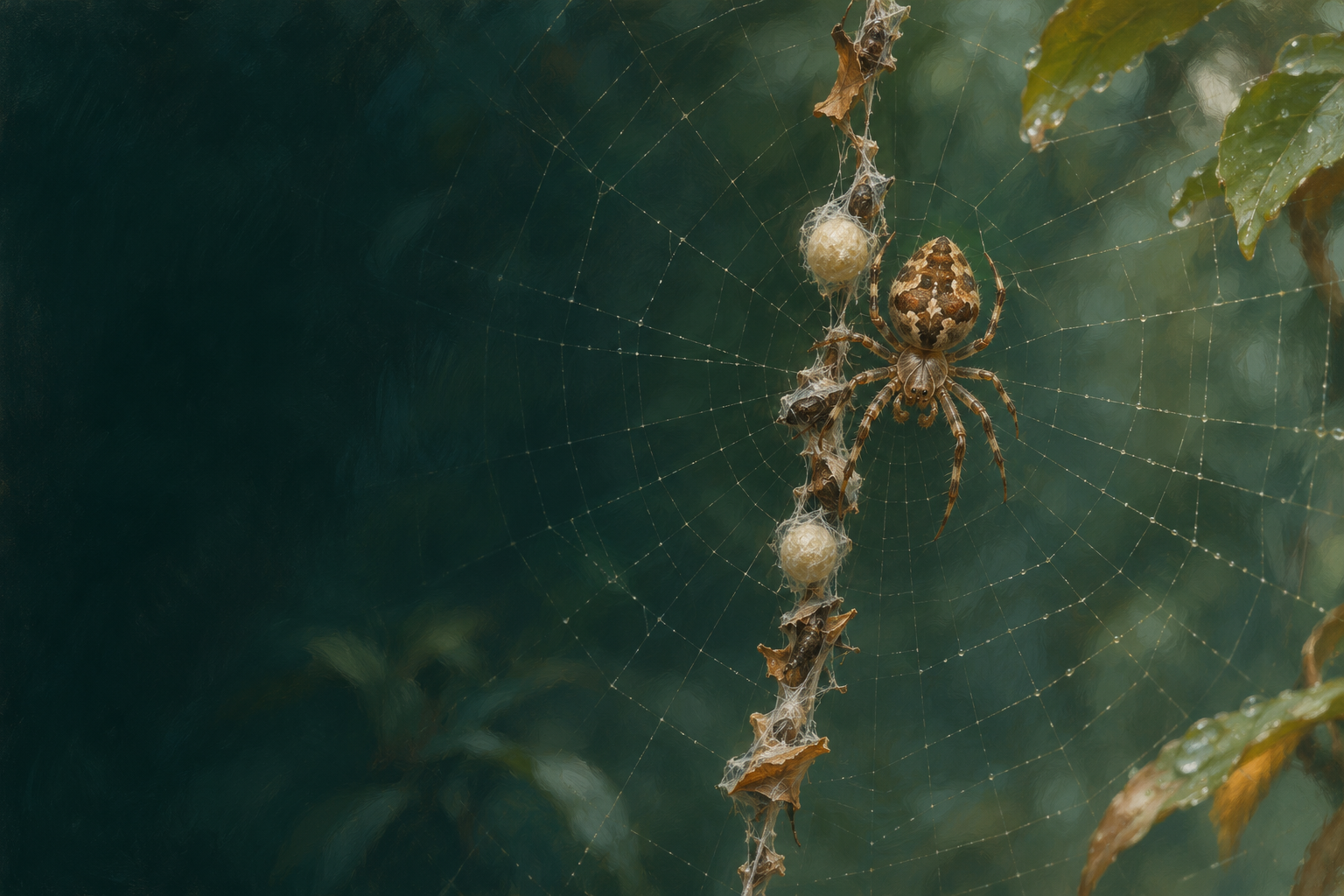
Remains become part of the web
The spider can arrange prey remains and egg sacs in a line within the web. Resting among them, its outline merges with the material. The web is therefore more than a transparent capture device: its centre contains a pattern that can influence what other animals recognise and which part of the structure draws their response.
Concealment or attraction?
One investigation compared alternative explanations for the conspicuous decoration. Not every structure in a web automatically acts as a lure. Under the conditions studied, the results supported concealment from insects. Testing this requires considering the spider and decoration together, rather than merely describing how much more visible the web has become to an observer.
An attack can hit the wrong target
Another study examined diversion of predators. Material resembling the spider in size and appearance can redirect attacks towards other points. Visibility and safety are not equivalent: decoration may attract attention while also shifting the strike away from the animal. Which effect dominates depends on the encounter, the receiver and the arrangement of the web.
Show the right Cyclosa
The genus includes many species with different decorations. This portrait therefore shows a small spider in a line of debris, rather than a giant constructed spider sculpture. Its Asian distribution is supported by taxonomic records. The selection highlights a distinctive, testable relationship between an animal’s body, its construction and the perception of other animals.
What do we know, and where are the limits?
Studies test different functions of web decoration in particular predator and prey situations. The giant spider-shaped constructions reported for other Cyclosa species do not belong in this portrait.
Sources & image credits
- World Spider Catalog · Cyclosa mulmeinensis ↗
- Tan & Li (2009) · Detritus decorations and concealment ↗
- Tseng & Tso (2009) · A risky defence using decoys ↗
- Raffles Bulletin of Zoology · Cyclosa from Singapore and Malaysia ↗
Sources and classification checked on 3 November 2026. Scientific names and interpretations may change with new evidence.