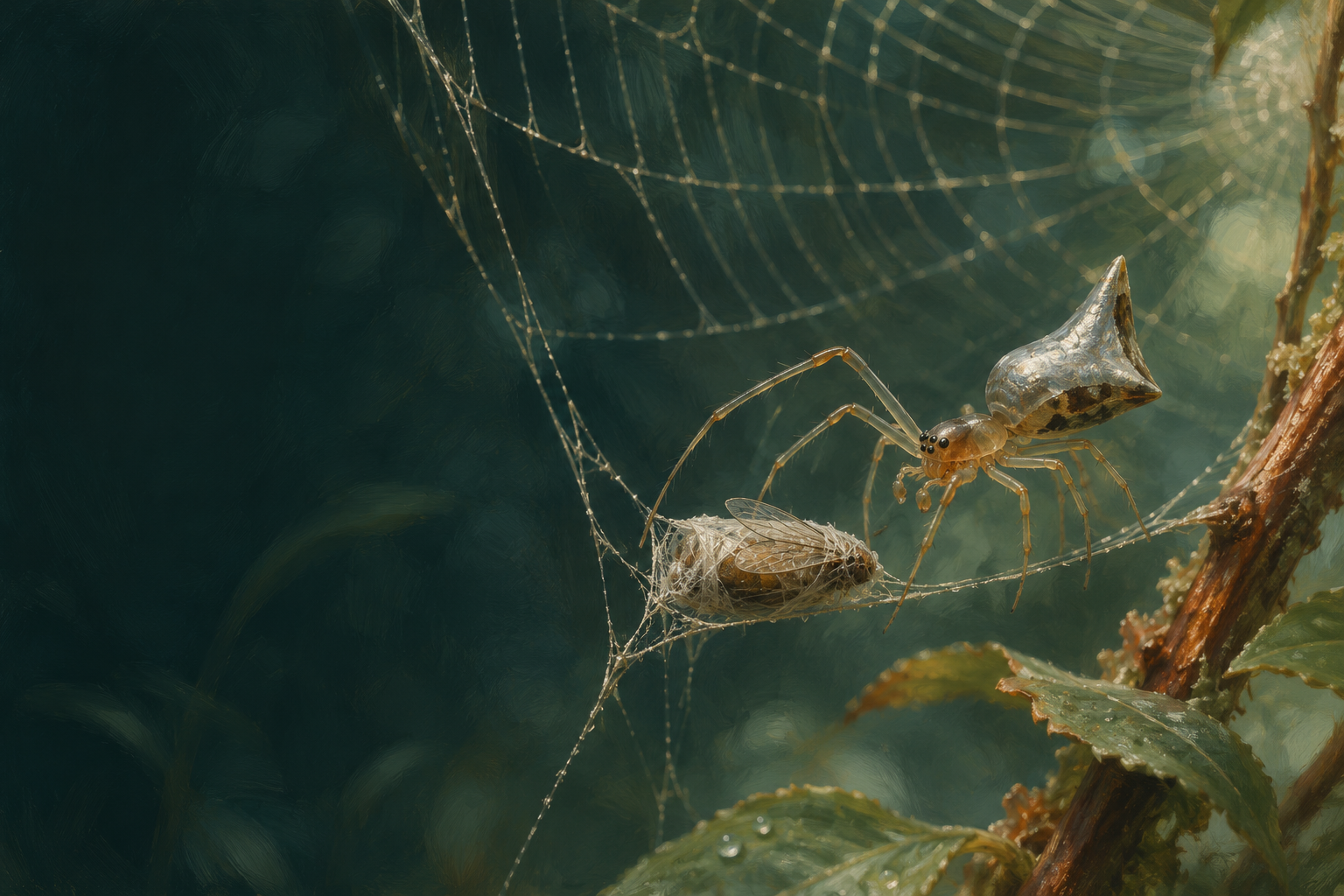
One web, several interests
Argyrodes elevatus inhabits other spiders’ capture webs. These provide access to insects without its having to construct a comparable orb of its own. The owner may lose food or be interrupted while feeding. Kleptoparasitism names this relationship: one animal benefits from food that another has already obtained through its own hunting effort.
Opportunity is part of theft
Observations describe approaches to already captured prey and different timings of raids. The web owner’s activity affects when opportunities arise. A seemingly quiet web is therefore not a static setting. Hunting, feeding and movements of several animals continually change which routes and food resources are accessible to the small resident sharing the threads.
More than one food resource
Research distinguishes stolen insects, egg sacs and spiders as potential resources available to these web inhabitants. In one study, A. elevatus preferred prey captured by its host over egg sacs. That finding is useful because it reveals alternatives. It does not mean every individual makes the same choice across all hosts, habitats and feeding conditions.
A broad range, an unusual perspective
Its known range extends from the United States to Argentina and includes the Galápagos Islands. That breadth does not imply identical conditions everywhere. This portrait invites a different view of a spider web: a habitat with competing interests. A spider on another animal’s threads is not necessarily prey, a potential mate or an accidental visitor.
What do we know, and where are the limits?
Prey theft and alternative feeding tactics have been studied in this species. Preferences from particular experiments are not an immutable menu for every population.
Sources & image credits
- World Spider Catalog · Argyrodes elevatus ↗
- Vollrath (1979) · Behaviour of the kleptoparasitic spider Argyrodes elevatus ↗
- Meira, Moura & Gonzaga (2021) · Araneophagy as an alternative foraging tactic to kleptoparasitism ↗
- Revista de Etologia (2012) · Notes on the behavior of the kleptoparasitic spider Argyrodes elevatus ↗
Sources and classification checked on 3 November 2026. Scientific names and interpretations may change with new evidence.