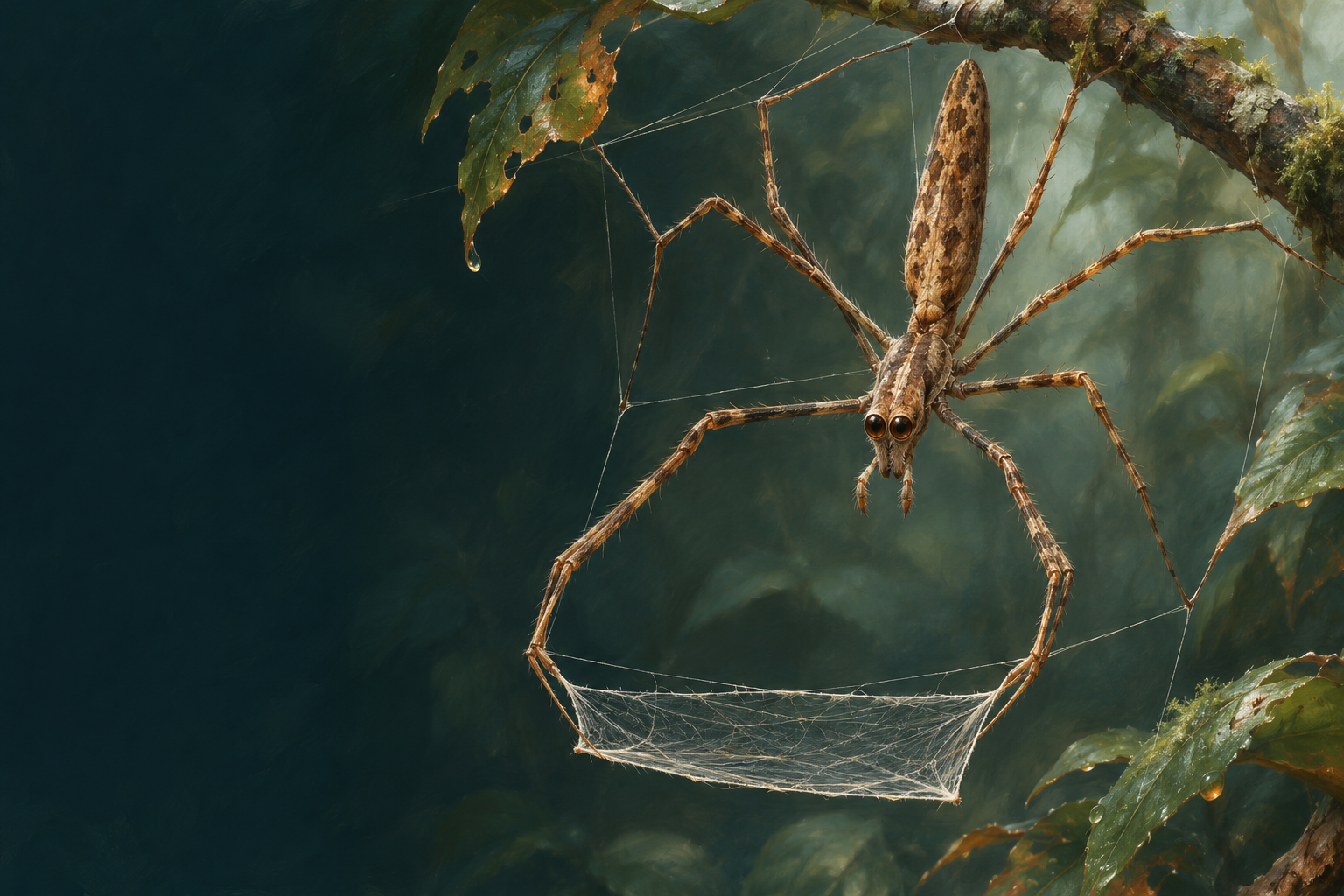
A net between the legs
The spider holds a small rectangle of silk between its legs in front of its body. During a strike it stretches this capture device over the prey. This is not a large orb in whose centre the spider waits for contact. The arrangement resembles a carried tool, though it is made from the spider’s own silk.
Two eyes stand out
Two especially large eyes stand out among the eight. These enlarged posterior median eyes are an important feature of the familiar wide-eyed net casters. Their size makes the face striking, but it does not tell the whole hunting story. An animal can use several sensory routes according to where potential prey happens to move.
Sound through the air
Researchers recorded neural responses and behaviour during sound playback. Certain acoustic stimuli could elicit backward capture strikes, offering a route to detecting prey that is not walking directly in front of the large eyes. Sound-sensitive structures associated with the legs provide a different solution from a human ear and its eardrum.
Separate measurement from explanation
A neural response does not automatically produce the same visible action at every frequency. The study therefore distinguishes sensory detection, capture responses and possible additional functions. The catalogue records the species from the USA and Caribbean islands to Venezuela. This portrait does not transfer its experimental results uncritically to all other net-casting spiders.
What do we know, and where are the limits?
Experiments on Deinopis spinosa demonstrate responses to airborne sound and associated capture movements. These do not imply vertebrate-like ears; functions proposed for high frequencies remain partly interpretive.
Sources & image credits
- World Spider Catalog · Deinopis spinosa ↗
- Stafstrom et al. (2020) · Ogre-faced net-casting spiders use auditory cues to detect airborne prey ↗
- Coddington, Kuntner & Opell (2012) · Systematics of Deinopidae ↗
- University of Nebraska · Wide-eyed spider relies on sound for airborne ambushes ↗
Sources and classification checked on 3 November 2026. Scientific names and interpretations may change with new evidence.