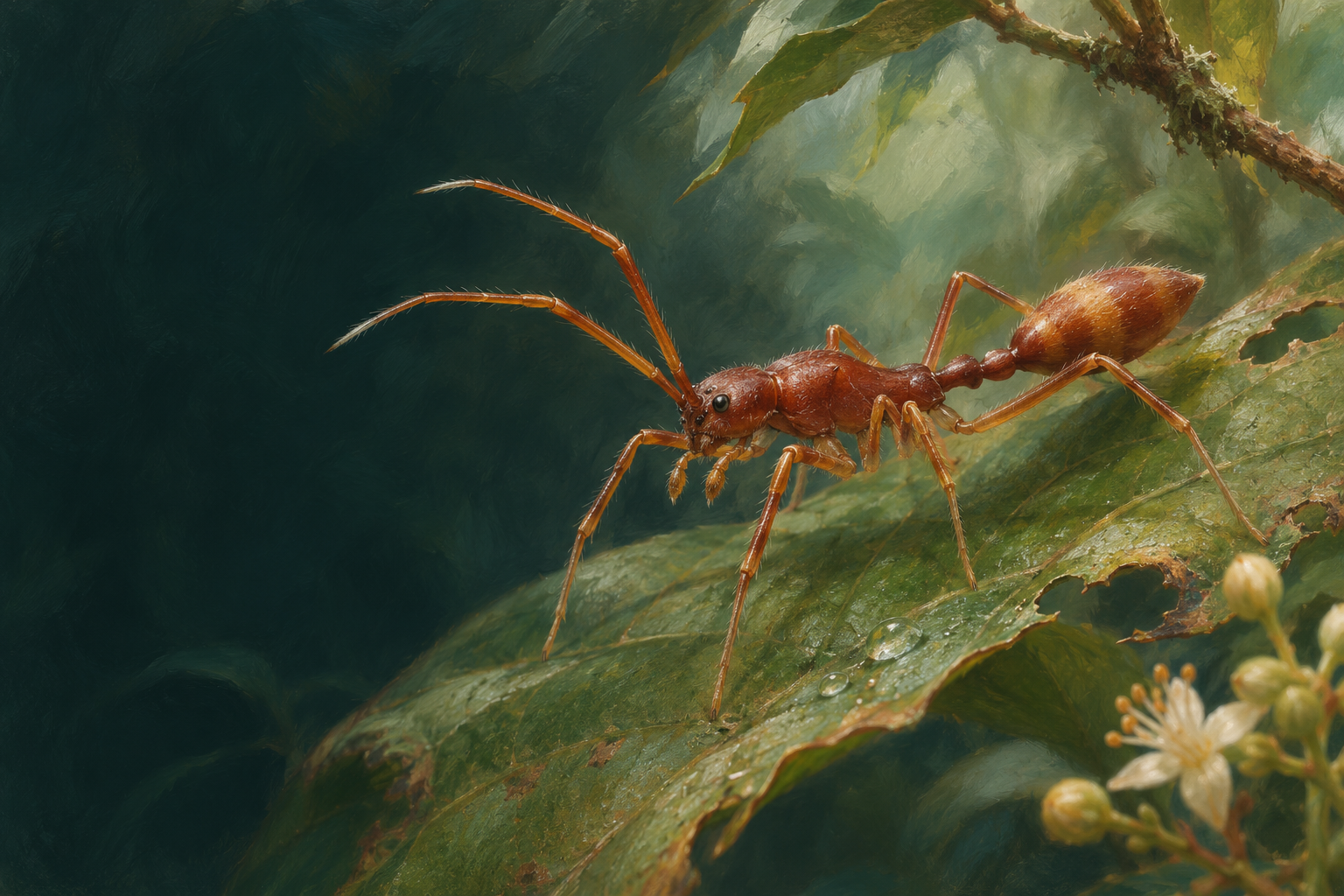
Eight legs in an ant disguise
The narrow, constricted body recalls an ant, but remains a spider’s body. The front pair of legs can strengthen the impression of antennae. A still photograph captures only part of the effect: posture and movement work together in shaping how another animal perceives and classifies the form moving in front of it.
A particular model
Its resemblance to the weaver ant Oecophylla smaragdina has been examined scientifically. Such work measures features and movements instead of relying entirely on human impressions of similarity. The model ant has substantial defences of its own. An ant-like outline can therefore mean something different to a predator than the outline of an ordinary jumping spider.
A disguise with limits
The mimicked ant does not automatically become an ally. Observations document weaver ants preying on these spiders. The portrait is therefore an ecological balancing act rather than a story of friendship. Reduced risk from one kind of enemy can coexist with other dangers, and a similar appearance does not imply an identical way of life.
Shape changes possibilities
An ant-like body also changes the physical circumstances of a jumping hunter. Research on ant-mimicking spiders therefore asks how form relates to movement and predation. The catalogue records this species across parts of South and Southeast Asia. Its inclusion here reflects a distinctive adaptation, rather than a claim that it is globally rare.
What do we know, and where are the limits?
Body form and movement have been compared with weaver ants. Mimicry is not complete protection; ants can themselves become predators.
Sources & image credits
- World Spider Catalog · Myrmaplata plataleoides ↗
- An arachnid’s guide to being an ant (2023) ↗
- Ant mimicry and locomotor constraints ↗
- Peckhamia 174.1 · Weaver-ant predation on an ant-mimicking spider ↗
Sources and classification checked on 3 November 2026. Scientific names and interpretations may change with new evidence.