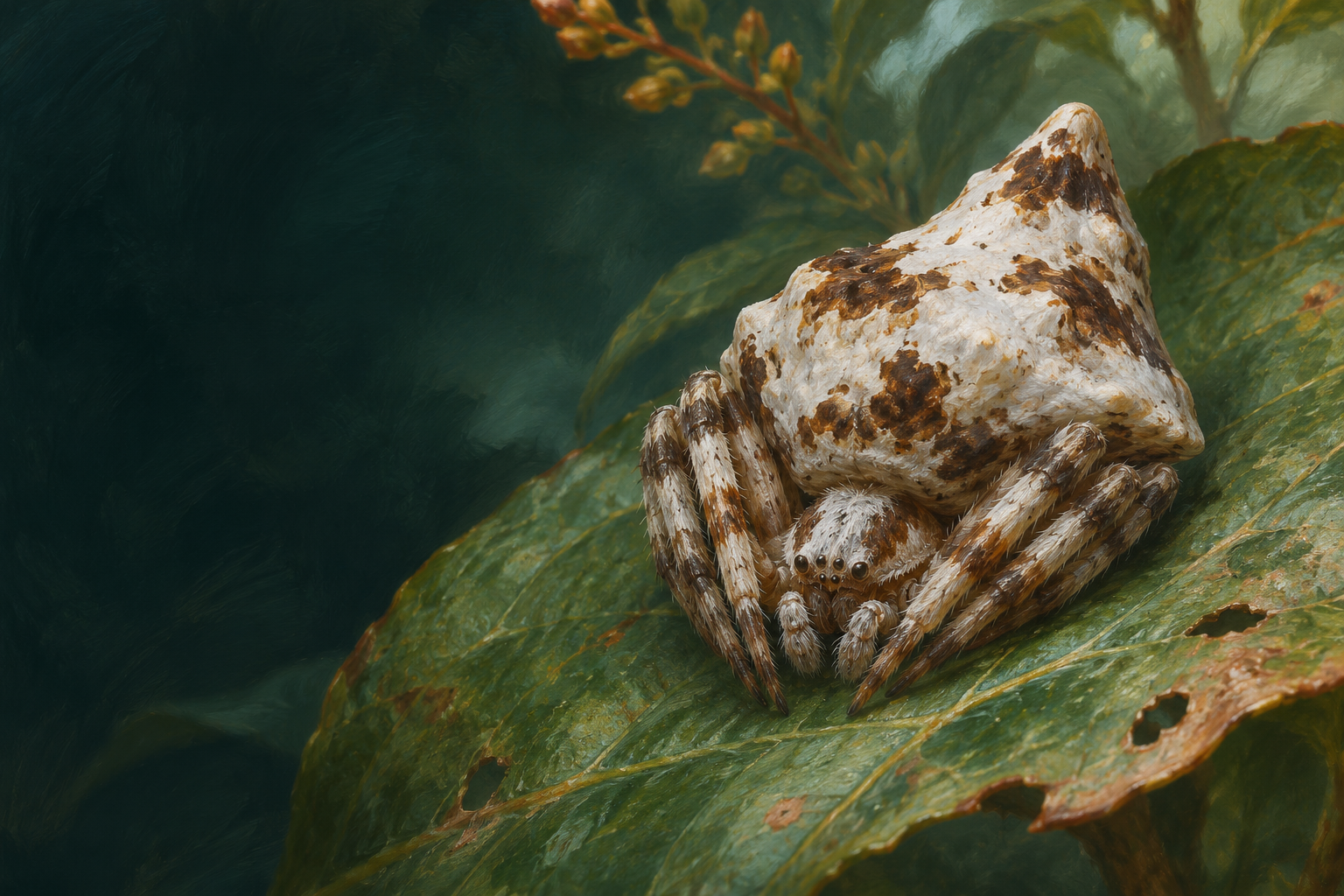
A blotch with legs
The broad, irregular female has cream and dark patches. Closely folded legs strengthen the impression of an unappetising dropping. Its appearance differs sharply from the symmetrical spider silhouette we expect. Overlooking it on a leaf also illustrates why human attention is not a reliable measure of how readily small animals will be recognised by other observers.
Forelegs open after dark
Its quiet daytime shape does not reveal the whole hunting sequence. At night it waits for moths with its front legs extended. A large orb is not its capture tool. Nor does this hunting method use the swinging sticky ball of bolas spiders. A similar focus on prey therefore does not mean that the two groups share the same capture technique.
Scent reaches flying prey
Museum accounts describe the attraction of male moths through a pheromone-like scent. Capture therefore begins before physical contact. The spider exploits a sensory world important to a searching moth. A photograph cannot display that chemical component directly, so explaining it alongside the image is more informative than adding visible imaginary scent trails.
Egg sacs belong to the retreat
Egg sacs and the motionless female can together form a distinctive little assemblage. The species is catalogued for Australia and New Zealand. Its place in the library rests on the unusual combination of appearance and hunting. An inconspicuous daytime position, or a photographer’s infrequent sighting, does not automatically establish a rare global population.
What do we know, and where are the limits?
Australian museums document appearance, egg sacs and moth hunting. These accounts do not establish experimentally measured protection from every predator through the dropping-like resemblance.
Sources & image credits
- World Spider Catalog · Celaenia excavata ↗
- Australian Museum · Bird-dropping Spider ↗
- Museums Victoria · Celaenia excavata ↗
Sources and classification checked on 3 November 2026. Scientific names and interpretations may change with new evidence.