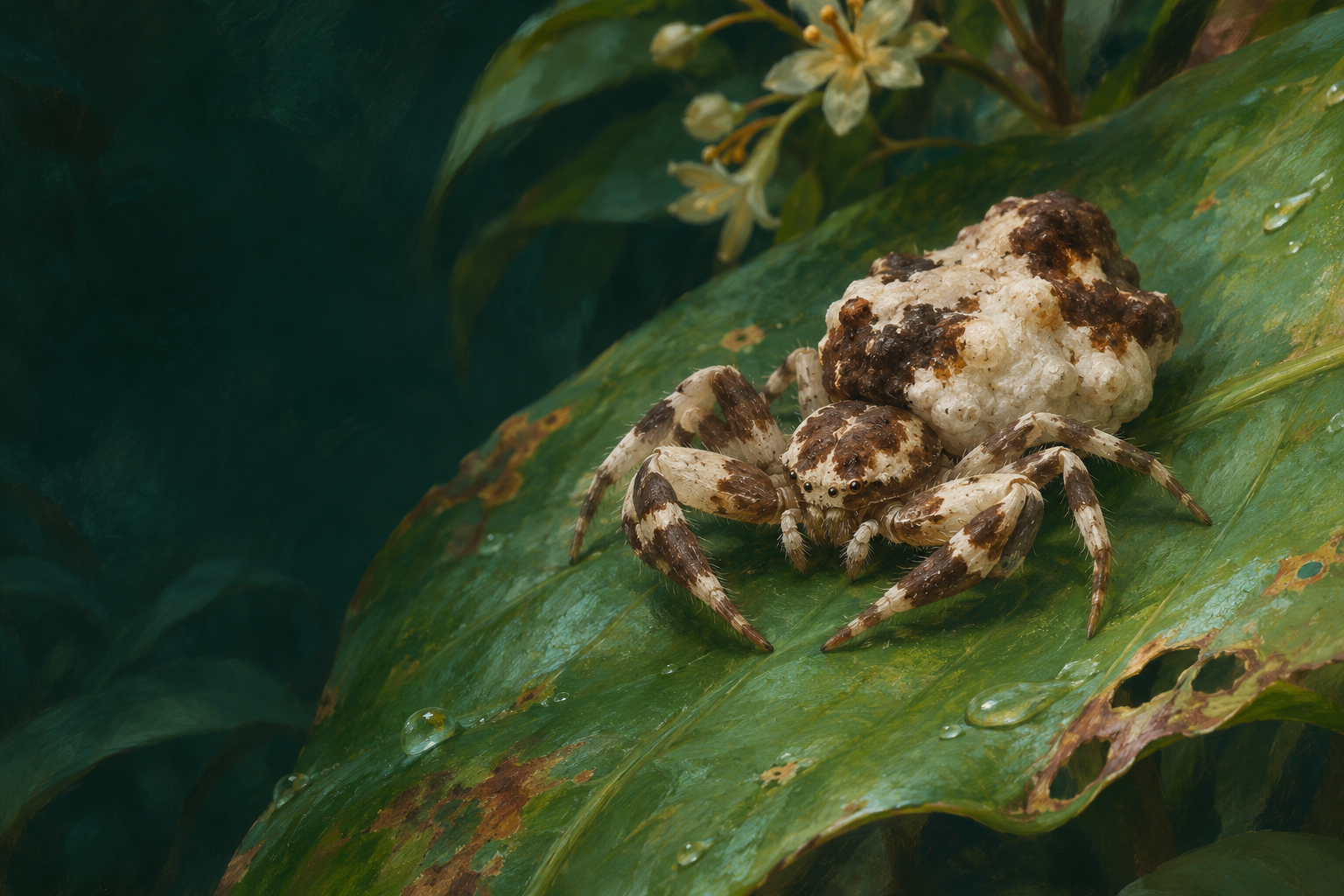
An unappetizing resemblance
On a leaf the adult resembles an irregular pale-and-dark lump. Its sturdy front legs are held close to the body, reinforcing the compact outline. What makes a human look away can mean something different to another animal. Some insects visit bird droppings as a resource, so a mistaken approach can bring them within reach of a predator.
Testing the deception
Researchers compared responses to spiders, bird droppings and additional experimental conditions, including changes to visible appearance. This tests more than resemblance in a photograph. The results support a role for masquerade in attracting prey. The spider need not plan as a human would: evolution can produce effective signals without requiring a conscious intention to deceive each approaching insect.
A different appearance with age
A further study investigated colour changes during development. Small juveniles and larger females are not simply differently sized copies of the same form. As the animal grows, the defensive effect can shift from inconspicuous coloration toward stronger resemblance to bird droppings. Life history therefore becomes part of the disguise: body size and appearance need to be considered together.
A predator without a capture web
Like other crab spiders, it captures prey by direct contact rather than in a large orb web. A small position on a leaf can nevertheless be a complex hunting site. Posture, surface appearance and visitors’ responses interact. A single label such as camouflage therefore cannot fully explain the relationship between protection from enemies and encounters with potential prey.
What do we know, and where are the limits?
Species-specific studies examined prey responses and age-related coloration. Results concern the tested situations; not every insect is deceived in the same way.
Sources & image credits
- World Spider Catalog — Phrynarachne ceylonica ↗
- Taxonomic notes on Phrynarachne from China (2022) ↗
- Masquerading predators deceive prey by aggressively mimicking bird droppings (2022) ↗
- From crypsis to masquerade: ontogeny changes colour defences (2022) ↗
Sources and classification checked on 3 November 2026. Scientific names and interpretations may change with new evidence.