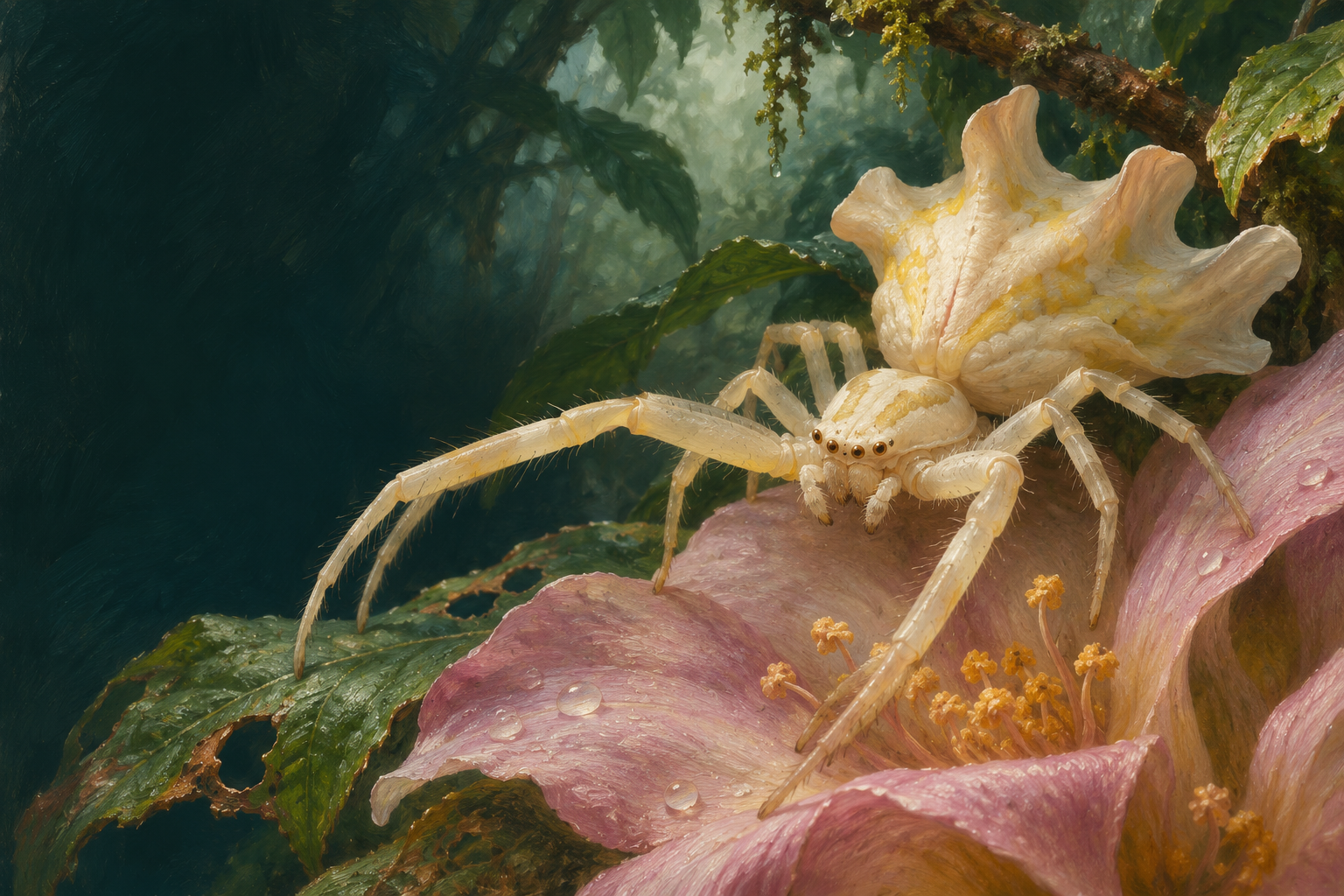
Lobes rather than petals
The elevated abdomen bears conspicuous lobes. Combined with pale coloration, they can suggest parts of a flower. Nevertheless this is entirely a spider’s body; no plant grows from its back. The strong front legs remain ready to seize prey. The combination of an apparently soft floral shape and a precise capture apparatus makes the animal especially striking.
Adults do not always need flowers
The studied way of life differs with developmental stage. Juveniles are often associated with flowers, while adults can hunt on leaves. This creates a revealing question: can the spider itself provide a signal that attracts visitors? The background then becomes more than scenery; it is a crucial variable for investigating the effect of the animal’s own appearance.
Experimenting with ultraviolet light
An experiment changed the spider’s ultraviolet reflectance and compared it with control conditions. This recognizes that insects inhabit visual worlds different from ours. A surface appearing whitish to a person can carry different information for a pollinator. The results support attraction while also showing why an ordinary colour photograph cannot fully reproduce the signals relevant to such an encounter.
Keeping the richer question open
It looks like a flower is a useful starting point, not a complete explanation. Precise flower mimicry and exploitation of broader visual preferences are different possibilities, a distinction discussed in the study. This portrait keeps that question visible: the species illustrates how researchers separate resemblance as humans perceive it from the actual behavioural response of a potential prey animal.
What do we know, and where are the limits?
A species-specific experiment manipulated UV reflectance and supports prey attraction. Exact flower mimicry versus broader sensory preferences remains a question requiring careful distinction.
Sources & image credits
- World Spider Catalog — Epicadus heterogaster ↗
- Crab Spider Lures Prey In Flowerless Neighborhoods (2017), Scientific Reports ↗
Sources and classification checked on 3 November 2026. Scientific names and interpretations may change with new evidence.