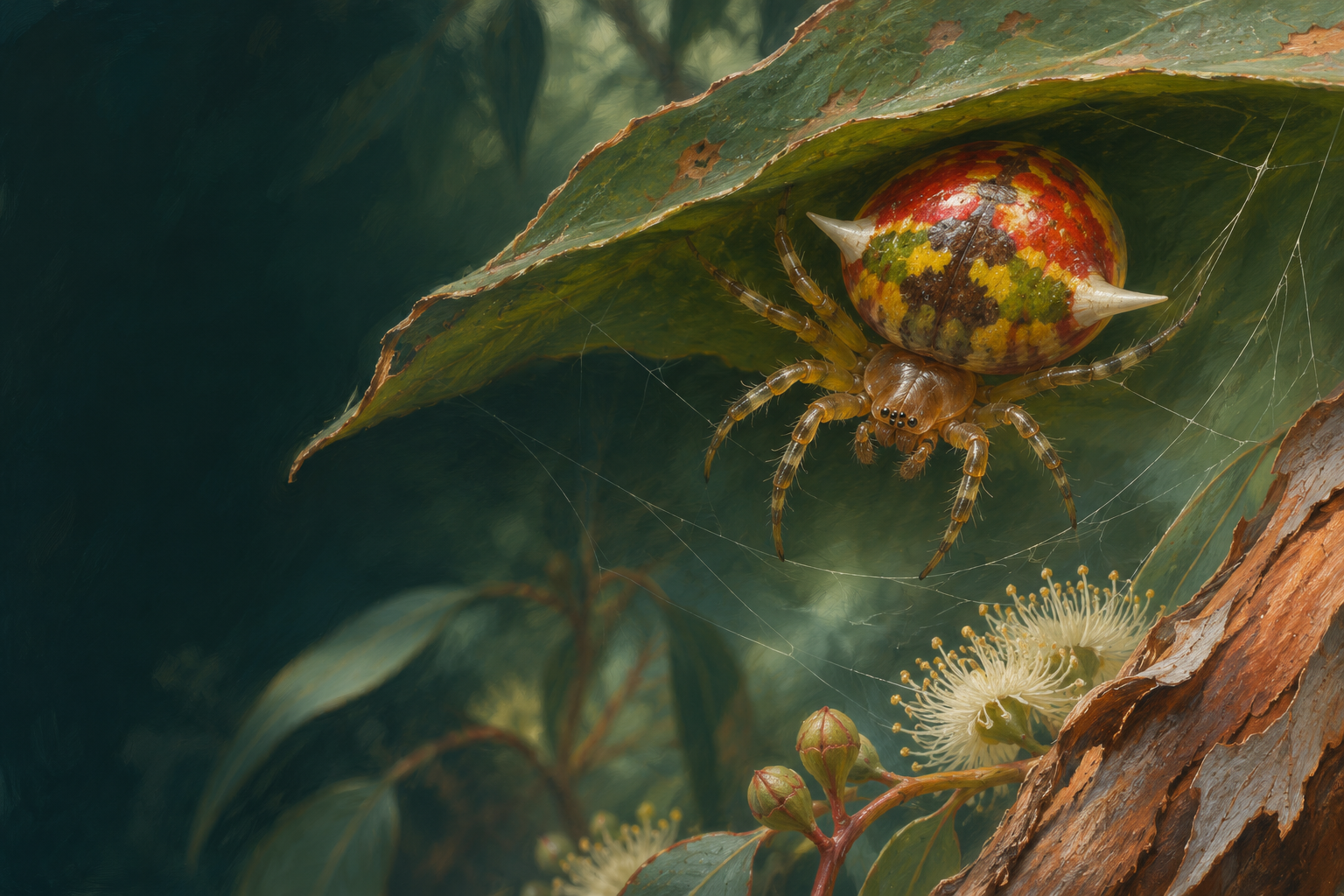
Two pale points
A rounded abdomen with strong colours and two pale lateral points makes the female conspicuous. Red, yellow, green and dark markings can occur close together. The effect belongs to the body of a small spider rather than a separate shell placed over it. Look again for the less conspicuous legs beneath the colourful abdomen to recover the whole animal.
Resting beneath leaves
By day the spider shelters beneath leaves. Viewed from above, such a resting place can hide its striking dorsal pattern completely. Conspicuousness and concealment are therefore not fixed opposites that apply to the whole animal at every hour. Viewing direction, position and activity all help determine how readily another organism could detect the spider in the first place.
A night shift in silk
The Australian Museum describes an approximately horizontal orb web built at night and taken down in the morning, with silk consumed again. The web is therefore part of a schedule rather than a permanent, unchanged furnishing. Someone looking only for a large visible web in daylight could easily overlook a spider that actively uses the very same vegetation after dark.
An Australian starting point
The species is recorded from Australia and the Pacific region, with introduced occurrences also documented. Its Oceanian origin guides the regional label used here. A point on a map can tell different stories: original distribution, transport by people, or a previously overlooked population. Distinguishing these possibilities matters more than treating every distant record as an identical kind of occurrence.
What do we know, and where are the limits?
The Australian Museum documents appearance and nocturnal webs. The colourful two-spined form particularly represents adult females; it is not a photographic identification key for every sex and stage.
Sources & image credits
- World Spider Catalog — Poecilopachys australasia ↗
- Australian Museum — Two-spined Spider ↗
- Australasian Arachnological Society — Poecilopachys australasia ↗
Sources and classification checked on 3 November 2026. Scientific names and interpretations may change with new evidence.