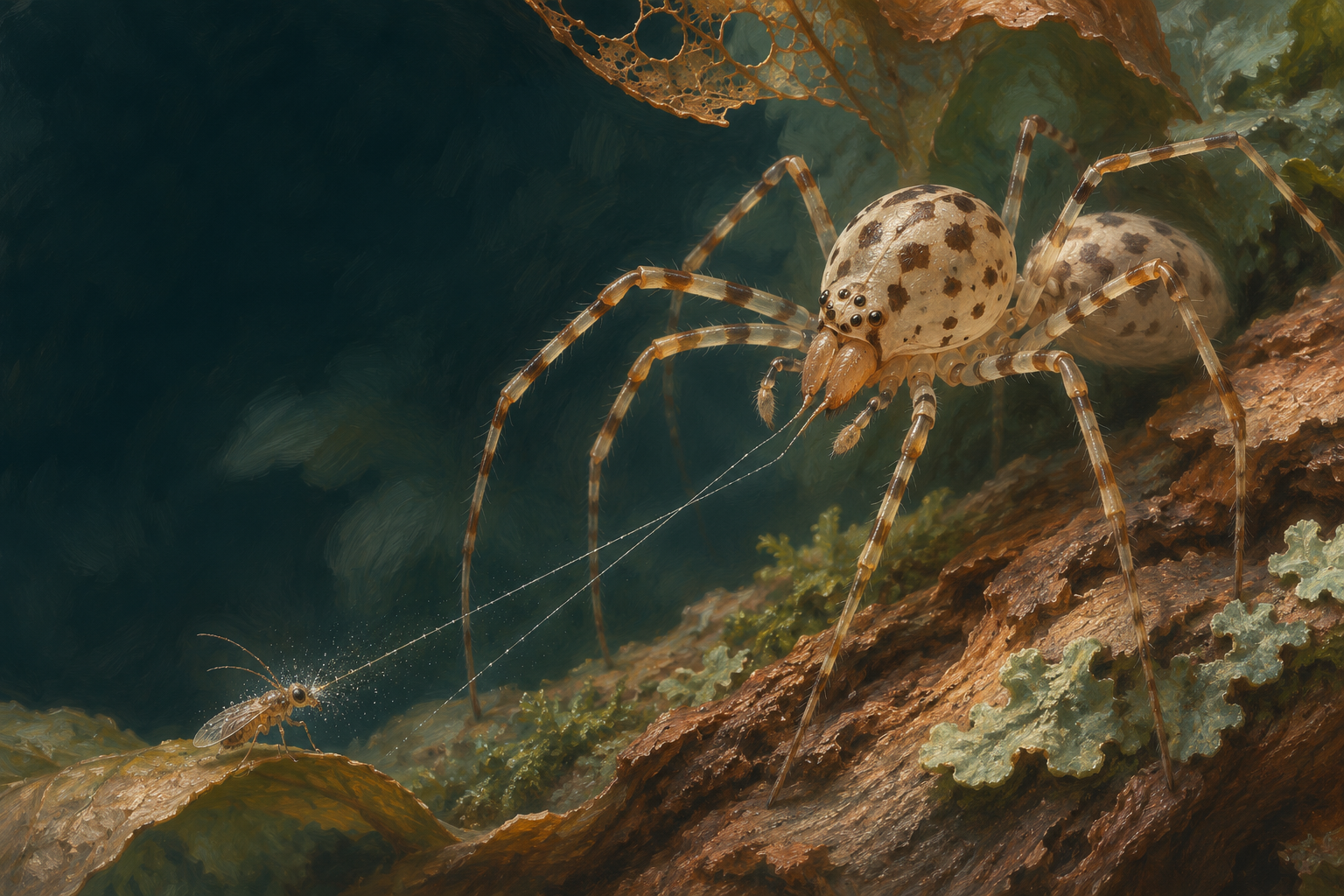
A domed front body
A high, domed front body and thin banded legs give Scytodes thoracica its characteristic appearance. Six eyes form part of its body plan. That prominent shape is more than decoration: it houses a specialised gland system involved in its unusual capture method. This spider offers a particularly clear invitation to consider anatomy and function together.
Capture material from the chelicerae
The spider projects a mixture containing sticky and threadlike components from openings at its chelicerae. It spreads over small prey and can fasten them to the substrate. This differs from a capture web produced at the rear spinnerets. Similar tasks can therefore be solved using tools located in very different parts of a spider’s body.
Movement draws the capture pattern
High-speed recordings reveal how movements of the chelicerae and fangs structure the ejection. Material is not simply released as a disorganised drop. Movement distributes it across an area, and projected threads subsequently contract. Holding prey therefore depends both on what the material is made from and on how the spider places it onto a target.
An encounter on a small scale
The species originates in the Old World and has been introduced elsewhere. It can also occur inside buildings. Its portrait needs no exaggerated threat scene: the interest is a small predator’s precision against small prey. A scientific view separates a fascinating capture technique from the unsupported idea that every unusual venom or adhesive system must threaten people.
What do we know, and where are the limits?
High-speed recordings studied ejection directly in S. thoracica. Spitting describes the function; the material does not emerge from a mouth as human saliva does.
Sources & image credits
- World Spider Catalog · Scytodes thoracica ↗
- Suter & Stratton (2009) · Spitting performance parameters and their biomechanical implications in Scytodes thoracica ↗
Sources and classification checked on 3 November 2026. Scientific names and interpretations may change with new evidence.