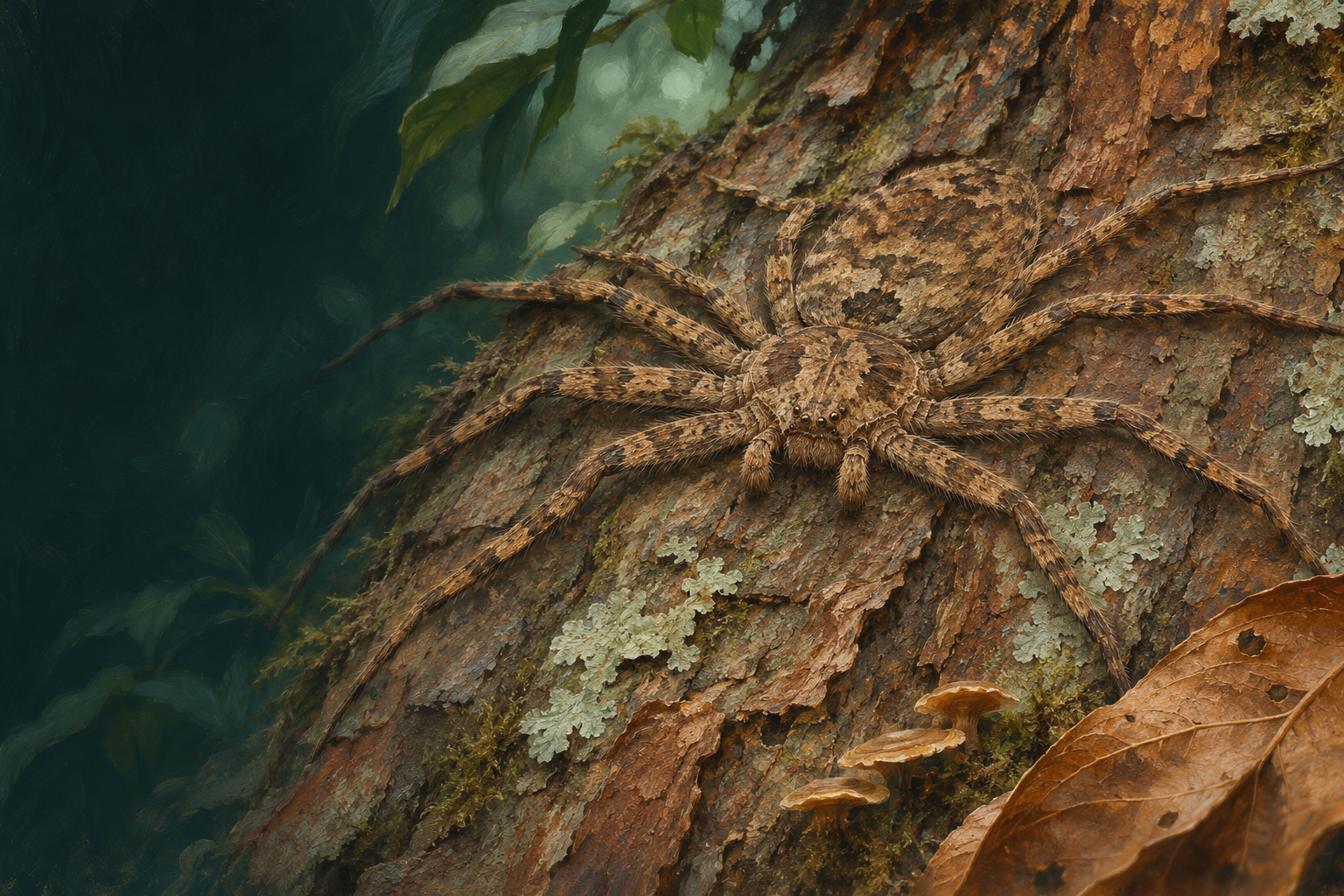
Flattened against the substrate
Selenops debilis has a strongly flattened body and legs directed far to the sides. Its posture differs from a spider standing high above the ground. Several legs begin ready to act in different directions. The catalog lists the United States and Mexico, making this species a North American example of the family’s distinctive body plan.
Striking without a lengthy turn
A biomechanical study filmed prey strikes of several Selenops species at high speed, including S. debilis. The spiders combined rapid rotation with movement towards prey. Targets were not restricted to positions directly ahead of the body. This explains the significance of their starting posture better than an isolated comparison of ordinary forward running speeds would do.
Legs alter the turn
During strikes, legs near the prey can pull while others assist movement. Bringing free legs inward also changes the distribution of body mass. Force generation and turning therefore work together. A flat body alone would not explain the performance: coordinated changes of leg configuration turn a distinctive shape into an effective system for rapid manoeuvring.
Relatedness does not guarantee every trait
Other research has described directed aerial descent in tropical Selenops. Those results are not automatically transferred to S. debilis here. The documented connection between body plan and strike manoeuvres is compelling on its own. Scientific names matter particularly when popular accounts merge a whole genus although experiments involved only particular animals and identified or unidentified species.
What do we know, and where are the limits?
The movement study included S. debilis but pooled several species. Gliding by other, partly unidentified Selenops is not attributed to this species.
Sources & image credits
- World Spider Catalog · Selenops debilis ↗
- Zeng & Crews (2018) · Biomechanics of omnidirectional strikes in flat spiders ↗
- Crews (2011) · A revision of Selenops in North America, Central America and the Caribbean ↗
Sources and classification checked on 3 November 2026. Scientific names and interpretations may change with new evidence.