A closer look at North America
The World Spider Catalog lists Canada, the USA and Mexico as the distribution. A continental label must not be mistaken for a record at every location. Season, site and verifiable features still matter for an individual observation. Our portrait introduces that diversity without acting as an identification service for every locality.
Stalking instead of waiting in a web
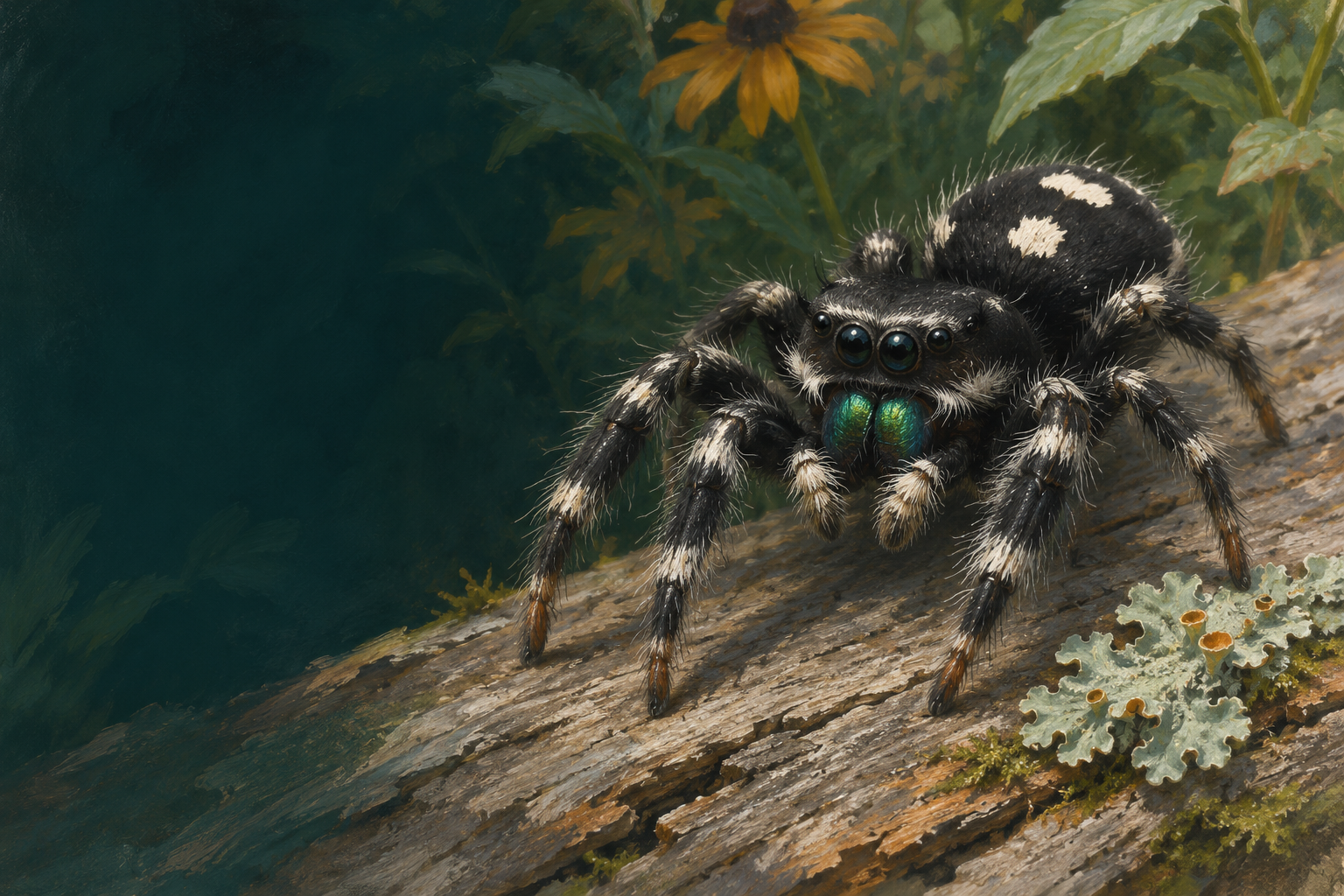
Like many jumping spiders, Phidippus audax actively searches for prey and uses vision to do so. Its body can orient towards an object before a further approach. The large front eyes fit this way of life, but they do not let us infer human-like curiosity from every apparent gaze.
A study broadens the picture
In laboratory experiments published in 2014, Vickers and colleagues showed that spiders could complete their life cycle on dead prey. Survival and developmental timing were less favourable than with live prey. This is neither husbandry advice nor evidence that scavenging dominates outdoors. The experiment tests a possibility under defined conditions.
A picture is not yet a secure identification
A dark hairy body and pale abdominal spots can be memorable. Other jumping spiders can look similar, however, and young spiders need not have the same colours as adults. A record photograph becomes more useful with a location and date. The artistic illustration on this page does not replace that documentation.
Sources & image credits
- World Spider Catalog · Phidippus audax ↗
- Missouri Department of Conservation · Bold Jumper ↗
- Vickers et al. (2014) · Scavenging throughout the life cycle of the jumping spider, Phidippus audax ↗
Sources checked: 2 November 2026. Comparisons carry the qualifications stated in each article.