Between Asia and Australia
The World Spider Catalog lists a range from India, Sri Lanka and Nepal through China and Taiwan to Australia. This crosses several of our world regions. A map provides orientation, not continuous occupancy: a country in the range list does not mean every forest or elevation in that country is occupied.
Spiders as prey
Portia fimbriata can prey on other spiders. Researchers have studied particularly inconspicuous stalking of other jumping spiders in Queensland animals. Here, two animals can detect and respond to one another. The hunt is therefore an interaction, not an automatically successful performance by a super-predator.
Another spider’s web as an encounter space
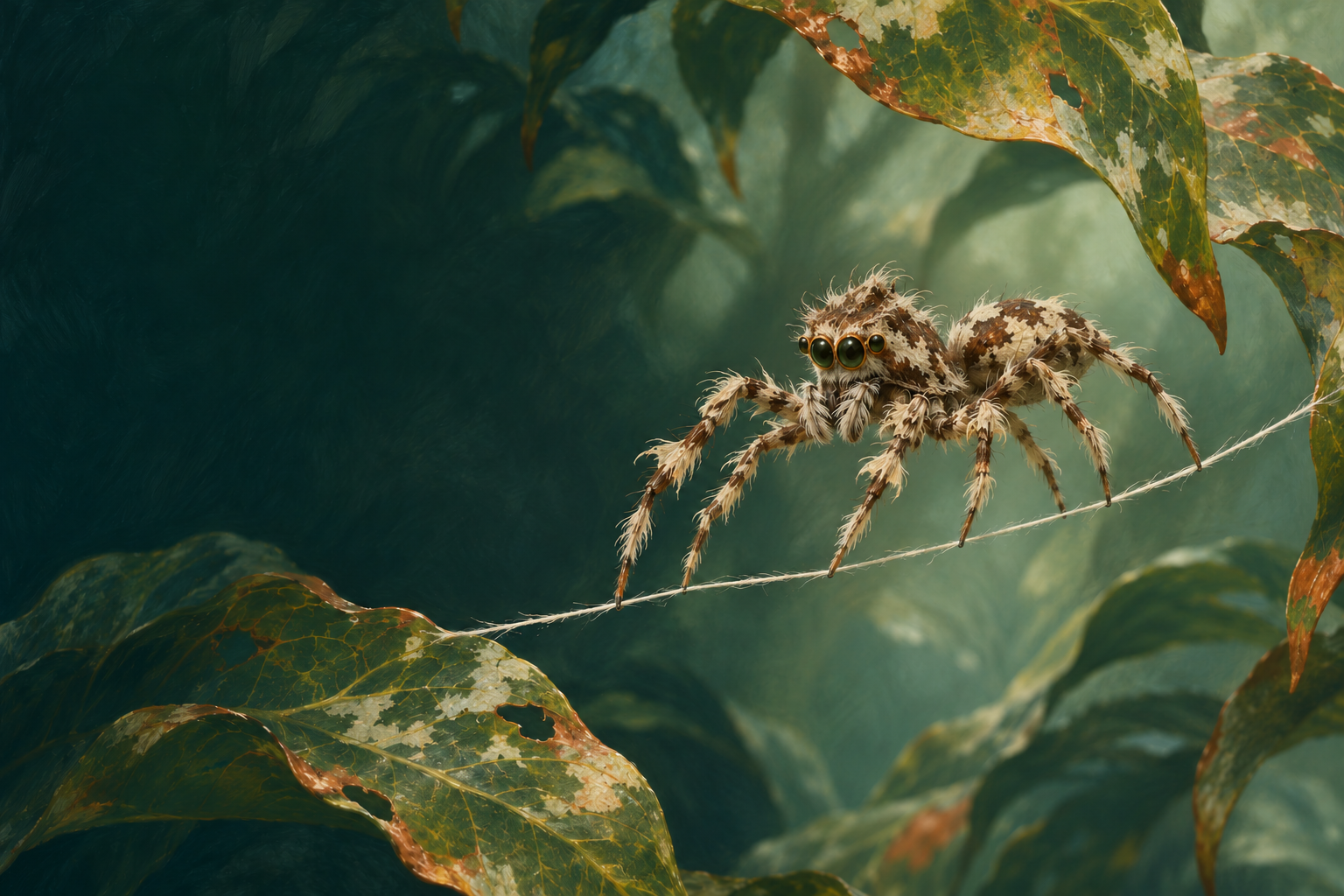
Studies also describe encounters in other spiders’ webs and the use of its own silk. For Portia, webs are therefore more than obstacles in a setting of branches and leaves. Their structure and the signals carried through them are part of the hunting situation, linking silk, perception and predator–prey relationships.
One study location is not the whole species
Specialised findings from Queensland should not simply be extended across the entire broad range. Naming the population, prey and experimental setting keeps those limits visible. It also suggests a useful habit: after reading an impressive behavioural claim, ask which animals were actually observed, and under which conditions.
Sources & image credits
- World Spider Catalog · Portia fimbriata ↗
- Prey classification by Portia fimbriata: species that elicit cryptic stalking ↗
- Web use during predatory encounters between Portia fimbriata and its prey (2000) ↗
Sources checked: 2 November 2026. Comparisons carry the qualifications stated in each article.