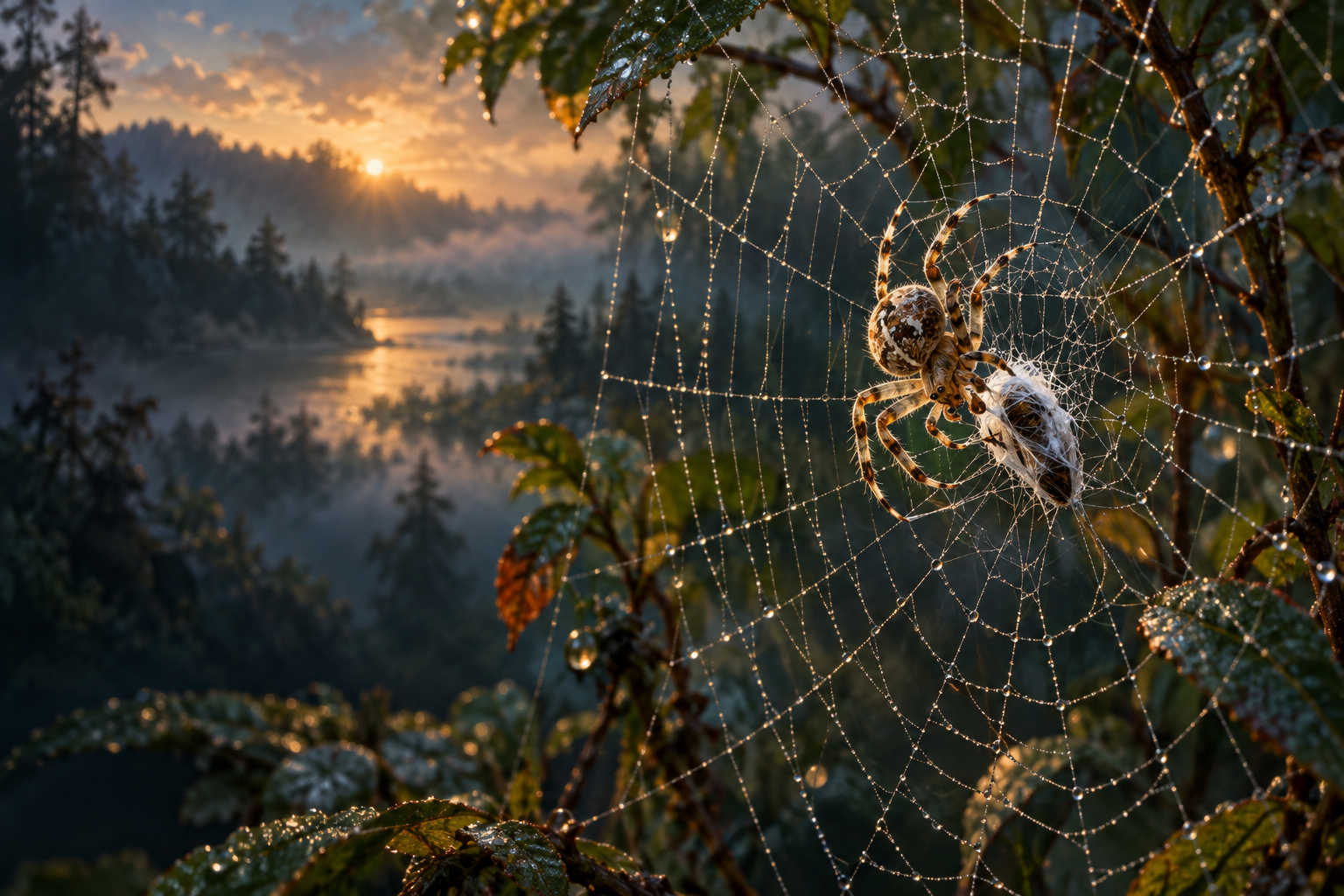
Subduing prey
Most spiders are predators, often feeding on insects or other arthropods. Size and hunting style affect the available prey. An animal may be held with legs and mouthparts, secured with silk and subdued using venom. The order varies among groups. A web does not perform every part of capturing and processing a meal.
Digestion outside the body
Digestive fluids help break down prey tissues, after which the spider takes in liquid food. Hard external parts may remain. Describing this only as sucking leaves out the chemical processing involved. Mouthparts can also contribute mechanically. Wrapped prey may be held in a web temporarily before it is consumed.
A relationship in the food web
Spiders are predators and also food for other animals. Their ecological effects depend on local prey and enemies. A name such as birdeater does not describe a fixed bird-based menu: even large species frequently eat invertebrates. A spectacular isolated capture should not be mistaken for the ordinary diet of an entire group.
Sources & image credits
- Australian Museum · Prey capture and feeding ↗
- Smithsonian’s National Zoo · Goliath bird-eating tarantula ↗
Sources checked: 1 November 2026. Figures and records carry the qualifications stated in each article.