The dune becomes part of escape
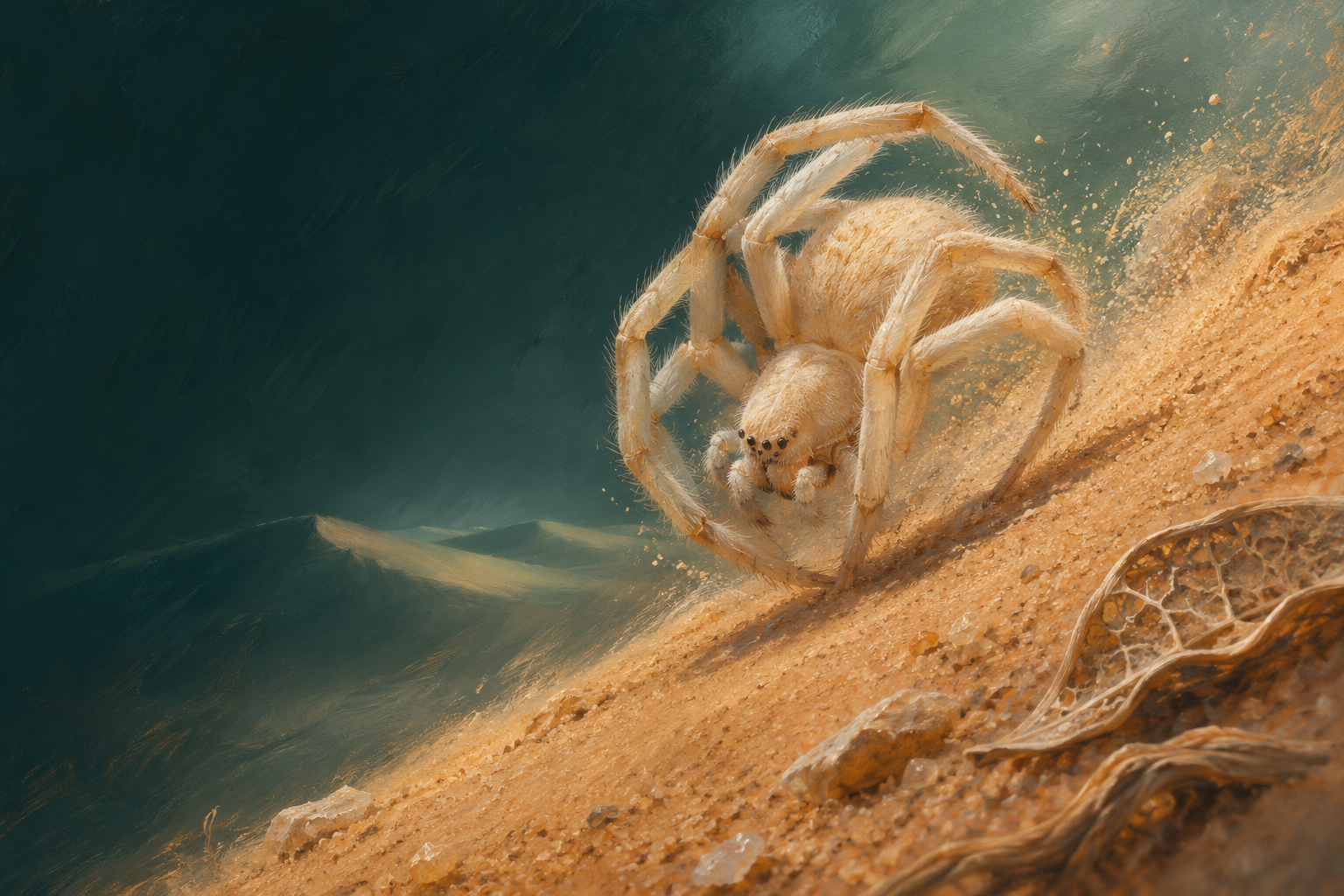
Carparachne aureoflava is known from Namibia. On suitable slopes it folds its legs into a curved posture and wheels downhill. The slope supplies the energy through gravity. Terrain is therefore not interchangeable scenery: it makes available a movement option that the same spider would not possess in the same way on level ground.
A response to pursuit
Wheeling was described in an escape context, including threats from hunting spider wasps. Such enemies can matter greatly to a ground-dwelling spider. An unusual movement therefore need not serve prey capture. The same legs that support and steer ordinary walking adopt a different functional arrangement during this escape response on a suitable sandy slope.
Separating wheeling from somersaulting
Comparison with Cebrennus rechenbergi reveals two different solutions. Carparachne exploits downhill motion, whereas Cebrennus powers its somersaults actively. Both look spectacular, but their energy sources and operating conditions differ. Their shared family makes the contrast especially interesting: related animals do not necessarily achieve an unusual movement by using the same underlying mechanism in their bodies.
Sand offers shelter and difficulties
Sand-dwelling spiders need more than an escape option: they must also cope with loose ground and changing conditions. Studies of Namib spiders therefore consider burrowing and habitat alongside movement. This portrait belongs in the selection because it connects body and landscape. A remarkable adaptation becomes clearer when the everyday demands of its setting remain visible too.
What do we know, and where are the limits?
Field observations document wheeling as an escape response. It is not powered somersaulting as in Cebrennus, nor evidence of equivalent rolling on every surface.
Sources & image credits
- World Spider Catalog · Carparachne aureoflava ↗
- Henschel (1990) · Spiders wheel to escape ↗
- Henschel (1997) · Psammophily in Namib Desert spiders ↗
Sources and classification checked on 3 November 2026. Scientific names and interpretations may change with new evidence.