A somersault with its own power
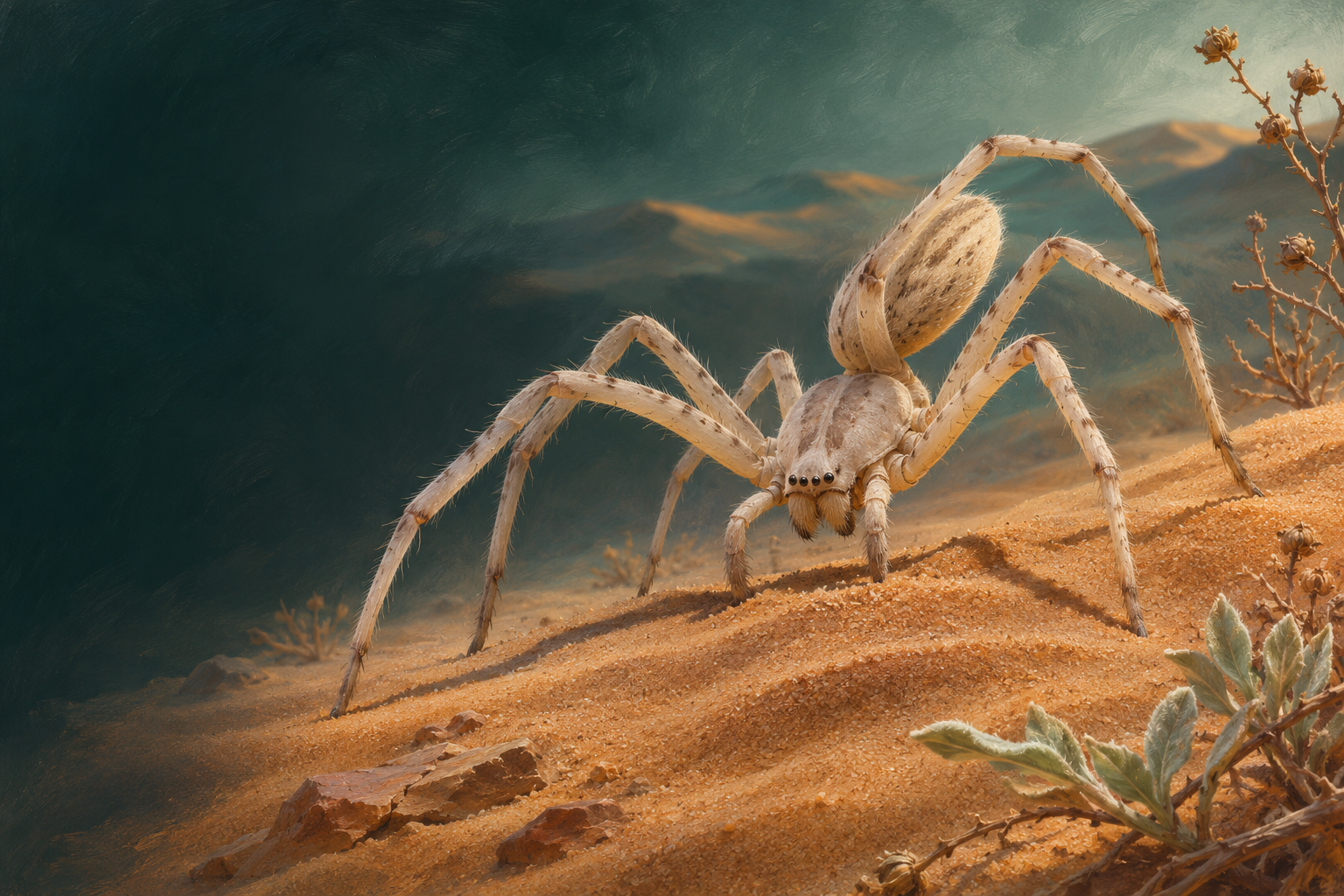
Cebrennus rechenbergi was described from Moroccan sand dunes. During its unusual locomotion, the spider uses its legs to perform a sequence of actively powered somersaults. Its body is not simply carried downhill as a rolling ball. This distinction explains the mechanism: the movement requires muscular work and offers a specialised alternative to ordinary walking.
Sand is a challenging building material
Researchers have also studied construction of vertical burrows. Dry grains readily flow back into a hole, yet the opening must remain usable. The spider has to remove material while leaving a stable cavity behind. Its home reveals a less spectacular but equally interesting side of living in a dune landscape whose building material is constantly movable.
A carrying basket made of bristles
Long bristles on palps and chelicerae form a carrying apparatus for small portions of sand, termed a psammophore. Loose material can be transported to the entrance and deposited outside. Comparing other burrowing spiders is revealing: sharing a substrate does not force animals to use identical solutions, even when they all need to produce a stable tube.
More than an acrobatic moment
A video of somersaults reveals only one part of this lifestyle. Excavation, shelter and everyday walking matter too. This selection values the connection between conspicuous movement and carefully investigated construction. It keeps a species from being reduced to a single trick while its habitat becomes interchangeable scenery rather than a source of practical challenges.
What do we know, and where are the limits?
Somersaulting and burrow construction are documented in this species. Its powered movement differs from gravity-driven rolling in Namibian Carparachne.
Sources & image credits
- World Spider Catalog · Cebrennus rechenbergi ↗
- Jäger (2014) · Cebrennus revision and description of C. rechenbergi ↗
- Foelix et al. (2017) · Sand transport and burrow construction in sparassid and lycosid spiders ↗
Sources and classification checked on 3 November 2026. Scientific names and interpretations may change with new evidence.