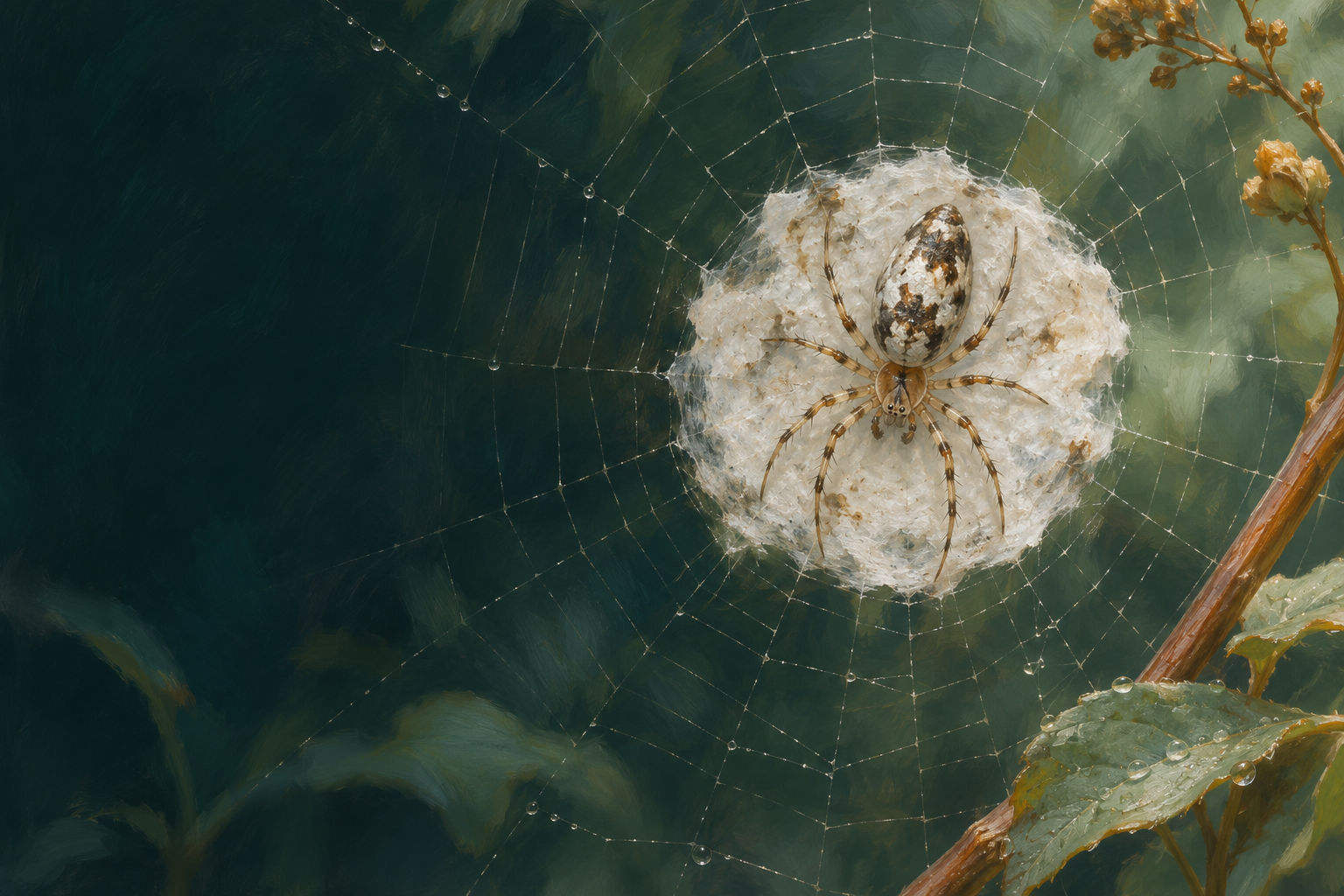
Body and disc belong together
Cyclosa ginnaga can rest against a white silk disc within its web. Its silver body becomes part of a larger pale form. The relevant appearance therefore lies not only in the animal’s surface or posture. A self-built element changes the immediate background and, with it, the appearance of the whole assembly to an approaching observer.
An unappealing interpretation
The combination can resemble a bird dropping. Rather than merely preventing detection, masquerade can allow an observer to see something but classify it as an uninteresting object. This differs from blending into green leaves. A visible structure need not be recognised as an edible animal, and its interpretation can matter as much as its detectability.
Testing the interpretation
Researchers compared optical properties and altered the appearance of the white decoration in the field. Observed attacks were consistent with the proposed protective function. This goes beyond the human judgement that something “looks like droppings”. It remains important, however, to identify which predator and environmental conditions the investigation actually tested.
Another species, another construction
The catalogue records the species in East Asia, including China, Taiwan, Korea and Japan. White silk is central here, rather than a line of prey remains. That difference deserves its own portrait. Related spiders can use different constructions even when a casual description would group both under the simple heading of a decorated web.
What do we know, and where are the limits?
Field manipulations and comparisons using a wasp-vision framework support bird-dropping masquerade. The tested situations do not establish an effect on every possible predator.
Sources & image credits
- World Spider Catalog · Cyclosa ginnaga ↗
- Liu et al. (2014) · Evidence of bird dropping masquerading by a spider ↗
- California Academy of Sciences · The bird-poop disguise ↗
- Tanikawa · Revision of Japanese Cyclosa ↗
Sources and classification checked on 3 November 2026. Scientific names and interpretations may change with new evidence.