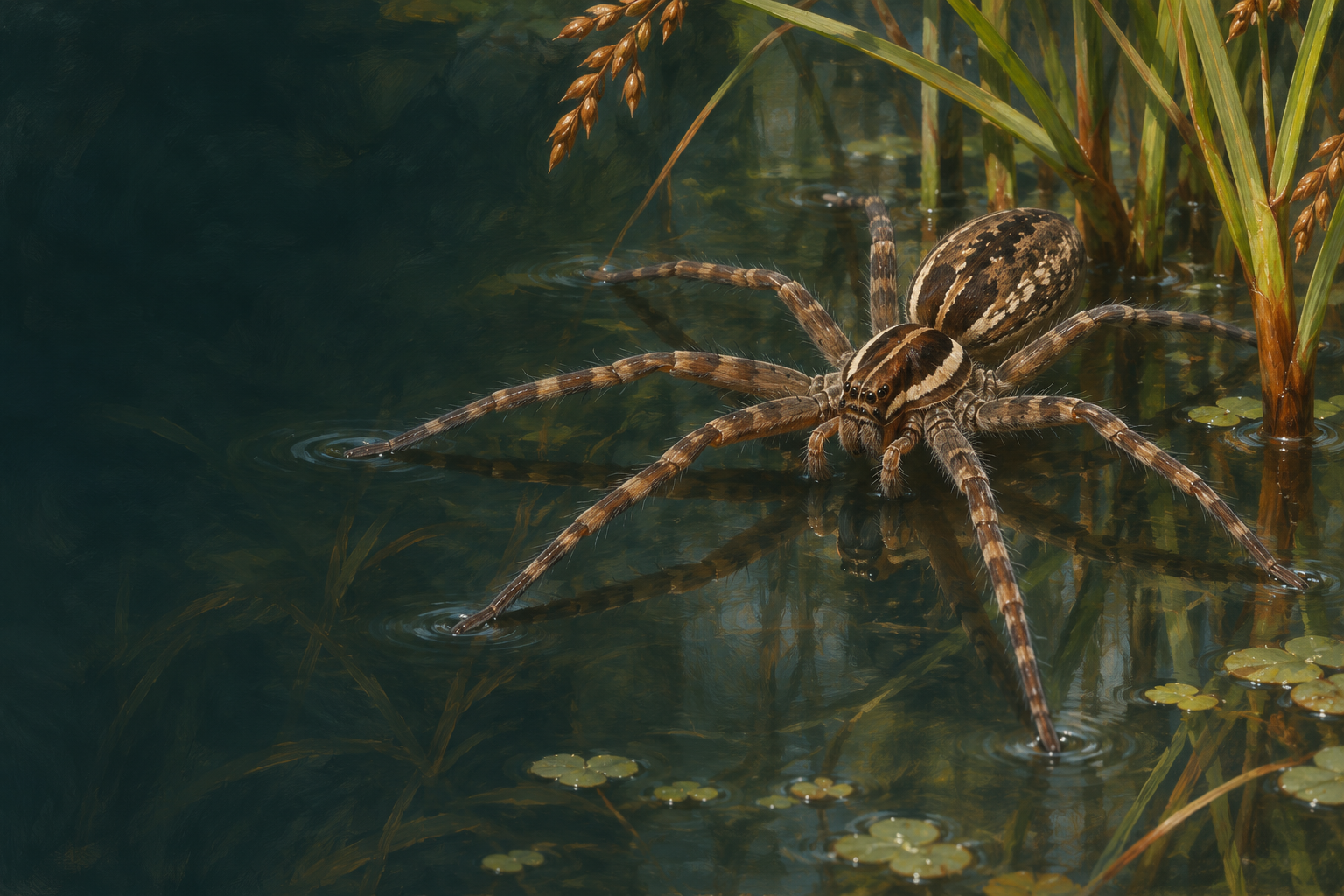
Legs on a deformable surface
Dolomedes triton can move across the water surface. Its legs meet a deformable interface rather than a rigid road. Surface tension and water-repellent body surfaces belong to this way of life. Water is therefore more than a photographic background: it directly influences how the animal is supported and how its movements generate progress across the surface.
Prey generates its own trace
Struggling animals produce waves on water. Experiments with D. triton show that surface waves assist detection and localisation of prey. Movement can therefore transmit information without the spider directly touching its source. Water links separated animals, turning a disturbance at one position into a signal that a hunter can use from another position nearby.
The hunter is hunted too
Research involving frog attacks examines another side of the same lifestyle: the spider’s escape. Air movements can trigger directed responses through fine sensory hairs. A hunter must therefore detect more than food. Its surroundings contain several types of cues at once, and not all of them reach the animal through waves on the water surface.
A North American life history
The species is known from North America, including Cuba. It represents a studied water-associated specialist here, without implying that all fishing spiders share identical biology. Habitat and available research differ even within one genus. Observers can therefore learn more by connecting a scientific name with the particular water body and behaviour actually observed there.
What do we know, and where are the limits?
Prey localisation and escape responses were studied directly in D. triton. The current catalog uses Dolomedidae; older papers use Pisauridae.
Sources & image credits
- World Spider Catalog · Dolomedes triton ↗
- Bleckmann & Lotz (1987) · The vertebrate-catching behaviour of the fishing spider Dolomedes triton ↗
- Suter (2003) · Trichobothrial mediation of an aquatic escape response in Dolomedes triton ↗
- Yu & colleagues (2024) · Dolomedes fishing spider biology: gaps and opportunities for future research ↗
Sources and classification checked on 3 November 2026. Scientific names and interpretations may change with new evidence.