Six eyes and a flattened body
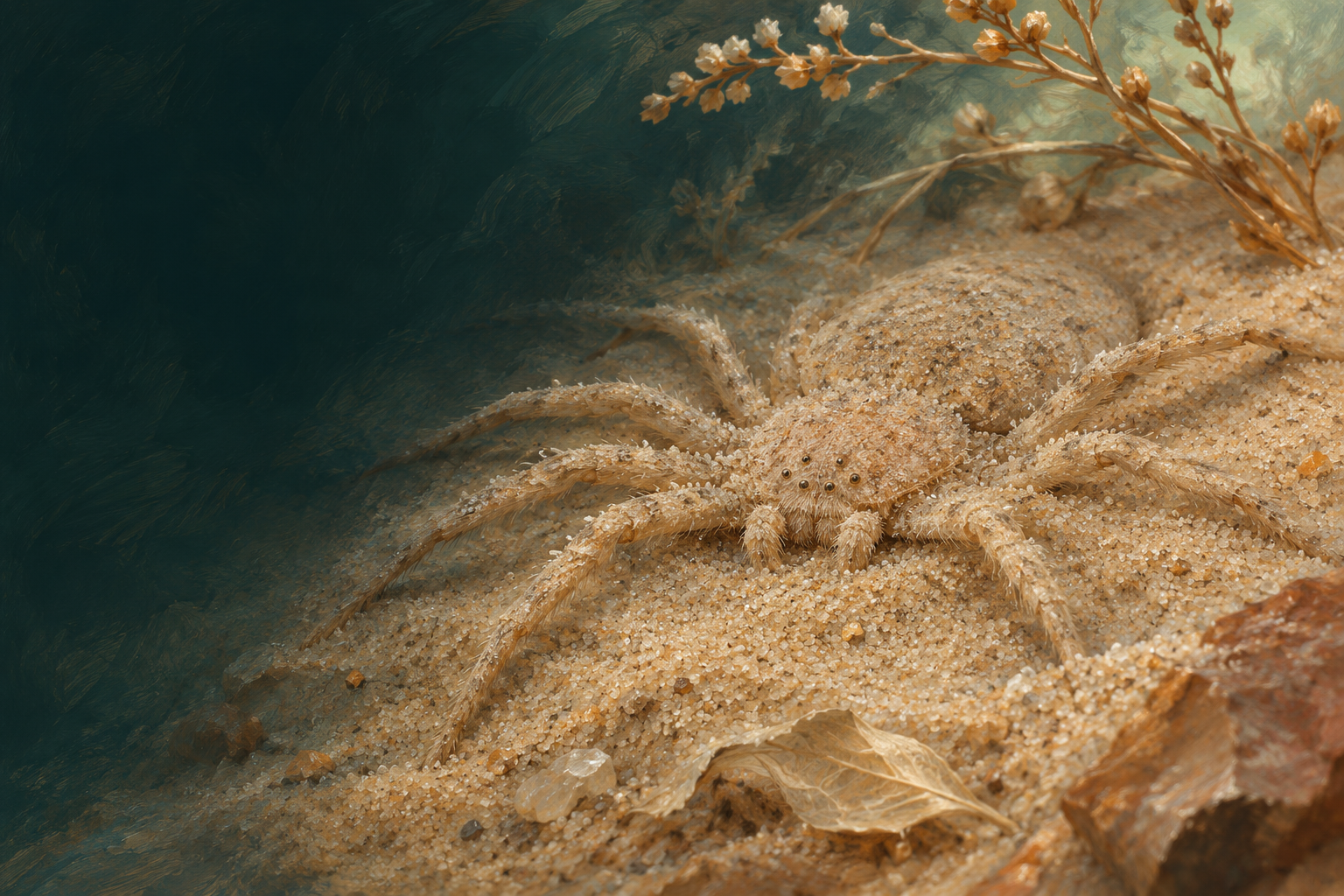
Hexophthalma hahni belongs to Sicariidae and has six eyes rather than the eight familiar in many spiders. A flattened body and laterally directed legs alter its silhouette. These are useful entry points into its body plan. However, sandy colour and a photograph from above are often insufficient to distinguish closely similar species with confidence.
More than open desert dunes
The taxonomic revision records the species in Namibia, South Africa and southern Zimbabwe. Examined specimens came from several landscape types, including Karoo, savanna and fynbos, and from shelters beneath rocks or wood. The label sand spider should therefore not create the impression that it lives exclusively on one kind of bare, shifting desert dune.
Sand and the body surface
Research on sand-covered relatives examines microscopic structures on body hairs that retain particles. This provides an interesting comparison for the group without transferring every measurement to H. hahni. A sand coating involves behaviour, particle properties and body surfaces together. The ground beneath an animal can therefore contribute directly to what observers see on its exterior.
Why names matter to research
Older publications place African members of this group in Sicarius. A later revision restored Hexophthalma, while further work united names previously treated separately. These are more than changes in wording. Confusing different animals also undermines comparisons of their properties. A reliable portrait therefore begins with traceable specimens rather than dramatic labels attached to an uncertain identity.
What do we know, and where are the limits?
The 2018 revision documents occurrence and identity. Sand-adhesion studies on then-named Sicarius provide comparative context; unsupported venom rankings are excluded.
Sources & image credits
- World Spider Catalog · Hexophthalma hahni ↗
- Lotz (2018) · An update on the spider genus Hexophthalma in the Afrotropical region ↗
- Duncan, Autumn & Binford (2007) · Convergent setal morphology in sand-covering spiders ↗
Sources and classification checked on 3 November 2026. Scientific names and interpretations may change with new evidence.