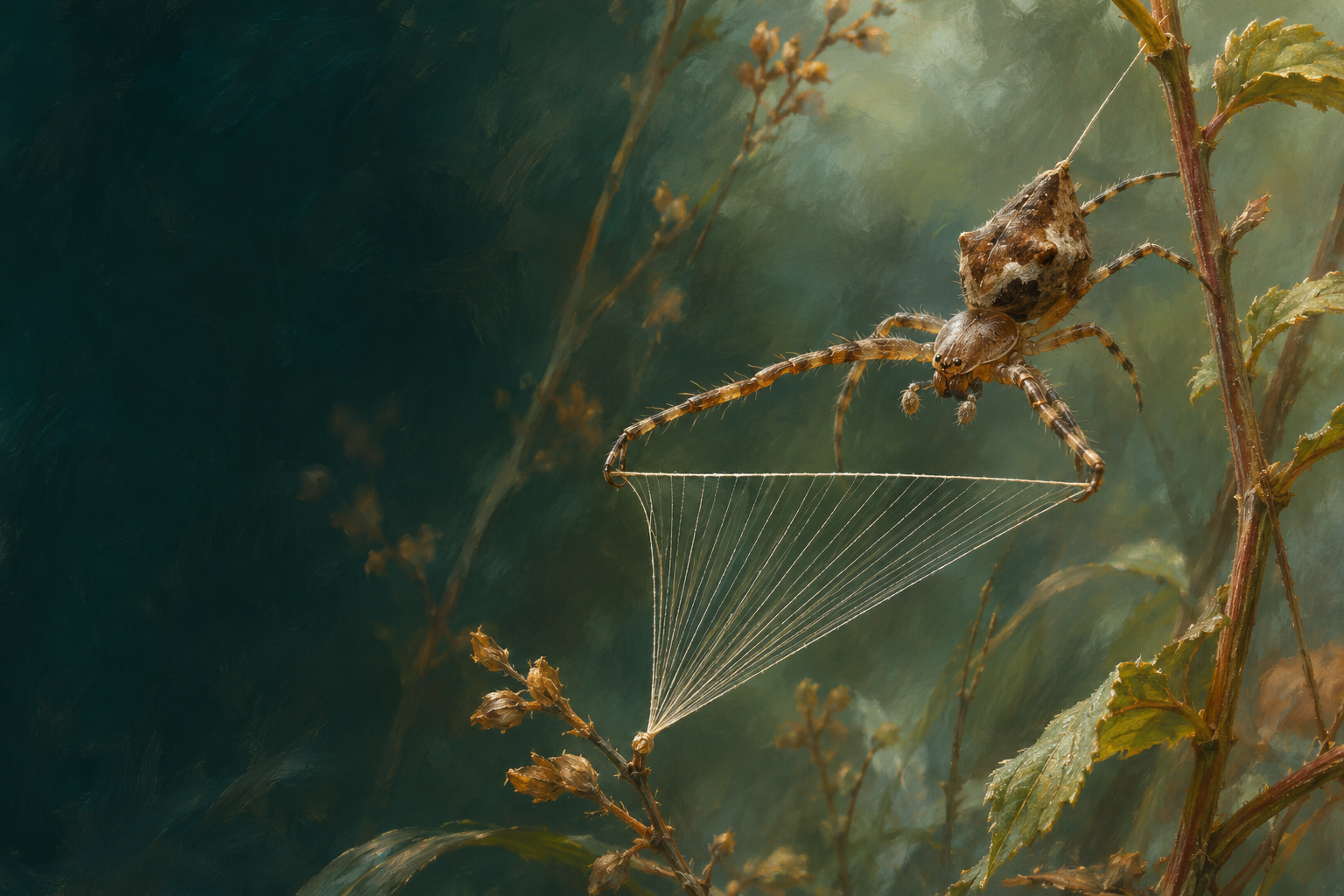
A triangle instead of a complete orb
The capture web of Hyptiotes cavatus resembles a slice of an orb web. Supporting rays and intervening capture threads form a triangular surface. The spider occupies its narrow end, linking the capture area to an anchor. That position allows the animal to alter tension throughout the system rather than simply waiting inside a passive trap.
Work before the decisive moment
Repeated leg movements pull the web tighter and store elastic energy outside the body. Muscles therefore need not perform all their work during the brief instant of attack. A drawn bow offers a useful mechanical comparison, although the components here are silk, anchors and the spider’s own body rather than a human-made weapon.
The trap moves too
When an insect contacts capture threads, the spider can release its rearward hold. The preloaded system springs forward, bringing additional threads against the prey. Running speed alone is therefore a poor description of this attack. Movement of the capture surface changes how contacts accumulate and how effectively an insect becomes entangled in silk.
Considering body and tool together
This North American species belongs to Uloboridae, a family lacking a functional venom apparatus. Silk has a particularly important role in overcoming prey. Its portrait shows why an animal should not always be considered in isolation: part of its hunting performance emerges from connections between legs, threads and stable attachment points in the surroundings.
What do we know, and where are the limits?
Power amplification was tested experimentally in this species. Release follows prey contact; this differs from the mechanism in Theridiosoma.
Sources & image credits
- World Spider Catalog · Hyptiotes cavatus ↗
- Han et al. (2019) · External power amplification drives prey capture in a spider web ↗
Sources and classification checked on 3 November 2026. Scientific names and interpretations may change with new evidence.