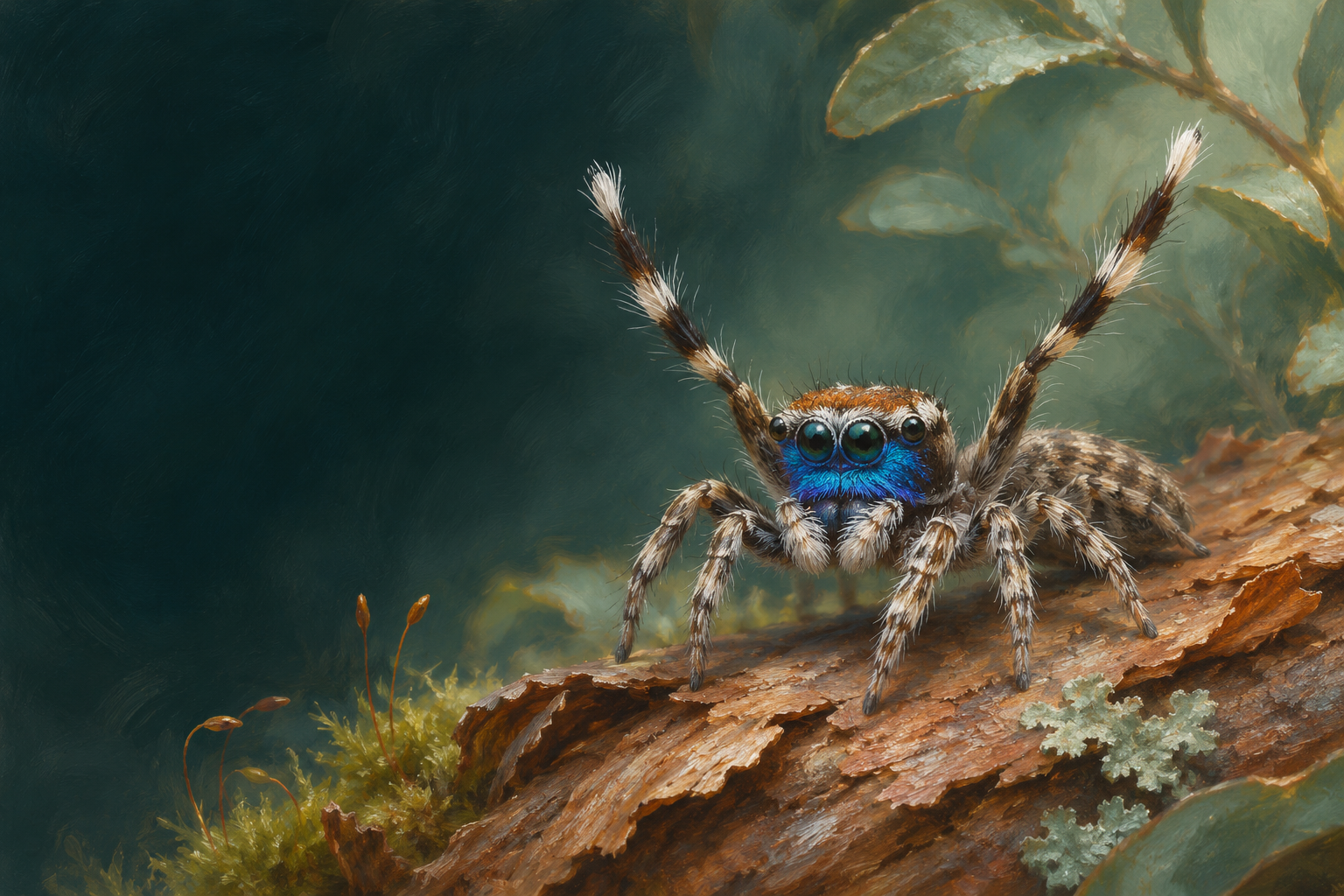
The mask takes centre stage
The male has conspicuous blue colouring across its face, drawing attention towards the eyes and front of the body. Even within a familiar genus, different species can place visual emphasis in different places. The scientific name personatus refers to this mask-like appearance, an important feature documented in the species’ original description.
Legs instead of a raised fan
The display of related peacock spiders cannot simply be transferred to this species. Described males prominently use their third pair of legs and do not lift the abdomen into a colourful shield. A suitable portrait therefore emphasises the facial mask and leg posture, rather than adding an attractive but inappropriate raised abdominal fan.
Not every individual wears the mask
The conspicuous appearance belongs to the adult male. Females and juveniles should not be portrayed with the same colourful mask. Such differences remind us that a species portrait often depicts only one sex and life stage. An appealing courtship image is therefore not a complete identification guide to every member of the species.
A locality is not abundance
The species was described from Western Australia, with Cape Riche an important locality. Taxonomic records document where examined animals were found; they are not, by themselves, a global population census. This collection highlights its documented courtship distinction without automatically treating a limited set of recorded localities as evidence of threatened status.
What do we know, and where are the limits?
The original description and authors’ catalogue document the male and its display. It does not raise the abdomen like some relatives; these accounts do not establish abundance.
Sources & image credits
- World Spider Catalog · Maratus personatus ↗
- Otto & Hill (2015) · Maratus personatus, Peckhamia 127.1 ↗
- Otto & Hill · Catalogue of the Australian peacock spiders ↗
Sources and classification checked on 3 November 2026. Scientific names and interpretations may change with new evidence.