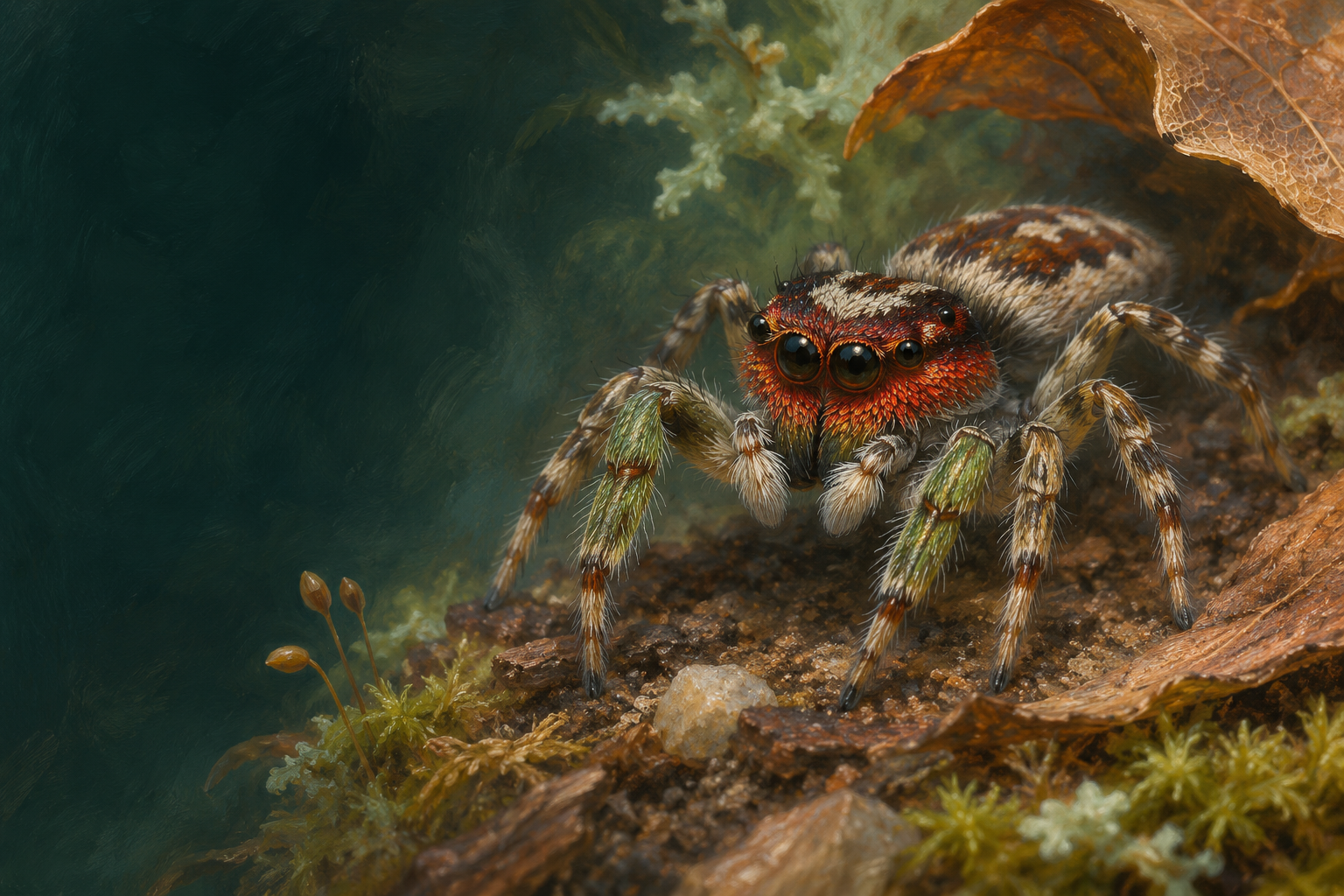
A red face
Males have conspicuous red facial scales and coloured forelegs. Those colours form part of a moving courtship sequence. They are not red eyeballs or arbitrary ornament: body position and orientation can affect which elements of the display a female sees at a given moment and how a subsequent movement is presented.
Filters inside the eye
A study describes a filter within part of the principal-eye retina. It changes the spectral sensitivity of some receptors and expands the possibilities for colour discrimination. This does not amount to human vision in miniature. Even within one eye, the retinal region receiving a coloured signal can matter for how that signal is detected.
Dancing on a vibrating floor
Courtship is not solely a visual performance. Movements can also create substrate-borne vibrations, turning a leaf or patch of ground into a transmission route between the spiders. A silent photograph records colour and posture but leaves out part of the information exchange that can be relevant to the encounter and its outcome.
More than a colourful species
Its native range lies in the USA and Mexico; the catalogue lists Hawaii as an introduced occurrence. The species was selected because conspicuous signals and sensory organs can be considered together. Describing the colours alone misses an equally interesting question: how another organism actually receives those signals and how the display reaches its sensory system.
What do we know, and where are the limits?
Retinal filters and courtship signals have been studied in this species. Findings concern particular eye regions and experiments, not a human-like experience of colour.
Sources & image credits
- World Spider Catalog · Habronattus pyrrithrix ↗
- Zurek et al. (2015) · Spectral filtering enables trichromatic vision ↗
- Courtship signal alignment in Habronattus pyrrithrix (2017) ↗
- University of Florida IFAS · Habronattus jumping spiders ↗
Sources and classification checked on 3 November 2026. Scientific names and interpretations may change with new evidence.