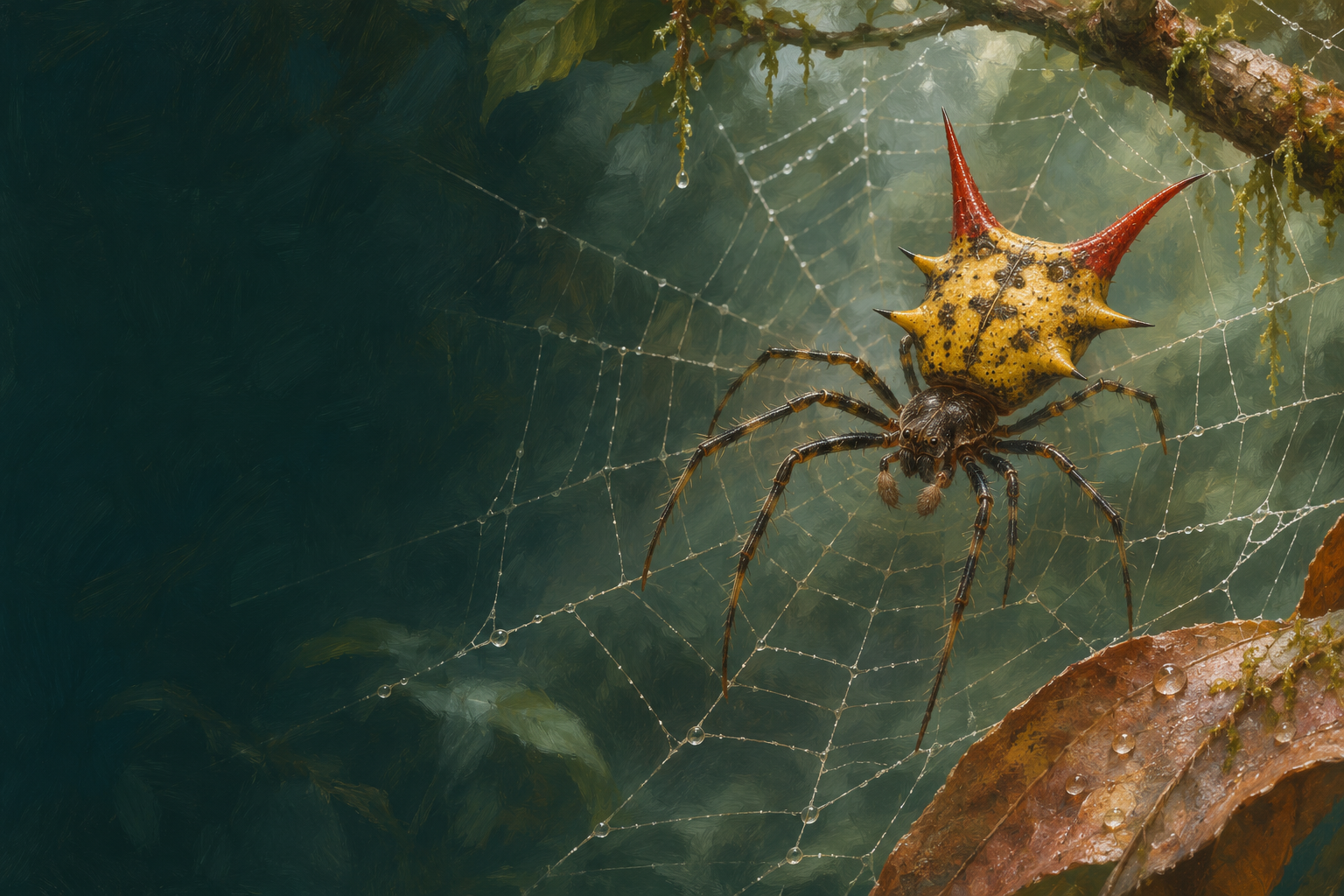
Spines belong to the abdomen
The female bears prominent abdominal projections that give its outline an angular, almost constructed appearance. These spines are not additional limbs. The actual legs remain fine and mobile, attaching to the front body as in other spiders. Males and females can look markedly different, so the impressive female silhouette should not be treated as a universal portrait of every individual.
An orb with extra silk
Alongside the capture web, conspicuous additional silk can occur. These decorations may look ornamental to human eyes, but they are a research subject. They can alter visibility and the responses of other animals. The role of a particular addition must be tested in its own setting; our impression that it looks decorative is not in itself a biological explanation.
Bees in a choice experiment
One study presented stingless bees with different web situations to investigate their responses to silk decorations. This moves an appealing idea into a testable question. Any result initially applies to the animals, experimental arrangement and signals actually examined. It should not become a story in which every bright patch of silk automatically attracts all kinds of insects everywhere.
An American context
The catalog records the species from Mexico to Brazil, linking Central and South American settings. Its place in this selection comes from the connection between form and research rather than an exotic-sounding locality. A recognizable animal can illuminate a deceptively difficult question: what do other animals actually detect, and how do they respond, when they approach a web?
What do we know, and where are the limits?
Taxonomy supports the species and range. An experiment with stingless bees examined web decorations; it does not supply a universal explanation for every decoration and prey species.
Sources & image credits
- World Spider Catalog — Micrathena sexspinosa ↗
- Gálvez (2011) — Web decoration and a frame-web choice experiment with stingless bees ↗
Sources and classification checked on 3 November 2026. Scientific names and interpretations may change with new evidence.