Mirrors without glass
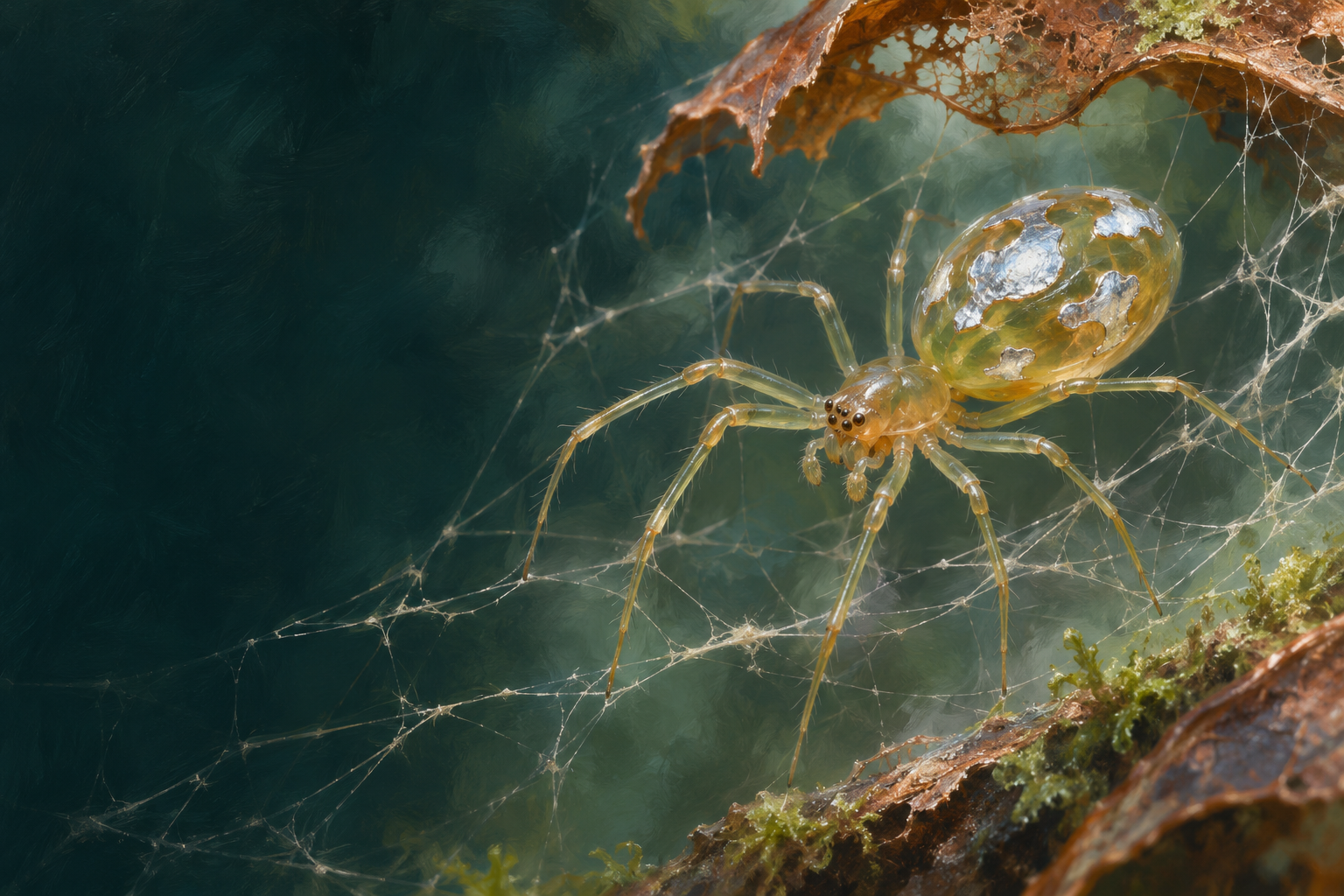
Irregular silvery patches cover parts of the abdomen. They belong to the body rather than being glass fragments attached to it. Their reflections change the impression with lighting and viewpoint. The reflective patches are flat parts of the surface: the remarkable feature is the combination of a delicate body surface and conspicuous reflected light.
An animal in fine silk
Thwaitesia belongs to Theridiidae, a diverse family associated with three-dimensional webs. The reflective animal therefore sits within a context of silk and vegetation. Its metallic appearance should not distract completely from that living setting. Behind the unusual reflections is a complete organism with legs, mouthparts and a finite body size, rather than a piece of jewellery suspended in empty space.
Queensland behind the reflections
The current catalog lists Queensland as the distribution. The original description appeared in a work on northern Queensland arachnids. That specific origin is more informative than a general label such as tropical mirror spider. Other reflective species can look similar in photographs, so resemblance alone should not quietly expand the supposed distribution of this particular scientifically named species.
An effect and its explanation
A strongly reflective surface can be observed. Explaining why it persisted through evolution requires additional evidence. Concealment, signalling and physiological relationships are different questions. We therefore separate the visible effect from a completed functional story. The spider can inspire wonder without every silver patch having to be assigned a purpose that research has already conclusively established.
What do we know, and where are the limits?
Taxonomy supports the name and Queensland origin. Reflective patches are documented; their precise functions and frequently repeated mood-based explanations are not thereby experimentally established for this species.
Sources & image credits
- World Spider Catalog — Thwaitesia argentiopunctata ↗
- Rainbow (1916) — Arachnida from northern Queensland, Australian Museum ↗
- Australasian Arachnological Society — Thwaitesia argentiopunctata ↗
Sources and classification checked on 3 November 2026. Scientific names and interpretations may change with new evidence.