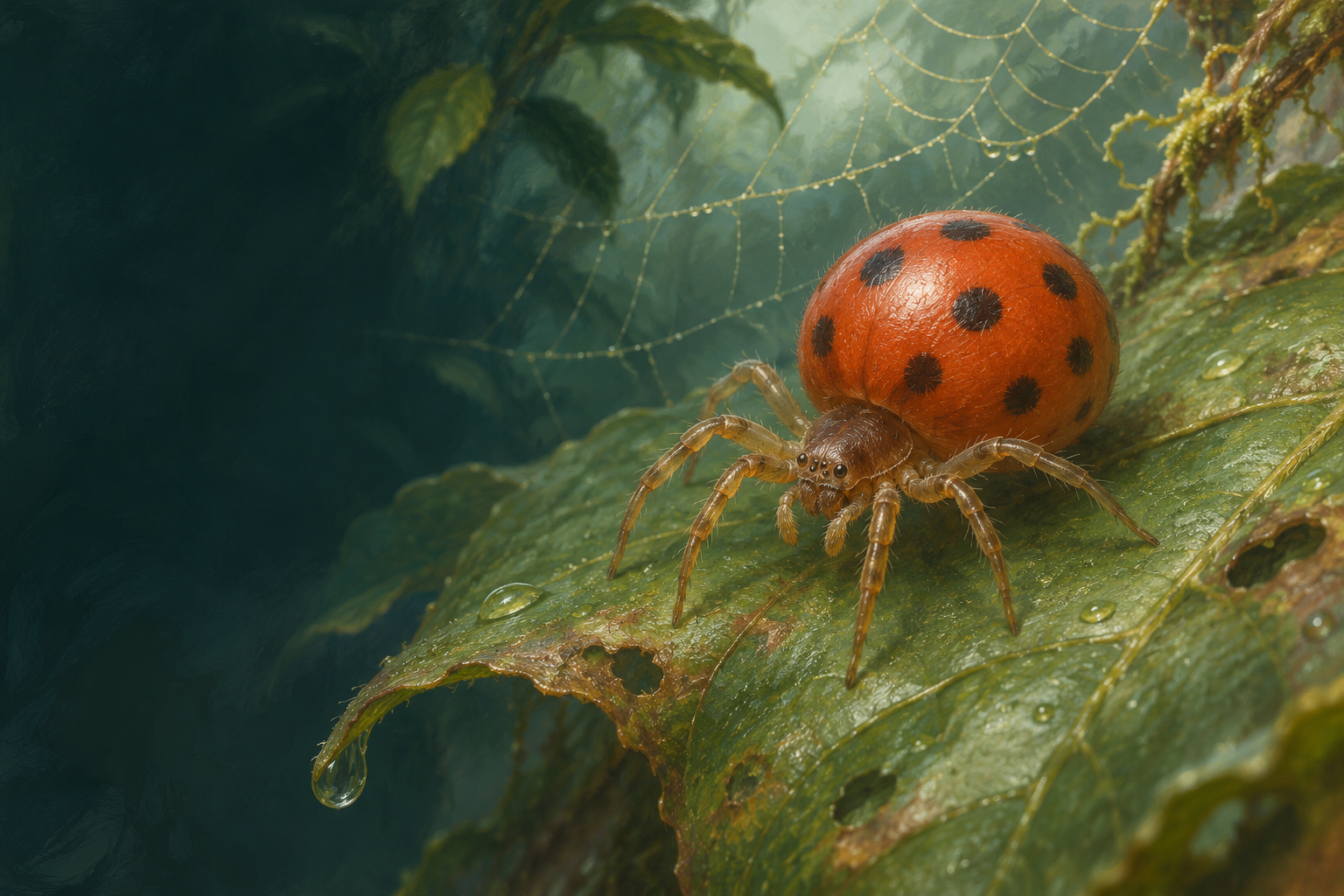
A spotted dome
The rounded, domed abdomen and dark spots suggest a beetle-like form. The differences matter just as much in a faithful image: there is no seam between wing cases, no antennae and eight rather than six walking legs. The spots sit on a spider’s abdomen. This combination of a familiar pattern and an unexpected body plan makes the species worth discovering.
A documented connection to Java
The scientific name connects to material from Java. The Muséum national d’Histoire naturelle in Paris records a holotype from Palabuhanratu. A collection specimen is not merely background decoration for research. It links a name to examinable material and a collection context, allowing later researchers to assess which animals genuinely belong to the species rather than relying on superficial resemblance.
Resemblance is not yet proof
A ladybird-like pattern invites an explanation involving mimicry. Demonstrating a defensive benefit would require testing potential predators and comparing suitable alternatives. The taxonomic sources used here do not do that. We therefore present the remarkable appearance without claiming that every bird mistakes the spider for an unpalatable beetle, or that the spider shares a beetle’s chemical defences.
A deliberately open life history
The sources reviewed here reveal less about hunting sequences, daily activity and reproduction than about identity and body form. Those gaps belong in the portrait. General family characteristics or imaginative scenes cannot reliably fill them. This selection includes precisely such animals: scientifically named and visually extraordinary, but without a comfortably complete story about their everyday lives in the available evidence.
What do we know, and where are the limits?
The catalog and Paris museum document the species and type material from Java. Beetle resemblance describes appearance here, not experimentally demonstrated defensive mimicry or toxicity.
Sources & image credits
- World Spider Catalog — Paraplectana duodecimmaculata ↗
- Muséum national d’Histoire naturelle — Paraplectana duodecimmaculata holotype, AR16404 ↗
Sources and classification checked on 3 November 2026. Scientific names and interpretations may change with new evidence.