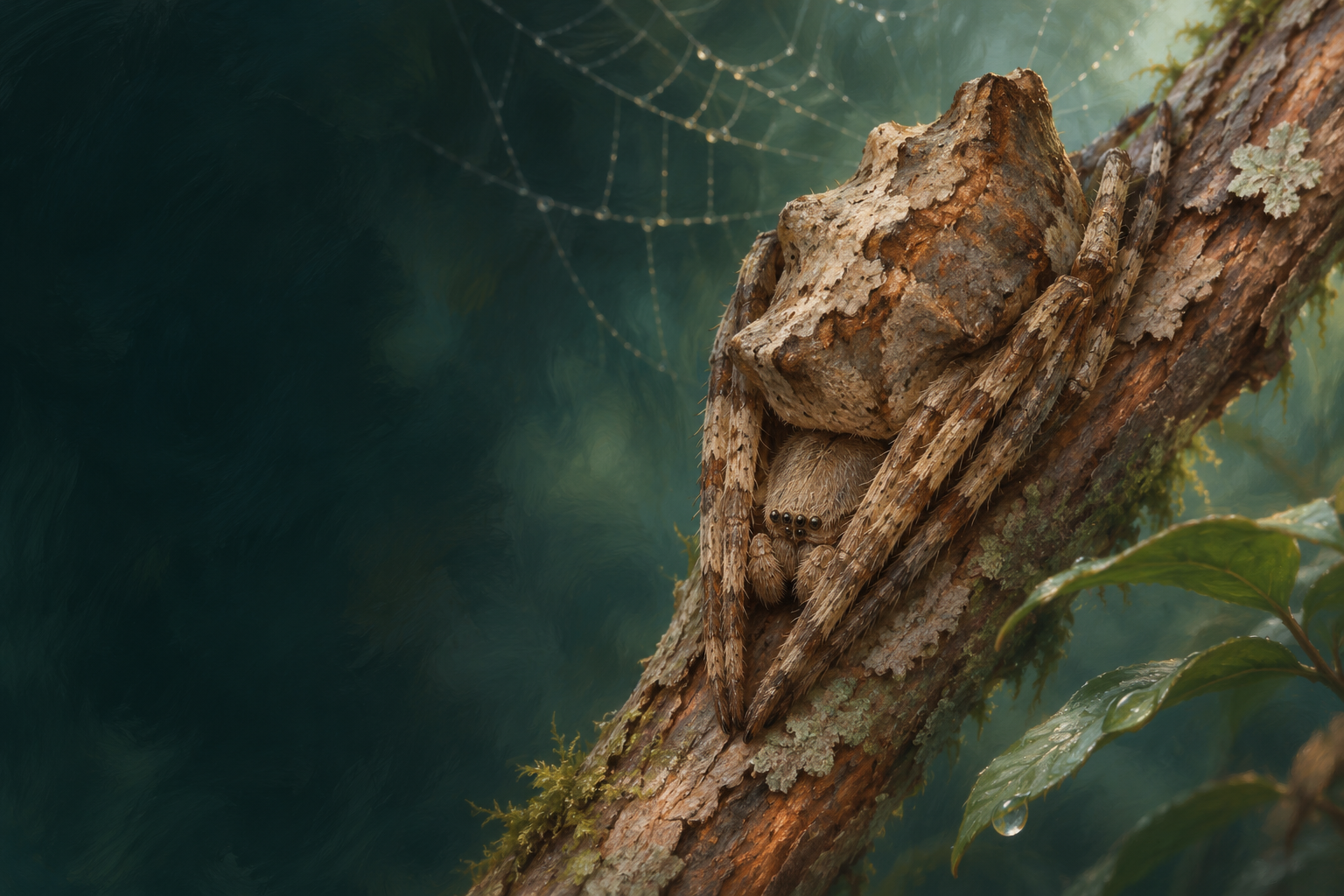
A body without a familiar outline
The abdomen can show irregular projections and a rough brown surface. With the legs folded close, the familiar spider outline becomes difficult to separate from bumps and twigs. The animal does not turn into wood. Its real body form instead changes how readily it can be distinguished against a background already rich in structure.
Resting by day, building at night
Poltys belongs to the orb-weaving spiders, even though its daytime appearance hardly resembles the familiar animal sitting at a web hub. At night, a silk capture surface enters the scene. Observing only the concealed spider therefore reveals half the story: different times of day place the same organism in very different relationships with its surroundings.
Take variation seriously
A revision of Australasian Poltys shows how much appearance can vary within these spiders. Taxonomic work therefore relies on additional characters, including structures of adults. One conspicuous abdominal projection is not a reliable shortcut. The illustration communicates one plausible form, rather than supplying a universal identification key for every individual of the species.
A broad range, unevenly reviewed
The current catalogue lists occurrences from Asia to Australia and nearby islands. That does not automatically make every historical identification equally secure. This portrait relies especially on the Australasian revision. Its interest lies in the concealment strategy and documented variation, rather than in an unsupported assertion that the species is exceptionally rare.
What do we know, and where are the limits?
A taxonomic revision describes the species and emphasises variation. Abdominal projections alone do not establish identification; some historical Asian records require particular caution.
Sources & image credits
- World Spider Catalog · Poltys illepidus ↗
- Smith (2006) · A revision of the genus Poltys in Australasia ↗
- CSIRO/Lucid · Araneidae Poltyinae ↗
Sources and classification checked on 3 November 2026. Scientific names and interpretations may change with new evidence.